October 7, 2026
5 min
Missed-call text-back vs. AI receptionist for dental practices: what each handles, when each wins, and which recovers more booked appointments.
July 10, 2026
12 min
Explore how DSO consolidation and private equity trends are reshaping multi-location dental marketing, post-acquisition integrations, and organic patient acquisition strategies.
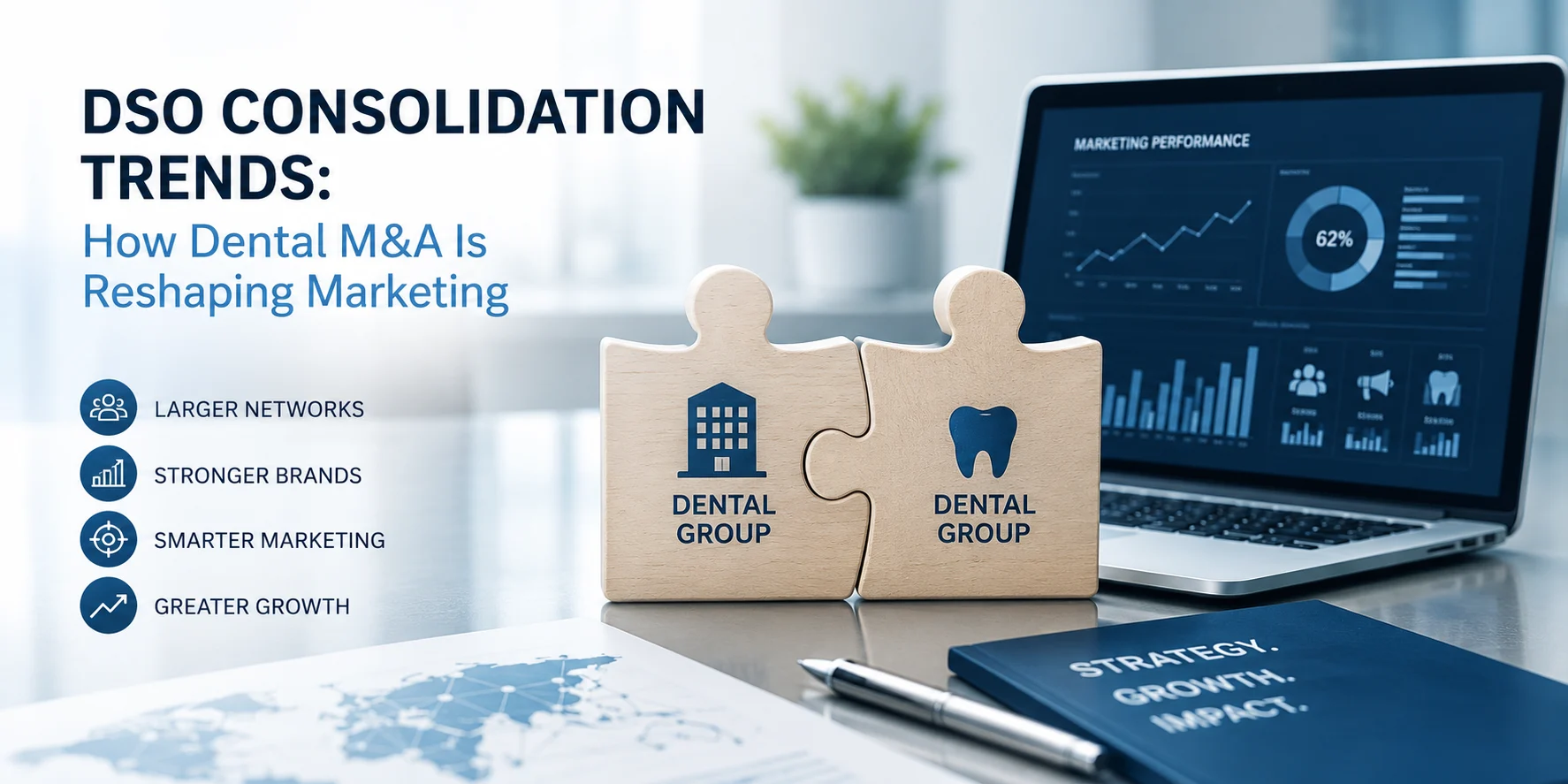
The dental industry is experiencing a profound transformation as the traditional, solo practitioner model rapidly gives way to institutional scale. If you operate a dental practice, direct marketing for a growing dental group, or manage a Private Equity (PE) portfolio, you know firsthand that the competition for patient acquisition has shifted from local neighborhoods to institutional boardrooms.
As DSO consolidation trends hit record velocities, the challenge of scaling dental organizations has evolved. Through our work helping independent practices, scaling dental groups, and multi-location organizations across the US and UK navigate these shifts, we have observed a critical reality: successful DSOs do not simply acquire practices to aggregate revenue—they build scalable marketing systems, unified patient acquisition strategies, centralized analytics, and consistent brand experiences that drive organic, long-term growth.
For years, growth in the dental sector was driven primarily by rapid dental mergers and acquisitions. However, in 2026, arbitrating multiple arbitrage is no longer enough. To win today, organizations must leverage their regional density to create sustainable clinical and marketing efficiencies.
If you are looking for a rapid overview of the 2026 dental M&A and marketing landscape, here is the executive summary:
To ensure alignment across strategic discussions, let us establish precise, contemporary definitions for the core mechanisms driving the industry:
The macro-economic environment of 2026 has created a challenging landscape for the standalone dental practice. According to data tracked by Group Dentistry Now and Becker's Dental + DSO Review, the percentage of practicing dentists affiliated with a DSO has risen sharply, driven by a convergence of intense operational pressures.
Inflationary pressures on clinical supplies and real estate, combined with a persistent shortage of dental hygienists and dental assistants, have squeezed margins across the industry. Independent practices lack the purchasing power and specialized recruiting infrastructure that centralized DSOs possess, making baseline profitability harder to sustain.
From AI-powered diagnostic software (such as Overjet or Pearl) to digital workflow suites and advanced 3D imaging, modern dentistry requires heavy capital expenditure. DSOs can amortize these technology investments across dozens or hundreds of locations, whereas a solo practitioner faces a prolonged path to ROI.
Insurance providers continue to squeeze reimbursement rates, forcing practices to optimize operational efficiency just to maintain flat revenue. Concurrently, modern consumers expect seamless, digital-first experiences—including real-time online scheduling, automated text reminders, and unified payment portals. Meeting these expectations requires a sophisticated software stack that is easier to deploy via a centralized corporate infrastructure.
The influx of private equity dentistry money has changed the timeline for dental group expansion. Institutional investors view dental services as a highly fragmented, recession-resistant market ripe for roll-up strategies.
[PE Capital Influx] ➔ [Aggressive Sub-DSO Roll-Ups] ➔ [Regional Cluster Density] ➔ [Operational Optimization] ➔ [Enterprise Value Multiplier Exit]Rather than focusing exclusively on massive national platforms, dental private equity trends show investors building sub-DSO platforms—regional clusters that capture dominant market share within specific geographic corridors. The objective is clear: acquire practices at lower EBITDA multiples, integrate them into a standardized operational platform, expand capacity through organic marketing, and exit at a significantly higher enterprise multiple.
However, this model demands predictable, scalable growth. Investors are no longer satisfied with static revenue aggregation. DSOs must prove they can generate internal growth through robust DSO growth strategies, placing immense pressure on the marketing department to deliver highly optimized, repeatable patient acquisition streams.
When a DSO acquires a dental practice, the historical approach to marketing becomes obsolete. Legacy marketing—characterized by disjointed local agency relationships, unmonitored ad spend, and a lack of conversion data—must be systematically replaced by an enterprise-grade DSO M&A marketing strategy.
The primary friction point in multi-location dental marketing is finding the right balance between centralized efficiency and local market relevance. Successful groups utilize a hub-and-spoke model:
In a consolidated model, managing your digital footprint requires absolute architectural precision. Instead of letting acquired practices maintain entirely separate, disjointed websites, DSOs often execute structured website migrations, transitioning individual sites into highly optimized location pages under a unified corporate domain. This aggregates domain authority and accelerates overall search visibility.
Simultaneously, Google Business Profiles must be audited, claimed, and managed through an enterprise dashboard. Every location must maintain flawless Name, Address, and Phone number (NAP) data. AI search engines and traditional local packs rely heavily on this structured location data to serve immediate local answers to high-intent patient queries.
Data fragmentation is the enemy of scalable growth. Enterprise DSOs integrate their practice management systems (like Dentrix, Open Dental, or Eaglesoft) with advanced Customer Relationship Management (CRM) platforms and marketing automation engines.
[Ad Impression] ➔ [Call Tracked via Dynamic Number] ➔ [PMS Appointment Created] ➔ [CRM Revenue Attribution] ➔ [ROI Proven]
By deploying dynamic call tracking and unified marketing automation, a DSO can trace an individual patient from the specific keyword they searched, through the phone call or online booking, directly to the production revenue generated in the chair. This level of attribution allows marketing directors to reallocate capital away from underperforming campaigns and directly into high-converting zip codes.
While the financial thesis for dental mergers and acquisitions is sound, the operational reality of integrating acquired practices introduces significant marketing friction.
Forcing an immediate, aggressive rebrand on a newly acquired community practice can alienate long-term patients who are deeply loyal to the founding doctor. DSOs must navigate this transition carefully, often using an endorsement strategy (e.g., "Main Street Dental, a proud partner of Elite Dental Groups") rather than a sudden corporate overhaul.
Migrating a legacy practice website to a corporate parent domain is a high-stakes technical SEO maneuver. If executed poorly—without precise 301 redirect mapping, structural schema deployment, and content preservation—the practice can suffer a catastrophic drop in local organic visibility. This drop can freeze patient acquisition right at the start of the integration cycle.
Acquired clinics often come with years of uncleaned digital data, including forgotten directory listings, duplicate Google Maps markers, and rogue social media accounts. Cleaning up this digital clutter requires a methodical integration playbook. Furthermore, getting local front-desk staff aligned with centralized call-routing protocols and review generation goals requires clear internal communications, effective patient communication platforms, and consistent tracking systems.
To outperform the market in 2026, forward-thinking DSOs are moving past basic digital marketing and adopting cutting-edge strategies designed for long-term scalability.
As AI search engines like Google AI Overviews, ChatGPT Search, and Perplexity become primary sources for consumer research, top-tier DSOs are optimizing their content structures for AI extraction. This involves publishing deeply authoritative, long-form clinical FAQs, ensuring clear entity data via structured schema markup, and earning authoritative citations across digital health networks.
Modern dental groups leverage AI chatbots and automated workflows to mine their existing practice management databases for uncompleted treatment plans. If a patient leaves a clinic without booking their recommended crown or deep cleaning, automated systems analyze the record and send hyper-personalized text reminders, rapidly recovering lost revenue without manual staff intervention.
Every location page within a DSO’s digital portfolio must be engineered as a high-performance landing page. This means implementing sticky, real-time online scheduling widgets, embedding clear video testimonials of real patients, showcasing clear lists of accepted insurances, and placing prominent tap-to-call buttons at the top of the mobile experience.
Because review sentiment is a primary ranking factor for both local SEO and AI search engine summaries, successful DSOs run unified review acquisition playbooks. They deploy automated platforms across all locations to solicit patient feedback immediately following appointments, explicitly encouraging patients to mention the specific treatment received to maximize semantic SEO keywords.
While DSOs command massive capital advantages, independent practice owners possess distinct competitive traits that can keep them highly successful in a consolidated market.
An independent dentist can dominate local search by becoming the definitive digital authority for their immediate neighborhood. Write highly localized content, sponsor neighborhood events, and build deep relationships with local businesses. Corporate groups managing hundreds of locations from afar struggle to replicate this level of authentic, localized community connection.
The primary complaint patients have about corporate dental groups is the feeling of being run through a high-volume assembly line, often accompanied by high doctor turnover. Independent practices can highlight their stability, clinical continuity, and deeply personalized patient care. Make sure your website prominently showcases your permanent team, your personal story, and your long-term commitment to the community.
Independent practices can pivot their marketing strategies quickly without waiting for corporate approval cycles. If a new treatment modality or local patient trend emerges, an independent dentist can launch a target campaign immediately. Additionally, expanding into high-value niche services—such as advanced cosmetic reconstructions or specialized sleep apnea therapies—can help a practice build a highly profitable customer base that is insulated from standard DSO price competition.
The consolidation wave shows no signs of reversing, but its operational focus will continue to mature. We anticipate that the next phase of development will focus heavily on industry predictions centered around true operational integration driven by unified technology stacks.
DSOs will increasingly rely on real-time, cross-location AI diagnostics to standardize the quality of care across their networks, ensuring that a patient receives the same high-level diagnosis whether they walk into a clinic in Miami or Seattle.
From a marketing perspective, the reliance on traditional, static keyword tracking will diminish entirely, replaced by sophisticated predictive modeling. Forward-thinking marketing suites will automatically analyze local demographic shifts, real-time schedule vacancies, and historical acquisition costs to instantly reallocate digital ad dollars to the specific locations that need appointments most. Brand equity, entity authority, and absolute data clarity—supported by robust DSO marketing analytics—will become the ultimate pillars of sustainable patient growth.
Navigating the landscape of DSO consolidation requires a sharp strategic focus. For corporate dental groups and private equity investors, long-term success depends on your ability to build centralized, highly scalable marketing engines that drive real, organic patient acquisition across multiple locations. For the independent practitioner, winning means leveraging your community roots and high-trust patient care to build an agile, local competitive advantage. By understanding these shifting market forces and implementing modern, data-driven marketing playbooks, your organization can confidently lead the ongoing transformation of the dental industry.
DSO consolidation is the ongoing business trend within the dental industry where independent dental practices are acquired, merged, or consolidated into centralized corporate networks known as Dental Service Organizations. This structural shift allows dental groups to centralize non-clinical, back-office operations—such as human resources, legal compliance, supply procurement, billing, and digital marketing—capturing significant economies of scale and operational efficiencies while allowing dentists to focus entirely on patient care.
DSOs are expanding rapidly because independent practice owners face significant operational pressures. Rising overhead expenses, persistent clinical staff shortages, complex regulatory burdens, and tightening PPO insurance reimbursement rates make the solo-practitioner model increasingly difficult to sustain. Furthermore, the significant capital investment required to purchase advanced clinical technology and modern patient communication software is much easier to manage under a corporate umbrella.
Private equity firms provide the large capital injections needed to fuel aggressive roll-up strategies across the dental industry. PE investors acquire a primary platform DSO and rapidly purchase smaller regional practices at lower valuations, integrating them into a unified business system. This investment drives rapid operational modernization, scale efficiencies, and centralized marketing strategies, with the explicit goal of maximizing enterprise value for a highly profitable sale within a few years.
Selling to a DSO depends entirely on a dentist's career stage, financial health, and long-term personal goals. For practitioners seeking relief from the administrative headaches of running a business, managing payroll, and handling marketing campaigns, partnering with a DSO offers an excellent way to offload non-clinical burdens while maintaining clinical focus. It can also provide a clear succession plan and monetization strategy for retiring dentists.
Successful DSOs market multiple locations by utilizing a centralized hub-and-spoke model. Strategic branding, website architecture, digital media buying, technology stacks, and enterprise analytics are managed out of a central corporate marketing department to capture maximum efficiency. Meanwhile, tactical localized elements—such as managing location-specific Google Business Profiles, earning local community reviews, and tailoring content to regional demographics—are maintained to protect local relevance.
Consolidation shifts patient acquisition from simple localized advertising to data-driven, enterprise-level customer acquisition. Aggregated dental groups possess the large budgets and data tools required to dominate paid search, deploy advanced multi-location SEO frameworks, and run highly targeted programmatic media campaigns. This raises the digital barrier to entry, forcing all market participants to run highly optimized campaigns to earn visibility in competitive local markets.
The most frequent marketing challenges following an acquisition include managing potential patient attrition during rebranding transitions, executing highly complex technical website migrations without destroying localized search rankings, resolving conflicting directory information, and cleaning up duplicate digital business listings. Additionally, ensuring that local front-desk personnel are fully trained on corporate patient intake protocols and data systems requires structured training playbooks.
Independent dentists can successfully compete by focusing heavily on their hyper-local advantages. They can outmaneuver corporate groups by building deep community roots, cultivating strong face-to-face patient relationships, and maintaining clinical continuity that prevents corporate patient turnover. By optimizing their local Google Business Profiles, offering personalized care, and building an agile online reputation, independent clinics can protect their market share.
AI plays an essential role in modern DSO marketing by automating patient communication and data analysis. Dental groups deploy AI to automatically scan practice databases for uncompleted treatment plans or missed hygiene appointments, sending targeted re-engagement text messages. AI chatbots handle after-hours patient inquiries, while generative data platforms analyze multi-location performance to automatically shift marketing spend toward the highest-ROI geographic areas.
Beyond 2026, dental consolidation will be driven by complete operational integration and predictive systems. We will see the widespread adoption of standardized, AI-powered diagnostic software across entire dental networks to ensure uniform care quality. From a marketing perspective, the focus will shift entirely toward advanced Entity Optimization and Generative Engine Optimization (GEO), ensuring that corporate clinic networks are seamlessly surfaced by voice search devices and conversational AI engines.



October 7, 2026
5 min
Missed-call text-back vs. AI receptionist for dental practices: what each handles, when each wins, and which recovers more booked appointments.

October 7, 2026
7 min
AI follow-up helps cosmetic dental practices respond faster, reduce no-shows, and convert more high-intent veneer and Invisalign leads into booked consultations.

September 30, 2026
8 min
Slow lead follow-up can silently drain your dental marketing budget. See where enquiries fall through the cracks and how faster response recovers lost patient value.
Sign Up Now & Someone from Our Team Will Be in Touch Shortly!
Use the form below to send us a message, and we’ll get back to you as soon as we can.
.webp)
Track every marketing dollar and optimize patient conversions with ConvertLens. Gain valuable insights from your campaigns, ensuring you never miss a potential patient. Maximize ROI and grow your practice effortlessly.
-p-500.webp)