This is a guide for dentists at every level: generalists, specialists, owners, DSO execs, IT heads, operations people, and anyone sizing up or road-testing AI in their practice. Think of it as a framework, not a checklist, for navigating the realities of clinical and business AI, with specifics about clinical value, quantifiable marketing ROI, regulatory obligations, data security, system integration, pilot structuring, vendor reliability, and how to track whether you’re actually getting any return on your effort. If there’s a way to approach these decisions methodically, this is it. Use it to shape every conversation, from your first vendor call to your last pilot review.
Let’s be clear on scope: “AI platforms” in dentistry means everything from diagnostic imaging and treatment planning to AI for practice management, marketing, CRM, and large language models for documentation, triage, and even patient comms. Clinical AI is only half the picture; growth and marketing tools (AI-driven sales pipelines, ROI dashboards) deserve the same critical scrutiny as a mole on an x-ray.
High-level takeaways
- Benefits: At their best: faster workflows, sharper segmentation, actual data on marketing effectiveness, and maybe a bump in diagnostic sensitivity (if your context matches the AI’s training set, see below).
- Risks: Don’t underestimate the following: performance in the wild may lag behind lab results, models can drift, your data may be messier than the vendor expects, and marketing/sales might be tempted to oversell what their product can do, especially if independent evidence is thin.
- What smart adopters do next: Demand independent results; set up your own local proof, not just a demo; don’t move data until a BAA is in place and data controls are explicit; test integration with your practice stack; run time-boxed pilots with real KPIs; and make sure you can get your data out again (no lock-in).
AI Capabilities and Where They Actually Help (or Don’t) in Dentistry
Let’s break down, by use case, where AI can add value, its limitations, and what to look for before deploying it. There’s a consistent theme: independent studies are good, but local validation trumps all. (See discussion: Clinicians should demand locally relevant proof before adopting AI in practice.) The only evidence that matters is how the model works with your images and your patients. Consider the points below field-tested rules, not mere theory.
Radiograph interpretation (caries, bone loss, endo)
- Why use it: Cuts down read time, sometimes picks up on findings you might miss, or just helps you look at the data differently. Useful for standardizing how decisions get made.
- The catch: Works well if your imaging and population match the validation studies. Always put it through its paces locally; “trust but verify” is a must.
- How it runs: Edge or cloud (typically via DICOM/FHIR). Insist on interoperability and don’t integrate until local validation makes the cut.
Intraoral photo analysis
- Why use it: Fast triage of photos, helps with documentation and patient explanations, and saves (some) staff time.
- The catch: Highly sensitive to how you capture the photos. Before you trust, put it through your current workflow. Tighten data controls at every step.
Cephalometric/ortho planning
- Why use it: Automates landmarking and makes the process more consistent, which helps with throughput and teaching.
- The catch: Emerging shifts in patient demographics aren’t always captured in the training data, so confirm the results on your own cohort.
Implant planning (CBCT)
- Why use it: It Frees up clinical time; data show it can plan faster than a human sometimes and, in studied cases, with comparable accuracy.
- The catch: Safety-critical steps need double validation: independent peer-reviewed studies and a hard-nosed look at your own cases.
LLM triage, charting and admin
- Why use it: LLMs produce quick notes and can handle initial triage.
- The catch: Until the hallucination issue is solved, always verify their outputs. Crosscheck that the vendor’s LLM workflow is HIPAA-compliant, contractually and technically.
Marketing & lead management
- Why use it: AI can score leads, track conversion, automate CRM, and in theory optimize marketing spend. See if it actually improves lead quality; never skip local validation, and keep a close eye on who “owns” the data and what’s shared downstream.
Quick principle: Local validation isn’t a box to check; it’s your margin of safety. Always review independent studies, confirm standards and compliance, and bake ethical criteria into onboarding. Repeat validation after every major model update. No exceptions. But tools alone aren’t enough, strong lead management systems ensure those insights convert into actual appointments, not just inquiries.
Validation and Evidence: Reading the Fine Print
If there’s one area where superficiality can kill you, it’s clinical validation. Here’s how to parse claims and ensure meaningful standards.
Judging diagnostic accuracy
- Core metrics: Sensitivity and specificity don’t change with prevalence, but PPV and NPV do, so you have to match the context to your patient base. AUC can offer a good summary of overall discrimination power.
- Remember context: Meta-analyses for things like caries detection quote high numbers (say, sensitivity at 0.87, specificity at 0.89), but the “real” answer is always: how well does it work with your equipment on your patient population in your daily grind?
How to actually run local validation
- Don’t cherry-pick: Use consecutive, real-world samples (with your specific devices), not just the “best” cases.
- Set a reference standard: Make it a consensus or expert panel decision in a blinded review.
- Be granular: Report confusion matrices and break down results by device, age, and tooth type. Know your model version.
- Size matters, but context matters more: Studies range from 112 to 3,600+ images; your goal is representative diversity, not raw volume. Vendors who care will help you power the validation.
- Set your bar before you start: Minimum thresholds for sensitivity and specificity, or requiring “no worse than” your current baseline, define this before the pilot.
When tracking performance, ensure your systems feed into reliable marketing analytics dashboards, where attribution and ROI remain transparent and measurable.
Finding trustworthy independent validation
Peer review and adherence to reporting standards matter: look for CLAIM, CONSORT‑AI, TRIPOD+AI, and DECIDE‑AI on the masthead. Remember, your own local data always carries the final vote, but you want both in hand: the independent and your own. Don’t go live without both.
Regulations and Security: Belt, Suspenders, and Lockbox
Whatever the vendor says, your legal risk lives with you the moment PHI is involved. Insist on HIPAA/HITECH if you’re in the US; GDPR awareness if you deal with European data; ADA/ANSI standards for technical cred; and, if in Europe, be familiar with the new AI Act. Vendors should have their risk programs mapped to something real (the NIST AI risk framework is a good anchor) and should show ongoing compliance, not just policies written in a vacuum.
Non-negotiable contracts
- Never move data without a signed BAA: must cover whether they can use your data to train, breach reporting timelines, your right to request deletion, and how they’ll support patient requests.
- Subcontractors are part of your risk: Everyone downstream needs to be contractually locked down.
- Indemnity and liability can’t be murky: Spell out who’s on the hook, and get real SLAs on uptime and incident handling.
Essential technical protections
- Data encryption (at rest and in transit), robust key storage, and audit everything. Weakness here is inexcusable.
- Role-based access, enforced MFA, and minimal access privileges are bare minimums.
- Training data: Demand de-identification or tokenization and require full logs if they have re-identification capabilities.
- Prefer architectures that let critical PHI stay local (hybrid/edge); trusted execution environments matter if you can’t.
Operational best practices
- Regular risk reviews, security audits (SOC 2 and ISO 27001 are strong signals), continuous staff training and real incident drills.
- For marketing/lead tools: get written consent flows, audit how ads are targeted and how leads/data move; know where everything is stored (including attribution and analytic data).
Integration, Workflow, and the Real IT Work
How to decide between edge and cloud
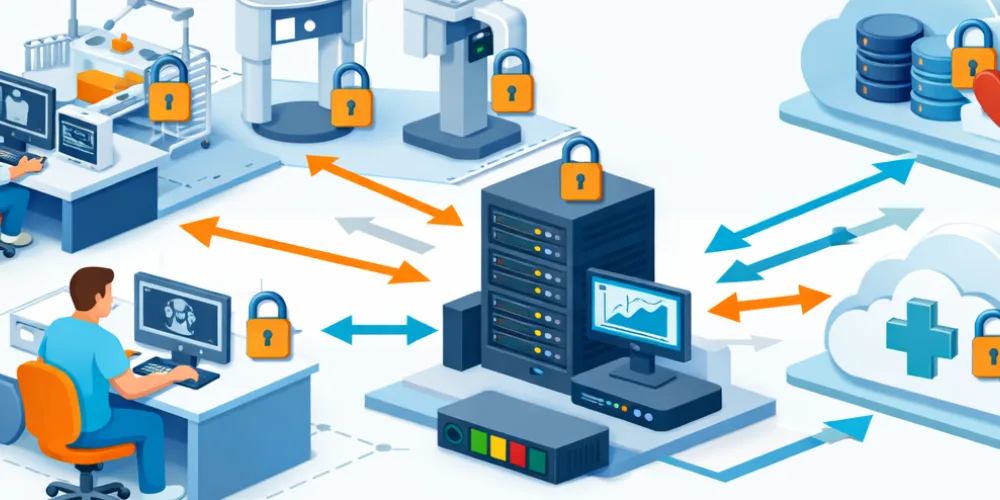
- Hybrid deployment is your friend if you’re nervous about latency or PHI locality. Doing immediate work at the edge and heavy lifting in the cloud works, so long as your architecture actually lets you toggle that switch.
- Sizing up bandwidth: Everyday tasks may need only 10 Mbps, but full imaging transfer (CBCT or panoramic) and concurrency across devices escalates this to 25–50 Mbps per device; scale up to 100 Mbps as a safety buffer in multi-chair/multi-device practices.
Integration: the concrete checklist
- APIs: Must support HL7/FHIR for EHR connectivity (Epic and most major systems are there) and DICOM for imaging flows and guarantee correct metadata. Don’t take the vendor’s word for it; test the interface.
- Authentication: Demand full SSO (SMART on FHIR, OAuth), automated user provisioning, and granular RBAC. Easy onboarding and offboarding is a security must.
- Data flows: Map where every bit of PHI lives and every subprocessor, and ensure you have export/portability options (DICOM, CSV, and FHIR included).
- Reliability: Confirm backup, archival, and disaster recovery. Best-in-class vendors offer near zero downtime for updates.
Seamless connectivity through software integrations ensures your AI tools work alongside PMS, CRM, and imaging systems instead of operating in silos.
Workflow and user interface: minimizing friction
- Overlay model outputs in the image viewer itself; don’t force users to swap windows. Clinician override with audit trail is essential.
- Alerting: If you want clinicians to pay attention, tier alerts and let thresholds be tunable; alert fatigue is real.
Security and monitoring in practice
- Layer controls (RBAC, audit logs, patch/update management, incident response) into your IT plan and verify every vendor delivers evidence (SOC 2/ISO certs, BAA, and their approach to post-market monitoring and updates).
Marketing and lead management: what’s special?
- CRM usability, sane lead assignment logic, and enforceable SLAs for lead delivery really matter. Make sure lead ownership (and exit portability) is clear; if you move systems, you should keep your leads. Don’t let platform lock-in creep up on you.
- Unified dashboards that bridge PMS/CRM to ROI: practical for minimizing busywork and making data actionable; ask for demos of this specifically.
Implementation: From Vendor Vetting to ROI
How to vet vendors (beyond the sales pitch)
- Clinical seriousness: Peer-reviewed studies, independent validations, published reporting in proper frameworks (CLAIM, CONSORT-AI, TRIPOD+AI, DECIDE-AI).
- Security: Require a signed BAA, proof of SOC 2/ISO 27001 (if available), an audit transcript, key technical safeguards, documented incident processes, and proof that their sub-vendors are locked down too.
- Business health: Get references from other practices like yours (not just ideal customers); review current financials or ARR; demand cyber/E&O insurance proof and real SLAs and support/escalation contacts, you’re interviewing them as much as they are you.
- Contract: Data exit rights, audit rights, firm model update/version rollbacks, and ironclad liability language. Never take “template” contracts at face value.
Pilot design that answers real questions
- 30–90 day pilots work for most; DSOs typically go to 3–5 sites at a pop.
- Clinical pilots should use consecutive retrospective cases to mirror real-world usage. sample sizes in the literature range from 112 to almost 3,700 images; match or exceed this, but focus on representative diversity. Make sure you’re using blinded reference reads.
- For marketing pilots: A/B test, hold a control or “holdout” arm, and always track lead quality to the clinical handoff, not just superficial “conversion” at the web form.
- Example: Implant planning studies show AI cut planning time from six minutes to under forty seconds, with accuracy nearly identical to humans; this is the type of time/accuracy record you want to see in your own pilots.
Practical costs and tracking ROI
- Budget for licenses, integration hours, storage, hardware (if going hybrid edge), higher bandwidth, training, security reviews, and monitoring. Hidden costs crop up in analytics upgrades, extra users, or per-lead/ad connector fees.
- Key clinical metrics: sensitivity, specificity, time per exam, diagnostic yield. Business KPIs: cost per lead, conversion, patient acquisition cost (expect $150–$300 per the usual market range), LTV, time to book, accurate attribution, and tracking dashboard for optimizing ROI over time.
FAQ, What Everyone Wants to Know
Q: Will AI replace dentists?
A: Of course not. All clinical decisions and treatment plans still rest with dentists. AI is a tool, useful but never a substitute. Outputs must be verified, documented, and under your authority.
Q: How reliable are dental AI diagnostics?
A: Studies show high accuracy on controlled datasets (often sensitivity ~0.87, specificity ~0.89 for caries), but translation to your practice demands rigorous local and independent validation.
Q: What is local validation and do I need it?
A: It’s essential: you test on your own data with your own devices and patients. Aim for study-sized samples (100–3,700 cases is a realistic range), covering your critical devices and subgroups.
Q: What data security steps must I demand from vendors?
A: Signed BAA, airtight encryption, auditable access controls, regular security review documentation, and total visibility into COB (chain of business) and subprocessor coverage.
Q: How should I evaluate vendor claims about accuracy?
A: Look for peer-reviewed evidence, real-world external validation, confusion matrices, device/patient subgroup breakdowns, and compliance with accepted reporting frameworks.
Q: What are common pricing models and hidden costs?
A: Most pitch a subscription, per-scan, or per-user fee, but real costs can hide in implementation hours, storage, add-on analytics, per-lead, and connector or API upcharges; ask for a cost table. For marketing, a $150–$300 patient cost is typical, but expect variance.
Q: How do I measure success once it's live?
A: Track (1) clinical output (sensitivity, specificity, and diagnostic improvements); (2) workflow/process changes (case/time per plan and throughput); and (3) business moves (conversion rates, CPA, LTV, time-to-book, and ROI by channel). Use dashboards, not anecdotes.
Q: Who is liable if an AI makes a clinical mistake?
A: You are. Every diagnosis is your legal and ethical responsibility. Make sure contract specifics on liability and indemnity are unambiguous, especially in lead gen and marketing use cases.
Q: How big/long should a pilot really be?
A: 30–90 days, 3–5 sites for DSOs, and enough cases to produce a meaningful statistical readout. Always use pre-agreed success criteria and A/B or “holdout” groups for marketing; for clinical cases, consecutive cases matter.
Q: Should I care about edge vs. cloud?
A: Absolutely. Hybrid deployment lets you control PHI locality, optimize speed, and match scalability to needs. Plan for bandwidth: allow at least 10 Mbps per device for routine uploads and 25–50 Mbps for imaging; more if running multi-room, multi-device clinics.
Paul Graham-Style Closing Playbook
- Let local validation and independent studies be your gatekeepers. Don’t skip. Make every vendor provide full local enablement and total transparency.
- Refuse to share data until a BAA is signed and every technical/organizational safeguard is documented and verifiable.
- Sketch out your stack early: Is HL7/FHIR solid? DICOM wired? PMS/CRM connectors working? SSO enabled? Bandwidth shouldn’t be a bottleneck. Confirm early, not late.
- Structure short pilots with clear, quantifiable goals; what gets measured gets managed, whether it’s clinical accuracy or marketing spend.
- Treat model monitoring as you would infection control, an ongoing part of practice, not a “check and forget.” Document every piece of validation, track every model update, and keep your evidence file current.
- Ethics and transparency are not nice-to-haves: bias mitigation, transparency, and patient consent—put these right in your procurement and governance flows, not as post-hoc patches.
Parting Prescription: Don’t drift into AI. Be deliberate, almost anti-hype. Work your way up the evidence chain: insist on vendor data, demand external peer validation, pilot with your own data, and watch performance after go-live. Integration standards and data governance aren’t optional; nor is clinician oversight. With this foundation, AI augments what you already do and lets you build a practice that actually gets smarter with every clinical decision and every new patient you see.





.webp)
-p-500.webp)