October 7, 2026
5 min
Missed-call text-back vs. AI receptionist for dental practices: what each handles, when each wins, and which recovers more booked appointments.
May 29, 2026
9 min
Discover why tracking calls through to booked appointments helps dental practices uncover revenue leaks, improve front desk performance, and make smarter marketing decisions.

Your dental practice phone rings all day. Google Ads are generating calls. Your website forms are bringing in enquiries. Your front desk sounds busy from open to close. But how many of those calls actually turn into booked appointments — and how many patients quietly disappear before ever making it into the chair?
This is where most dental practices lose visibility. They track how many calls came in, but not what happened after the conversation started. One missed call, one rushed pricing conversation, or one delayed callback can quietly cost thousands in lost treatment revenue without anyone realizing where the breakdown happened.
Call-to-appointment conversion tracking closes that gap. It connects your marketing, front desk performance, and appointment outcomes into one clear picture. Instead of guessing which campaigns are bringing in real patients, you can see exactly which calls turned into bookings, which traffic sources produced the highest-value appointments, and where potential patients dropped off in the process.
For dental practices investing in SEO, PPC, social media, or local advertising, this kind of tracking changes how decisions get made. You stop measuring activity and start measuring actual patient acquisition. This guide explains why call-to-appointment conversion tracking matters, how to set it up properly, and how to use the data to improve both marketing performance and front desk conversions.
Imagine your practice spends $3,000 on Google Ads in a single month. The campaign generates 80 phone calls. Your front desk speaks with 80 potential patients. But by the end of the month, only 22 of those calls became booked appointments.
That means 58 potential patients contacted your office, showed intent, and still never made it into the chair.
The real problem is that most dental practices have no idea where those patients were lost.
Without call-to-appointment conversion tracking, all of those lost opportunities stay invisible.
The math becomes significant very quickly.
If your practice converts calls at 38% when it could realistically convert at 55%, every 100 calls represents roughly 17 additional patients you are already paying to acquire but failing to book.
At an average first-year patient value of $1,000, that is nearly $17,000 in recoverable revenue per 100 calls — lost not because the marketing failed, but because the conversion process was never tracked closely enough to identify the breakdown.
Most dental practices monitor the top of the funnel obsessively. They know their cost per click, website traffic, and ad impressions. But very few know their actual cost per booked appointment or which phone conversations are turning into real patients.
This is where many practices unknowingly waste marketing budget.
When appointment numbers feel low, the instinct is usually to increase ad spend and generate more calls. But if the real issue is poor conversion handling at the front desk, more calls simply create more missed opportunities.
Call-to-appointment conversion tracking helps practices identify exactly where patients are dropping off so they can improve the process before increasing marketing spend further. This becomes even more valuable when paired with marketing performance measurement that shows which campaigns ultimately generate profitable patients."
Before setting up any tracking system, it’s important to understand exactly what you are measuring. In dental marketing, the word “conversion” can mean several different things depending on which stage of the patient journey you are looking at. When practices mix these together, the reporting quickly becomes misleading.
This is the most important conversion metric for most dental practices.
A potential patient calls your office, speaks with your front desk team, and schedules an appointment before the call ends. This number directly reflects how effectively your team handles inbound calls and converts interest into booked patients.
For practices beginning call tracking, this should be the primary focus because improvements here usually improve the rest of the patient funnel automatically.
Not every booked appointment actually shows up.
Tracking how many patients attend after booking helps identify issues like:
This is especially useful for understanding whether specific campaigns are attracting serious patients or simply generating low-quality enquiries.
This is the full-funnel revenue metric.
The patient attends the appointment and moves forward with treatment. This stage connects your marketing spend directly to actual production revenue and long-term patient value.
An overall call-to-appointment conversion rate only tells part of the story. A practice might see a 42% conversion rate and assume performance is acceptable — until the data is broken down by source.
That is often where the real insights appear.
Your Google Ads calls might convert at 61%, while calls coming from a directory listing convert at only 19%. Those are completely different patient behaviors, different levels of intent, and different operational challenges. Without source-level tracking, everything gets blended together and the real problems stay hidden. Combining this data with patient enquiry monitoring helps practices understand both lead quality and booking outcomes."
Patients calling from paid search are usually high-intent. They searched for a specific treatment or service, clicked your ad, and contacted the practice directly.
These calls should typically produce some of your strongest conversion rates. If they are not converting well, there may be a disconnect between the ad messaging and the actual phone conversation patients experience.
Google Business Profile calls are often driven by urgency, proximity, and reviews.
These patients are usually close to making a decision and are actively looking for a nearby provider. Fast response times and a strong front desk experience matter significantly here because patients can easily move to another practice if the call experience feels frustrating.
These are patients who found your practice through search results and then called from the website.
Some are researching treatments carefully before calling, while others already know what they need. Tracking which service pages generated the calls helps identify what content is actually driving patient enquiries.
Referral calls often come from existing patients, insurance directories, specialists, or other healthcare providers. These calls typically convert at very high rates because trust already exists before the conversation even begins.
Calls from platforms like Facebook or Instagram usually behave differently from search-based calls.
Patients may still be exploring options rather than actively ready to book. Conversion rates can vary widely depending on the campaign, audience targeting, and treatment type being promoted.
These calls usually come from existing patients responding to reminders, newsletters, promotions, or reactivation campaigns. Tracking them separately helps practices measure patient retention and reactivation performance instead of mixing them into new patient acquisition data.
When every call source is tracked separately, marketing decisions become much clearer. If Google Ads generates 40 calls with a 60% booking rate, while another channel generates the same number of calls but converts at only 20%, the problem is no longer hidden behind overall averages.
Instead of optimizing for call volume alone, your practice can start optimizing for booked appointments, kept appointments, and actual patient value, which is what ultimately drives revenue growth.
Setting up call tracking does not require a major technology overhaul. Most dental practices can have a functional system running within two weeks using tools they either already have or can access affordably. The best way to approach it is layer by layer.
Dynamic number insertion (DNI) is the technical foundation of call tracking. The system assigns a unique phone number to each traffic source — one number for Google Ads traffic, another for organic website visitors, another for your Google Business Profile, and so on.
When someone calls, the system records which number they dialed, allowing you to see exactly where the call originated.
Your call tracking data is incomplete without knowing what happened after the call. Did the caller become a patient in your PMS? This connection between a tracked call and a scheduled appointment in Dentrix, Eaglesoft, Open Dental, or your system of choice closes the loop on actual conversion, not just call volume.
Technology captures the call. Your team categorizes the outcome.
After every new patient enquiry call, the front desk staff should log the result in a simple call log — either inside your call tracking platform or in a shared spreadsheet. This turns raw call activity into actionable conversion data.
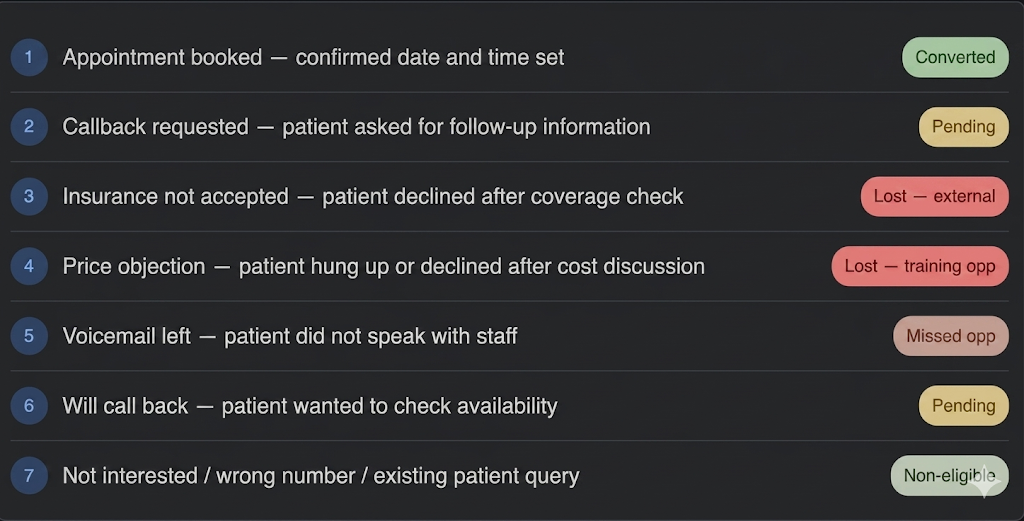
This tagging system turns raw call data into actionable categories. Over time, patterns emerge: if 30% of your lost calls are tagged "price objection," that's a front desk training signal, not a marketing problem.
If your practice is running Google Ads, enable call conversion tracking directly inside the platform. This allows Google to identify which ad clicks actually resulted in phone calls, helping the algorithm optimize for real patient enquiries instead of just website traffic or clicks.
For dental practices focused on lead generation, this is one of the highest-impact tracking configurations you can implement because it connects ad spend directly to inbound phone activity. Practices that regularly review lost patient opportunities from unanswered calls often uncover additional revenue leaks that marketing reports alone cannot reveal."
Configure Google Ads to count only calls longer than 60–90 seconds as conversions.
A 10–15 second call is usually:
Counting those calls as conversions inflates your reporting data and gives Google inaccurate optimization signals. Setting a minimum duration threshold helps keep your conversion tracking cleaner and more reliable.
Once you start recording and reviewing calls, the patterns show up fast. Certain moments in a dental phone conversation consistently cause patients to lose interest, hesitate, or move on to another practice, and most of them are completely fixable with the right front desk coaching.
Answering the phone and immediately saying “Can you hold?” without first acknowledging the caller is one of the quickest ways to lose a patient.
Someone calling a dental office is often nervous, in pain, or trying to make a fast decision. If they feel brushed off in the first few seconds, many will simply hang up.
A better response sounds like:
“Thank you for calling [Practice Name]. I’m helping another patient right now, can I grab your name and number and call you back within 10 minutes?”
That small shift makes the interaction feel personal instead of dismissive.
When a patient asks, “How much does a crown cost?” and the front desk immediately answers “$1,200–$1,600” with no explanation, many calls end right there.
Price questions are usually a sign the patient is seriously considering treatment. They are buying signals, not automatic objections.
Instead of jumping straight to numbers, train your team to:
Context keeps the conversation moving.
A surprising number of dental calls end without the front desk ever actually asking the patient to schedule. The caller asks questions. The team answers them. Then the conversation slowly dies out with no clear next step.
Every new patient call should end with a direct scheduling question like:
“I have Tuesday at 2 PM or Thursday morning available — which works better for you?”
Simple closing language like this can dramatically improve booking rates. Many practices strengthen these conversations by applying proven appointment booking techniques that help turn interested callers into scheduled patients."
Call tracking data consistently shows that calls going to voicemail during office hours are one of the biggest hidden revenue leaks in dental practices.
Most patients who reach voicemail do not leave a message. They simply move on and call the next practice.
This is especially true for high-intent calls like:
Every missed business-hours call should be treated like a missed patient opportunity.
“The earliest appointment we have is six weeks from now.”
When that sentence is delivered with no empathy, no waitlist option, and no alternative, the conversation usually ends there.
Train your team to keep the conversation open by:
Patients want to feel like the practice is trying to help, not just reading off a schedule.
Always remember, your front desk is not just handling phones. They are handling the moment a potential patient decides whether your practice feels trustworthy, helpful, and worth booking with.



October 7, 2026
5 min
Missed-call text-back vs. AI receptionist for dental practices: what each handles, when each wins, and which recovers more booked appointments.

October 7, 2026
7 min
AI follow-up helps cosmetic dental practices respond faster, reduce no-shows, and convert more high-intent veneer and Invisalign leads into booked consultations.

September 30, 2026
8 min
Slow lead follow-up can silently drain your dental marketing budget. See where enquiries fall through the cracks and how faster response recovers lost patient value.
Sign Up Now & Someone from Our Team Will Be in Touch Shortly!
Use the form below to send us a message, and we’ll get back to you as soon as we can.
.webp)
Track every marketing dollar and optimize patient conversions with ConvertLens. Gain valuable insights from your campaigns, ensuring you never miss a potential patient. Maximize ROI and grow your practice effortlessly.
-p-500.webp)