October 7, 2026
5 min
Missed-call text-back vs. AI receptionist for dental practices: what each handles, when each wins, and which recovers more booked appointments.
July 10, 2026
16 min
Learn how Google's AI recommends dental practices using GEO, EEAT, consistent local data, and review sentiment to future-proof your clinic's patient acquisition.
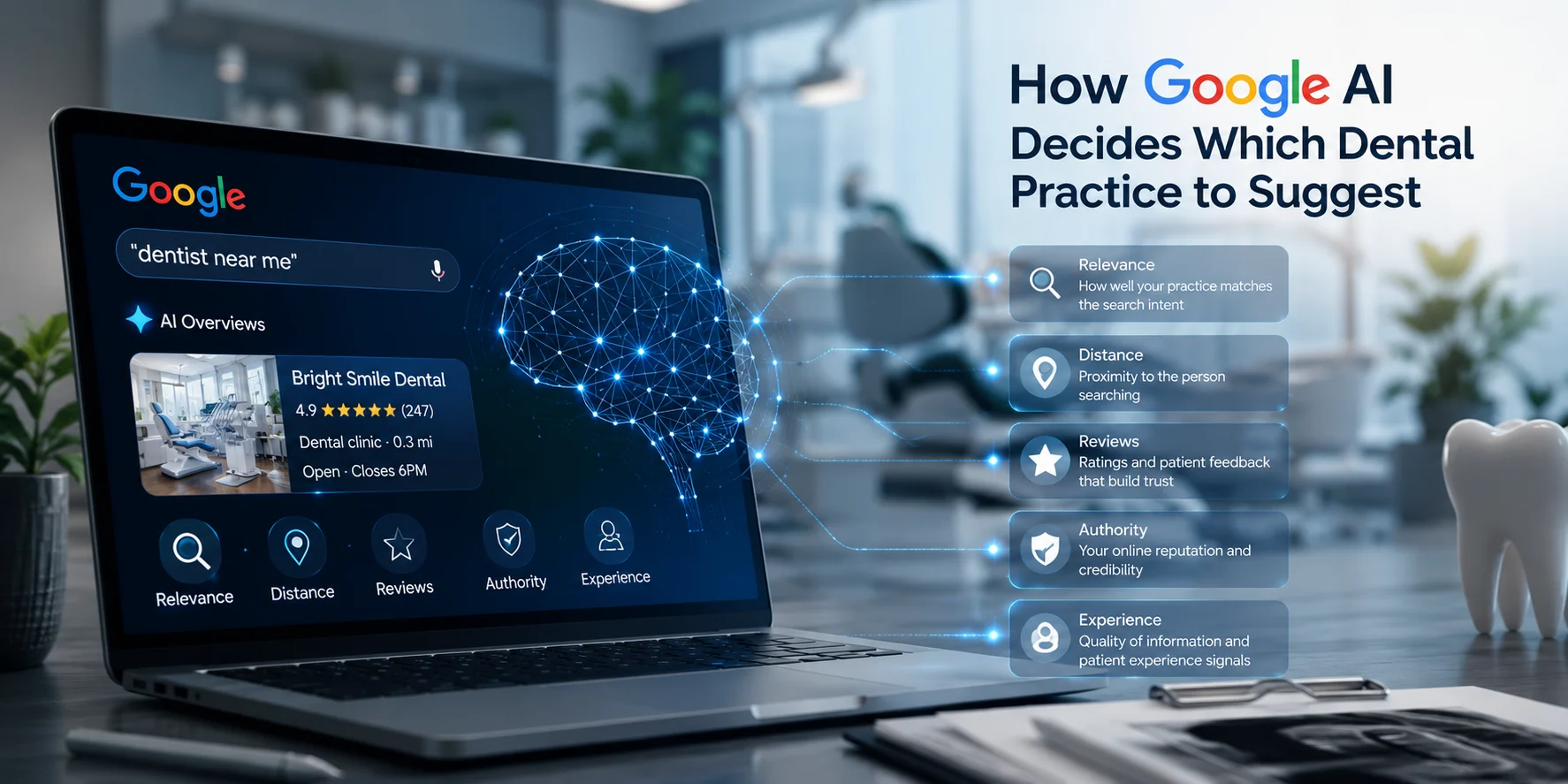
The dental marketing landscape is experiencing its most significant disruption since the launch of Google Maps. If you run a dental practice, a dental service organization (DSO), or manage marketing for a clinic, you have likely noticed that the way patients find you is changing. Search engines are no longer just lists of blue links; they have evolved into automated answer engines.
With the widespread rollout of Google AI Overviews, ChatGPT Search, Perplexity, and Gemini, patients are increasingly asking complex, conversational questions like, "Which pediatric dentist near me accepts Cigna and has the best reviews for anxious kids?" Instead of forcing the user to click through five different websites to piece together an answer, AI does the heavy lifting. It synthesizes the data and delivers a direct recommendation.
For many practices, this shift has caused anxiety. Traffic patterns are shifting, and traditional keyword tracking doesn't tell the whole story anymore. However, after analyzing search data and working with hundreds of dental practices across the US and UK, we have observed a clear pattern: practices earning strong local visibility today aren't simply ranking well on Google—they're becoming trusted sources that AI search engines confidently reference.
Understanding how google's AI decides which dental practice to recommend is not about chasing hacks or exploiting loopholes. It requires a fundamental shift from traditional search engine optimization (SEO) to Generative Engine Optimization (GEO).
If you are looking for a fast, high-level overview of how AI search impacts your dental clinic, here is the bottom line:
Before exploring the algorithms, let's establish a clear technical foundation. The terminology surrounding modern search can be confusing. Here are the core concepts you need to know:
To understand how an AI model selects a dental clinic, you have to stop thinking about keywords and start thinking about entities. In the eyes of a modern search engine, your dental practice is an entity—a distinct, identifiable node in Google's Knowledge Graph.
When a user submits a query, Google's generative models do not simply look for pages that repeat that phrase. Instead, they execute a multi-step retrieval process:
[User Query] ➔ [Intent Analysis] ➔ [Entity Retrieval from Knowledge Graph] ➔ [Data Synthesis via LLM] ➔ [AI Overview & Recommendation]First, the AI determines the exact user intent. If a user asks for "the best emergency cosmetic dentist open on Saturdays," the AI establishes strict filtering parameters: Location Proximity, Clinical Category (Cosmetic + Emergency), Availability (Saturday Hours), and Quality Baseline (High Sentiment).
Next, it queries its indexed data to find entities that match this matrix. The AI scans your website copy, your Google Business Profile, local directories (Yelp, Healthgrades), and mentions in local media. It looks for consensus. If your website says you offer emergency services but your Google Business Profile indicates you are closed on Saturdays, the AI experiences a drop in confidence. Because AI models are explicitly trained to avoid recommending incorrect information (hallucinations), lower confidence means you get left out of the AI Overview.
Finally, the LLM processes the data of the most trusted entities, summarizes why they fit the user's specific request, and generates the final output, complete with citation links. If your practice represents the highest-confidence match for that specific multi-layered intent, you earn the recommendation.
A common misconception among dentists is that AI Overviews completely replace traditional SEO. Some marketers claim that "SEO is dead" and that GEO is a completely unrelated discipline.
Crucial Reality: Generative Engine Optimization does not replace traditional SEO; it sits directly on top of it.
AI engines do not crawl an entirely separate version of the internet. Google AI Overviews use Google's core indexation and crawling infrastructure. If your website suffers from technical flaws—such as broken links, slow page load times, poor mobile rendering, or messy site architecture—Google's crawlers will struggle to parse your data. If the core crawler cannot parse your data, the AI model will never see it.
Think of traditional SEO as the ticket that gets you into the stadium. Without proper technical optimization, high-quality backlinks, and clean indexation, you aren't even in the game. GEO is what allows you to win the game by structuring that indexed information so an AI model can effortlessly summarize and recommend it.
Through our work with hundreds of dental clinics, we have mapped the primary signals that influence AI engine recommendations. To optimize your practice, you must address each of these distinct pillars.
Google’s Search Quality Rater Guidelines heavily emphasize EEAT: Experience, Expertise, Authoritativeness, and Trustworthiness. In the healthcare and medical space—which Google classifies as a "Your Money or Your Life" (YMYL) topic—the standards for E-E-A-T are exceptionally high.
AI models are trained to avoid recommending low-quality or potentially harmful medical advice. To establish your authority:
AI models excel at analyzing long-form, deeply informative content. Thin, 300-word service pages that simply say "We offer dental implants, call us today" will not win AI recommendations.
The AI looks for topical authority. If you want to be recommended for dental implants, your site needs to answer every tangential question a patient might have: What is the recovery timeline? What are the risks? How do implants compare to bridges? What financing options exist? The more comprehensively you cover a topic, the more context the AI has to pull from.
Your Google Business Profile (GBP) is the foundational anchor for your local entity data. It supplies the concrete facts that the AI uses to verify your business operations.
The AI builds its entity verification matrix by cross-referencing multiple critical trust sources:
If your Name, Address, and Phone number (NAP) are written differently across the web (e.g., "Main St. Dental" on your website, "Main Street Dental LLC" on Yelp, and an old phone number on an obscure directory), the AI's confidence score drops. Absolute consistency across all web citations is non-negotiable.
Traditional local SEO focused heavily on the volume and star rating of your reviews. Today, a proactive online reputation management strategy is equally important because AI engines analyze the context, specificity, and authenticity of patient feedback rather than relying solely on star ratings. While those metrics still matter, AI engines focus intensely on the semantic text within the reviews.
When a patient leaves a detailed review saying, "Dr. Smith did an incredible job with my Invisalign treatment. The clear aligners adjusted my deep bite perfectly, and the office staff handled my Delta Dental insurance seamlessly," the AI extracts critical entities: Invisalign, Clear Aligners, Deep Bite, and Delta Dental.
When a future patient searches for a dentist who treats deep bites with Invisalign under Delta Dental, the AI parses these real-world reviews to confidently make the recommendation.
Structured data, or Schema Markup, is a standardized language used to provide explicit clues about the meaning of a page to search engines. For dentists, implementing specific schema types—such as Dentist schema, MedicalBusiness Schema, FAQPage Schema, LocalBusiness schema — is like hand-delivering structured facts directly to the AI model.It explicitly tells the engine: Here are our hours, here are our doctors, here are the exact geographic neighborhoods we serve, and here are the precise insurance networks we accept.
The rise of generative search radically alters the patient acquisition funnel. The traditional journey involved a patient searching for a term, clicking on 3–4 websites from the organic results, navigating to their contact pages, and making a phone call.
With AI Overviews, we are seeing a massive increase in zero-click searches. Because the AI synthesizes everything the patient needs to know directly on the search engine results page (SERP), the patient may never click through to a website. Instead, they read the AI overview, look at the cited recommendations, and click the direct "Call" or "Directions" button right from the search interface.
[Traditional Funnel] Search ➔ Click Website ➔ Read Pages ➔ Call Clinic
[AI Search Funnel] Search ➔ Read AI Overview ➔ Click Cited Recommendation / Direct CallThis means your conversion metrics must adapt. Raw website organic traffic may flatten or drop, but direct actions (phone calls, booking clicks, map directions) from search profiles typically increase for highly optimized practices.
Furthermore, patients use conversational search to pre-qualify practices before ever speaking to a coordinator. This shift also reinforces the growing importance of AI voice search optimization, as more patients ask detailed questions through conversational interfaces instead of typing short keyword searches. If an AI engine cannot find clear information stating that your clinic offers sedation dentistry for pediatric patients, it will simply filter you out of the recommendation block entirely, rendering your practice invisible to that high-intent prospect.
To transform these insights into measurable patient growth, implement this five-step tactical playbook designed to optimize your clinic for generative search engines.
Review your website content and systematically expand it to address the full spectrum of patient concerns. Instead of generic marketing copy, write exhaustive, question-and-answer style resources.
AI search engines prioritize proximity and community relevance. You must clearly tie your clinical entity to your specific geographic sub-markets. Developing content that supports local dental lead generation helps strengthen your relevance for nearby high-intent patients while reinforcing local authority signals.
Ensure your web developer injects comprehensive, error-free JSON-LD schema across your site. Do not settle for basic corporate schema; use specific medical vocabularies.
{
  "@context": "https://schema.org",
  "@type": "Dentist",
  "name": "Elite Dental Partners",
  "image": "https://www.elitedentalpartners.com/images/clinic-front.jpg",
  "telePhone": "+1-555-765-4321",
  "url": "https://www.elitedentalpartners.com",
  "address": {
    "@type": "PostalAddress",
    "streetAddress": "123 Health Science Way, Suite 400",
    "addressLocality": "Austin",
    "addressRegion": "TX",
    "postalCode": "78701",
    "addressCountry": "US"
  },
  "geo": {
    "@type": "GeoCoordinates",
    "latitude": "30.2672",
    "longitude": "-97.7431"
  },
  "openingHoursSpecification": [
    {
      "@type": "OpeningHoursSpecification",
      "dayOfWeek": [
        "Monday",
        "Tuesday",
        "Wednesday",
        "Thursday",
        "Friday"
      ],
      "opens": "08:00",
      "closes": "17:00"
    }
  ],
  "medicalSpecialty": "CosmeticDentistry",
  "priceRange": "$$"
}Shift your patient review acquisition protocols away from generic feedback. When asking patients for reviews via text or email automation platforms (like Birdeye, Podium, or Weave), guide their responses.
Run a comprehensive citation audit to eliminate fragmentations of your business data.
Through our observation of dental campaigns that suddenly lost visibility during AI core updates, we identified several critical pitfalls. Avoid these mistakes to ensure you do not inadvertently block AI search spiders:
Looking ahead, the evolution of search will continue to pivot toward conversational interfaces, specialized voice queries via smart assistants, and predictive recommendations.
We are moving rapidly toward an environment where AI engines act as highly customized personal healthcare concierges. A user will eventually allow their AI assistant to securely cross-reference their personal dental insurance plan, dental history, and geographic location history to book an appointment automatically.
To succeed in this imminent future, dental brands must focus heavily on Entity Optimization and Knowledge Graph Integration. Your practice must become an undeniable fixture in your local healthcare ecosystem.
By consistently publishing original clinical perspectives, securing high-quality local media coverage, maintaining immaculate operational data, and cultivating deep patient trust that translates into detailed online sentiment, you ensure that no matter how drastically search technology evolves, Google's AI will always recognize your practice as the premier recommendation.
Understanding how google's AI decides which dental practice to recommend is the ultimate key to future-proofing your clinic's patient acquisition engine. The era of winning patients simply by stuffing keywords into metadata is officially over.
Today's generative search algorithms demand rigorous data consistency, verified clinical expertise, comprehensive topical depth, and authentic, highly descriptive patient validation. By aligning your digital footprint with the analytical needs of modern LLMs—structuring your website data flawlessly while building a bulletproof real-world reputation—you position your clinic to dominate both traditional search results and the new frontier of AI-driven recommendations.
Google AI selects a dental practice by analyzing a complex matrix of local proximity, verified operational data, and topical authority. The AI parses the practice’s website, Google Business Profile, and third-party directories to ensure perfect information consensus. It deeply analyzes the semantic text of real patient reviews to match specific dental care intents (such as complex cosmetic work or anxiety-free pediatric care) with the most reputable, trusted, and verified local clinic entity.
Yes, high-quality, text-rich reviews are critical for AI recommendations. While star ratings establish baseline trust, the generative AI reads the specific vocabulary within your reviews. When patients write out detailed accounts of specific treatments, technologies used, or insurance providers accepted, the AI uses that unstructured text to map your clinic's capabilities. This allows the engine to confidently recommend your practice for highly specific, long-tail user queries.
Absolutely. Your Google Business Profile is the foundational source of truth for Google’s Knowledge Graph. The AI treats your GBP as the master record for your name, address, phone number, operating hours, and customer interactions. If your website and your GBP contain conflicting information, the AI's confidence score drops, which dramatically reduces the likelihood of your clinic being featured in a Google AI Overview recommendation block.
Yes, traditional SEO remains completely indispensable. Google AI Overviews are built directly on top of Google’s core crawling and indexing infrastructure. If your website has poor technical SEO, messy architecture, slow page speeds, or unindexed pages, the AI engine will never see or synthesize your content. Traditional SEO gets your practice crawled and indexed, while Generative Engine Optimization (GEO) ensures your content is structured for AI extraction.
Generative Engine Optimization (GEO) in dental marketing is the systematic process of optimizing a dental clinic’s website, online reviews, local citations, and digital footprint specifically for extraction by large language models and AI engines. Unlike traditional SEO, which focuses heavily on ranking for specific static keywords, GEO focuses on establishing your practice as an authoritative local entity and providing direct, comprehensive answers to conversational patient questions.
Yes, ChatGPT Search and other conversational engines regularly recommend real-world businesses, including dental clinics. They achieve this by utilizing web-browsing integrations to crawl real-time local search directories, review aggregators, news sites, and your dental website. If your digital footprint is inconsistent, missing schema markup, or lacks authoritative local backlinks, AI search assistants like ChatGPT will overlook your clinic in favor of highly visible competitors.
To optimize your dental website for Google AI Overviews, focus heavily on creating authoritative, structured content. Implement clear H2 and H3 question-based headings that directly reflect patient queries, followed immediately by explicit, concise answers. Deploy error-free JSON-LD Dentist schema across your website, maximize your site speed, eliminate thin content, and publish deeply informative, long-form guides for your core clinical specialties.
Content that performs exceptionally well in AI search is deeply comprehensive, structurally organized, and strongly educational. Clear question-and-answer layouts, bulleted diagnostic checklists, structured pricing and insurance breakdowns, and detailed treatment timelines are easily parsed and cited by language models. The AI prioritizes authoritative content written by verified dental professionals that addresses the entire lifecycle of a patient's medical concern.
While basic technical website optimizations can show results within a few weeks, building the robust topical authority and digital footprint required for consistent AI search engine recommendations typically takes three to six months of sustained effort. This timeline is driven by the time required to build a consistent network of clean local citations, generate a steady stream of text-heavy reviews, and allow search spiders to index new clinical content assets.
Local SEO is more vital than ever because the vast majority of dental searches carry intense local intent. AI engines explicitly filter their summaries based on the user's geographical location when answering healthcare queries. Elements of traditional local SEO—such as managing your Google Maps profile, keeping local directory citations completely clean, and earning mentions in local publications—serve as the core signals that AI engines use to verify your physical business location.
Yes, website performance remains a vital foundational metric. Google's core algorithm uses Core Web Vitals to grade user experience, and fast-loading pages are crawled more frequently and deeply by search bots. If your website suffers from severe latency or poor mobile responsiveness, it hampers the underlying indexation process, which directly prevents generative AI systems from pulling your content into their live recommendation sets.
Dental Service Organizations (DSOs) must establish distinct, hyper-localized digital footprints for every individual clinic under their umbrella. Avoid using duplicated service page copy across different location sub-domains. Every clinic location must possess its own unique, fully optimized Google Business Profile, distinct local schema code detailing that specific address, localized patient reviews, and location-specific community content to prevent internal entity confusion.



October 7, 2026
5 min
Missed-call text-back vs. AI receptionist for dental practices: what each handles, when each wins, and which recovers more booked appointments.
October 7, 2026
7 min
AI follow-up helps cosmetic dental practices respond faster, reduce no-shows, and convert more high-intent veneer and Invisalign leads into booked consultations.

September 30, 2026
8 min
Slow lead follow-up can silently drain your dental marketing budget. See where enquiries fall through the cracks and how faster response recovers lost patient value.
Sign Up Now & Someone from Our Team Will Be in Touch Shortly!
Use the form below to send us a message, and we’ll get back to you as soon as we can.
.webp)
Track every marketing dollar and optimize patient conversions with ConvertLens. Gain valuable insights from your campaigns, ensuring you never miss a potential patient. Maximize ROI and grow your practice effortlessly.
-p-500.webp)