September 30, 2026
8 min
Slow lead follow-up can silently drain your dental marketing budget. See where enquiries fall through the cracks and how faster response recovers lost patient value.
February 21, 2026
8 min
Discover actionable dental email marketing tips to attract new patients, enhance engagement, and grow your practice efficiently.
Let’s start with the basics: email remains one of those underappreciated tools for dentists who want patients—new ones, loyal ones, the kind who come back, the kind who make a practice thrive. If what you’re after is some practical approach, not just slogans (“engage your audience!”) but actual habits that work, you’re in the right place. Below, we will walk you through playbooks, sharper strategies, templates, and even why pairing dental email marketing with SEO and a tuned-up Google Business Profile pulls in new patients (and keeps the old ones around). Get these working as a system and people will not only find your practice, but they'll also actually book appointments and return.
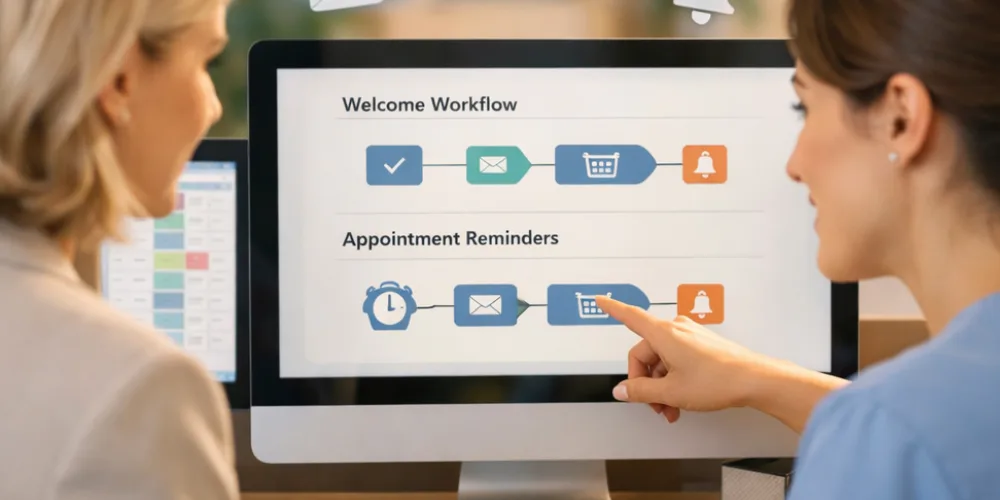
Let’s clarify: when we say “dental email marketing,” we are talking about the day-to-day systems any dental office, whether it’s one dentist, a multi-location group, or even a team of hygienists, can run. These aren’t just “tips,” but workflows: onboarding welcome emails that turn leads into patients, appointment reminders that cut no-shows, campaigns that get more people signed up for your dental membership plan, and referral nudges that people actually act on. These aren’t just for unicorns or huge DSOs; any busy corner practice (say, Foothill Dental) can outperform its size with the right systems and data.
So what’s realistic? If you look at the numbers, industry-wide open rates (ignoring Apple’s inflated numbers) average just north of 40%, with click-to-open rates in the 5% range and click-throughs a bit above 2%. What matters a lot more are CTOR, CTR, and, if you actually want revenue, how many emails translate to appointments. If you’re below 12% open, your targeting (or subject lines, or cleaning routines) isn't working. The trick is to connect email campaigns to actual practice data: use a platform, let’s pick on ConvertLens for now, one that merges PMS/EHR and campaign data so you see how leads turn into appointments and revenue.
Most dentist email programs are weak because they lack discipline in the groundwork. You need a strong welcome sequence, automated confirmations, and post-visit follow-ups. These aren’t frills; they’re fundamentals. Welcome emails turn interest into loyal patients (and highlight your dental membership plan, setting expectations right away). Confirmations and reminders are what actually stop no-shows. Good follow-ups are how you get Google reviews, retention, and more rebooking, measured in months, not years. Shoot for industry open rates (~42% or better), but pay more attention to CTOR and genuine conversion. A structured approach to patient retention strategies ensures these follow-ups aren’t random reminders but coordinated workflows tied directly to recall cycles and lifetime value.
Reactivation by Lapse Duration
Promos & Seasonal Offers
Referral Programs
For Loyalty: Personalize by default. Sprinkle in surveys and polls (patients like to be heard). Send seasonal greetings, automate membership renewals, and recognize birthdays and anniversaries. Test subject lines. The result: stronger patient bonds, fewer unsubscribes, and more referrals. Dentists who do this right don’t worry about churn.
You can’t run a results-driven dental email program with one big undivided list. Split by status: new, preventive, in-treatment, high-ticket (implants, cosmetic), and pediatric. Tailor messages: education for preventive patients, welcome/booking for new ones, and membership pitches to prospects. This means better confirmations, fewer bounces, better marketing ROI, and no wasted spending.
Get consent the moment you collect an email: on-site form, Google sign-up, in-office tablet, or online scheduler. Always capture a timestamped opt-in. Double opt-in is better for compliance. Log consent in your CRM; ConvertLens does this neatly with central tags and source attribution. Clean data practices also help you avoid unnecessary dental HIPAA violations that can occur when marketing and patient communication workflows aren’t aligned properly.
Grow with “lead magnets” (health checklists, tutorials), referral shares, and offers. Offer opt-down (less email) to avoid losing people entirely. Keep suppression lists and sunset inactive addresses. Use first name, last visit, provider, and membership status—plenty to personalize, never touch. PHI. Personalized, relevant messages keep people subscribed and engaged.
Small tweaks: A/B your welcome sequence for new patients, run quick polls for insights, and keep your community work or seasonal angles front and center. It’s not magic; just focus.

In 2024, you shouldn’t be orchestrating these campaigns by hand. Plug PMS/EHR sync (via APIs like ConvertLens, NexHealth, and Synchronizer) into your marketing tool. Auto-tag contacts, and kick off the right sequence for each status. For example, as soon as someone books online, trigger the welcome series. Intelligent CRMs will populate tokens and follow up without you doing anything.
Practices that integrate scheduling, messaging, and follow-up workflows avoid the hidden cost of disconnected patient communication systems, missed confirmations, duplicated outreach, and lost attribution.
Integration discipline: set regular syncs to avoid duplicates, always map tokens the same way, and keep PHI out. Coordinate with your vendor to validate the data flows. Ensure the vendor is HIPAA-ready if needed. Layering automation on these workflows is what turns ideas into a functioning, ROI-positive system.
Email is technical underneath. You have to handle SPF, DKIM, and DMARC. Monitor sender reputation and use List-Unsubscribe headers on bulk sends. Start slow with new domains, keep your transactionals (like reminders) separate, and resist the urge to spike sending volumes. Do all this and most deliverability headaches disappear.
On compliance: follow CAN-SPAM (address, honest subject lines, opt-outs), use double opt-in for EU/GDPR, honor CCPA and crucially, leave PHI out. Always log permission and timestamps. Vendors handling patient data need a BAA (ConvertLens claims to be HIPAA-ready). Treat consent as a first-class datum.
Keep bounces <2%, spam complaints <0.1%, and unsubscribes at about half a percent per campaign. Prune inactive emails; your inbox placement for the rest improves as a result.
For design: always mobile-first; single-column layouts, clear buttons, ALT text for images, and limited graphics. Make reminders plain text-capable with a single main action (one-click confirm, reschedule, or add to calendar). This is what makes your reminders readable everywhere and makes it more likely people will act. Personalized reminders, educational segments, and review requests reinforce loyalty, boost SEO, and have a compounding effect on practice growth when you keep the content relevant to each group.
How to Measure
How to Test
How to Optimize
Quick wins: a tight welcome sequence, a frictionless confirm/reminder flow, and a tested reactivation with membership promos or teledentistry options rapidly increase booked appointments. Watch your cost per new patient as you iterate.
Welcome Email
Subject: Welcome to Foothill Dental; finish intake in 60 seconds
Body: Hi {first_name}, thanks for picking our team. Complete your intake in under a minute: {intake_link}. Meet our staff, set up your portal, and check out the membership plan for regular savings. Book any time: {booking_link}
24‑Hour Reminder
Subject: Reminder: {date} at {time} with {provider}
Body: Hi {first_name}, just a heads-up: your appointment is at Foothill Dental on {date} at {time}. Click to confirm or reschedule: {one_click_confirm_link}. Add straight to your calendar: {add_to_calendar_link}
Post‑Visit Review Ask
Subject: How’d your visit go at Foothill Dental?
Body: Hi {first_name}, thanks for coming in. Take a second to share feedback or leave an online review: {review_link}. Your thoughts help us get better and help new patients find us.
Other Copy Tweaks
Deploying the Above
How often should we email?
Don’t batch-and-blast. Rely on event-driven emails (confirmations, reminders, renewals). Educational newsletters? 1–2x monthly is enough. Run promos in monthly or sharply targeted bursts. Over-sending is a shortcut to irrelevance and spam tabs.
How should lists be segmented?
Break out by: new, preventive, mid-treatment, cosmetic interest, and pediatric family. Smart tagging in a CRM or email platform is what allows automated follow-ups, and it’s how you move people through the funnel.
What catches attention?
Educational content, post-care tips, actual service announcements, patient reviews/testimonial highlights, and a clear, personal call to action. Offers that feel individualized always outperform blanket discounts.
How do I test if it’s working?
Run structured A/B tests, subjects and CTAs above all. Measure CTOR and appointment bookings. Use dashboards that close the loop from email to patient. If possible, automate what works.
What about compliance and the technical bits?
Opt-outs honored, PHI never in the message, SPF/DKIM/DMARC live and monitored, transactional flows isolated from promos, and automation to make reminders timely. None of these are optional if you want long-term results.



September 30, 2026
8 min
Slow lead follow-up can silently drain your dental marketing budget. See where enquiries fall through the cracks and how faster response recovers lost patient value.

September 30, 2026
10 min
Dental AI agents can screen patient inquiries by treatment need, urgency, insurance, and location, handing your front desk only booking-ready leads.

September 27, 2026
8 min
See the 10 key KPIs dental practices should track for AI receptionists, including call resolution, booking rates, cost per appointment, and ROI.
Sign Up Now & Someone from Our Team Will Be in Touch Shortly!
Use the form below to send us a message, and we’ll get back to you as soon as we can.
.webp)
Track every marketing dollar and optimize patient conversions with ConvertLens. Gain valuable insights from your campaigns, ensuring you never miss a potential patient. Maximize ROI and grow your practice effortlessly.
-p-500.webp)