September 30, 2026
10 min
Dental AI agents can screen patient inquiries by treatment need, urgency, insurance, and location, handing your front desk only booking-ready leads.
June 26, 2026
10 mins
Discover the differences between lead tracking and revenue tracking, and learn how connecting marketing efforts to production and collections drives sustainable practice growth.

Your marketing dashboard says your dental practice generated 120 leads this month. Calls are coming in. Forms are being submitted. Appointment requests look healthy. But when you check production numbers at the end of the month, growth barely moved.
Both numbers can be correct, but the disconnect creates confusion and makes it harder to decide what is actually working.
This gap between leads and revenue is one of the most common reporting blind spots in dental marketing. Lead tracking measures activity and interest. Revenue tracking measures what is converted into accepted treatment, completed care, and real business growth. Understanding the difference helps practices evaluate performance more accurately, allocate budget with greater confidence, and focus on the channels that create measurable outcomes rather than just more enquiries.
In this guide, we break down what revenue tracking and lead tracking actually measure, where dental practices often misread performance, and how connecting marketing activity to real production and collected revenue creates a clearer view of what is genuinely driving practice growth.
Here is a quick question: if someone asked you right now, “How is your dental practice performing?” What number would you reach for first?
Most dentists say something like: “We brought in 47 new patients last month” or “Google generated 30 calls a week.”
That is lead tracking. And on the surface, it feels like growth.
But those numbers only tell part of the story.
This is where the difference between lead tracking and revenue tracking becomes impossible to ignore. Lead tracking tells you what created attention. Revenue tracking shows you what created value.
And understanding which metric deserves more weight may be one of the most important growth decisions your practice makes this year.
Let’s start with the basics. Dental lead tracking is the process of monitoring how prospective patients discover your practice and take their first step toward becoming a patient.
That first action might look like:
Common lead sources for dental practices include:
Lead tracking answers a straightforward question:
Practices typically track this using tools such as:
For many practices, marketing now represents a meaningful growth investment, especially in competitive markets where patient acquisition costs continue to rise. Lead tracking helps determine whether those efforts are generating enquiries and where opportunities exist to improve performance.
It is easy to see why dentists value lead tracking. The feedback feels immediate. More calls. More forms. More appointment requests. The numbers move quickly and create visibility into marketing activity.
And to be clear, lead tracking matters. Every practice should know where patients are coming from.
But lead volume alone does not tell you whether growth is actually happening. That is where revenue tracking changes the conversation.
Revenue tracking looks beyond patient acquisition and focuses on what happens after a patient enters your practice. It connects patient activity directly to production, collections, treatment acceptance, and overall financial performance.
In a dental setting, revenue tracking typically measures:
Revenue tracking answers a different question than lead tracking:
Are the patients coming into the practice creating measurable value, and are we capturing the revenue opportunities already in front of us?
Practices typically monitor this through:
This matters more than many practices realize.
Industry benchmarks and dental consulting data consistently show that practices often carry a meaningful amount of diagnosed but unscheduled treatment sitting inside their patient database at any given time. In many cases, that value reaches tens or even hundreds of thousands of dollars, depending on practice size and specialty.
That revenue opportunity already exists. The patient has already found your practice. The diagnosis has already happened.
The question is whether your systems are converting treatment plans into completed care and collecting revenue.
That is a revenue tracking conversation, not a lead- generation conversation.
Lead tracking measures patient interest. Revenue tracking measures patient value.
One tells you how many people entered your pipeline. The other shows how much business those patients actually created.
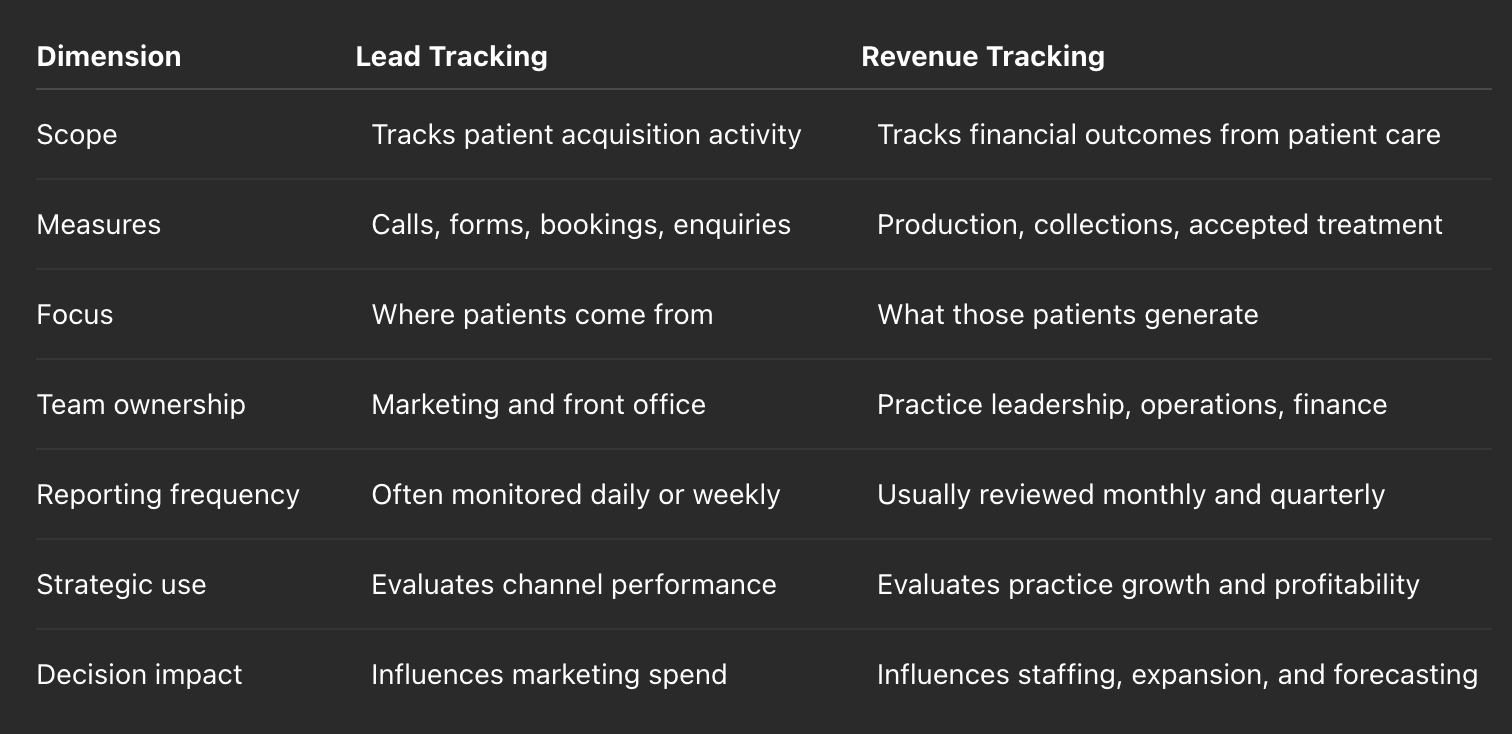
Marketing teams naturally focus on lead tracking because it gives fast feedback. More calls. More forms. More appointment requests. It shows whether campaigns are creating interest.
Revenue tracking answers a different question.
A practice can generate 100 leads and see modest growth. Another can generate 40 leads and outperform financially because treatment acceptance and production are stronger.
That is why practices need both metrics. Lead tracking shows where growth starts. Revenue tracking shows whether growth actually happened.
Let’s move from theory to the numbers that practices actually use to evaluate growth.
The challenge is that many dental practices still focus on measuring activity such as more leads, more calls, and more form fills, instead of measuring meaningful outcomes.
But growth is rarely driven by volume alone.
Here are some of the metrics practices monitor most closely:
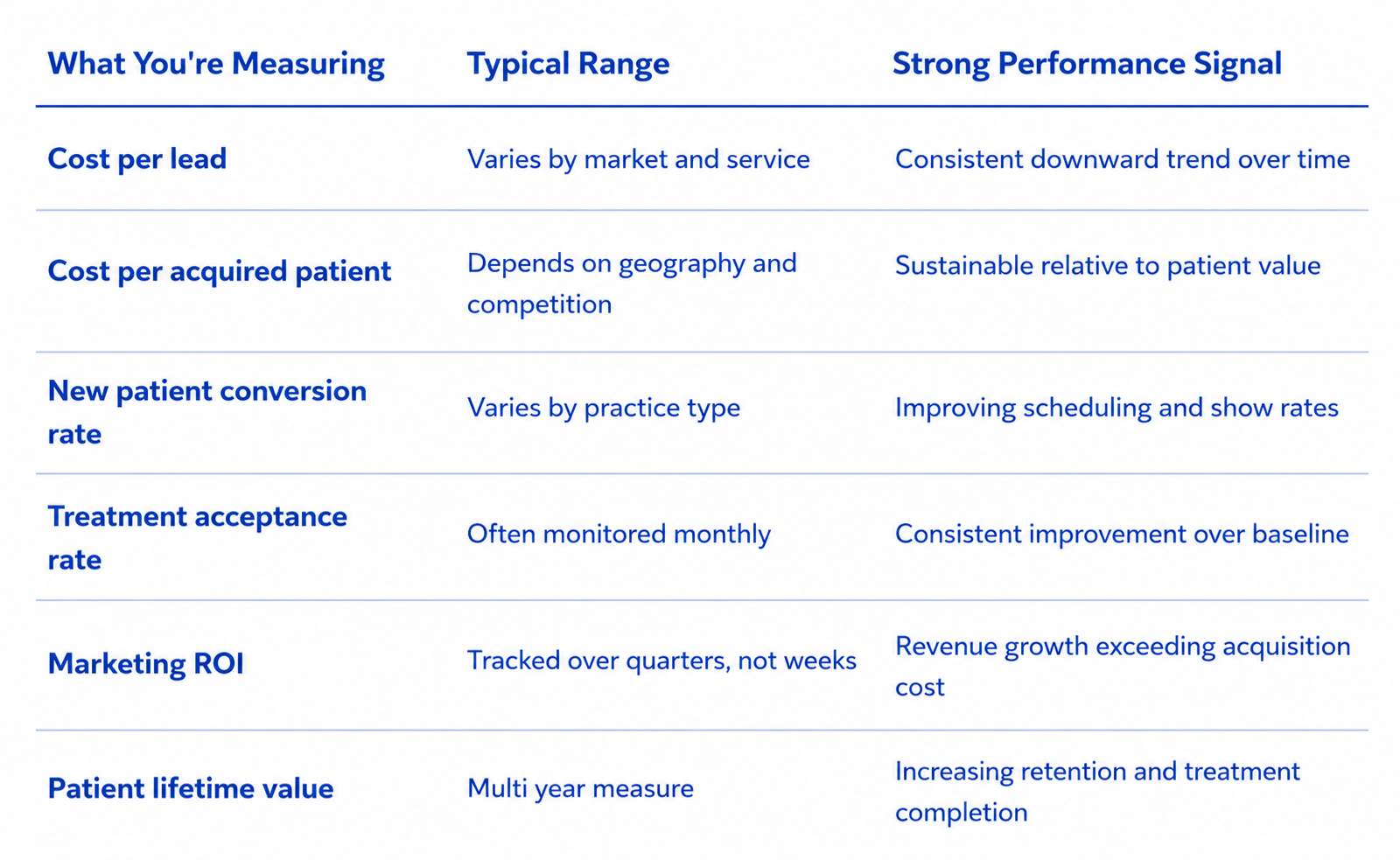
So what's the most important number here? Patient lifetime value.
Many practices evaluate marketing based only on the first appointment.
A patient books a hygiene visit or pays for an initial consultation and suddenly, acquisition costs feel too high. But that is rarely the full picture.
That patient may return for preventive care, accept restorative treatment, schedule cosmetic work, bring family members, and stay with the practice for years. Viewed through that lens, patient value changes completely.
That is why revenue per acquired patient often tells a more useful story than lead volume. A practice generating fewer enquiries but producing stronger case acceptance and higher long term patient value may outperform a practice creating twice the lead volume.
This becomes especially visible once practices connect marketing channels to real outcomes.
It is common to find that one campaign drives large numbers of enquiries but very few completed appointments, while another generates fewer leads but stronger production and collections.
That is the shift revenue tracking creates: less focus on activity, more focus on outcomes, and ultimately, better growth decisions.
Lead tracking is incredibly useful. The problem starts when practices expect it to answer questions it was never designed to answer.
Lead tracking genuinely helps when:
But lead tracking starts becoming misleading when:
So what actually counts as a lead? A real lead is a prospective patient who does not already know your practice and reaches out because they are actively considering care.
Existing patients, vendor calls, and wrong numbers do not count. Once practices clean up their tracking, lead numbers often look smaller but become far more useful because better decisions start with cleaner data.
Revenue tracking is where marketing performance becomes business performance. Using marketing ROI analytics helps practices connect marketing spend directly to production and revenue outcomes.
Lead tracking tells you who raised their hand. Revenue tracking tells you what happened next.
It connects marketing spend to actual outcomes: patients who booked, showed up, accepted treatment, returned for care, and generated production.
Here is what revenue tracking shows that lead tracking cannot:
The metrics that matter most:
For many practices, improving this number creates more growth than increasing lead volume.
One more thing to consider is that not every patient opportunity carries the same value. If your practice offers services such as implants, Invisalign, full mouth rehabilitation, or cosmetic treatment, fewer enquiries can still produce stronger results.
One completed high-value treatment may generate more revenue than dozens of lower-value visits. That changes how you think about marketing.
Because once revenue becomes visible, the question shifts from:
“Which campaign generated the most leads?”
to:
“Which campaign actually grew the practice?”
Here is the practical part: you do not need a data team, expensive software, or complex reporting to do this well. You need a simple process and someone in your practice who owns it.
Every channel, including Google Ads, Facebook, your website, postcards, and insurance directories, should have a unique phone number that forwards to your main line. When a patient calls, you know exactly where they came from.
Not every inbound call is a lead.
For each enquiry, capture:
This small habit dramatically improves reporting accuracy.
When a patient books, record the original source using dental lead attribution inside your practice management system. Then connect that patient through treatment acceptance and production.
Over time, you should be able to answer questions like:
"Google Search generated 28 new patients and $24,000 in production this quarter."
That is where marketing becomes measurable.
Set one recurring 30-minute review each month and focus on five numbers:
That is the system; one that includes reviewing performance monthly, making adjustments quarterly, and using those insights to drive faster, more confident growth decisions.



September 30, 2026
10 min
Dental AI agents can screen patient inquiries by treatment need, urgency, insurance, and location, handing your front desk only booking-ready leads.

September 27, 2026
8 min
See the 10 key KPIs dental practices should track for AI receptionists, including call resolution, booking rates, cost per appointment, and ROI.

September 24, 2026
6 min
An AI receptionist checks real-time schedules, matches providers and rooms, and confirms before updating, helping dental practices reschedule appointments without double-booking.
Sign Up Now & Someone from Our Team Will Be in Touch Shortly!
Use the form below to send us a message, and we’ll get back to you as soon as we can.
.webp)
Track every marketing dollar and optimize patient conversions with ConvertLens. Gain valuable insights from your campaigns, ensuring you never miss a potential patient. Maximize ROI and grow your practice effortlessly.
-p-500.webp)