September 21, 2026
9 min
Improve dental patient experiences with engagement technology that streamlines scheduling, strengthens retention, and eases front-desk workload.
August 7, 2026
8 min
Learn how multi-location dental groups can manage Google Business Profiles at scale with standardized processes, local optimization, review management, and tools that improve local search performance.
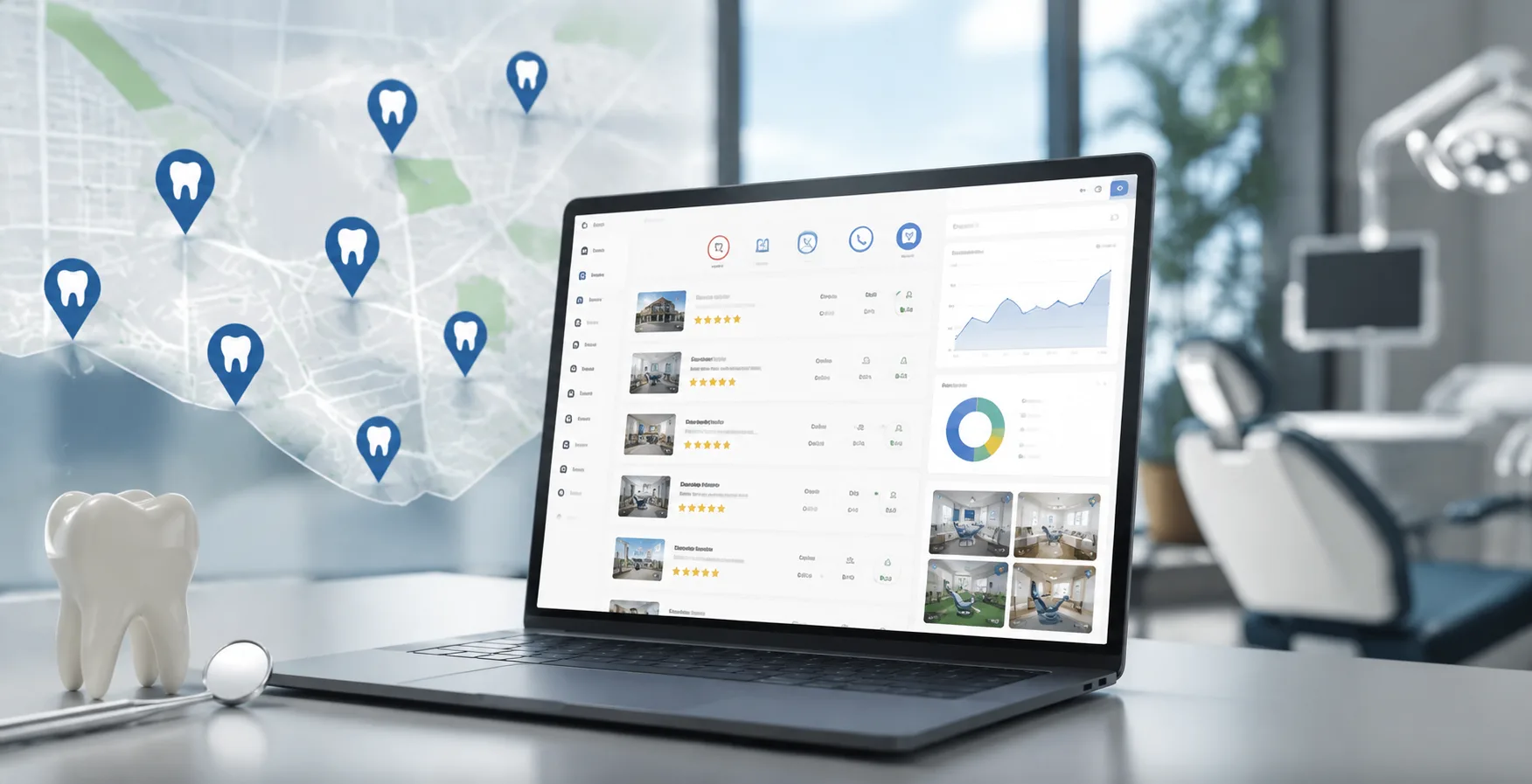
Managing one Google Business Profile is a checklist. Managing thirty is an operation. A single-location practice can get away with updating hours, posting occasionally, and replying to reviews when someone remembers to check. A dental group with even ten locations needs something closer to a system, because the same tasks that took an hour a week at one office now multiply across every location, and inconsistency between them shows up publicly, in front of every patient searching nearby.
Google Business Profile management at scale means standardizing how every location's profile is set up, updated, and monitored, while still allowing each one to reflect its actual local presence. Get the standardization wrong and every location looks slightly different in ways that erode trust. Get the localization wrong and every profile looks like a copy-pasted template.
At one location, a missed review response or an outdated photo is a small, fixable oversight. At thirty locations, the same oversight repeated inconsistently across a fraction of the group becomes a pattern patients and Google's own ranking signals both notice. Profiles with stale hours, inconsistent categories, or unanswered reviews tend to underperform in local search, and at scale, a handful of neglected profiles can quietly drag down how the whole group appears in nearby searches.
There's also a coordination problem that doesn't exist at a single location: who actually owns this. Is it front-desk staff at each office, a central marketing team, an agency, or some mix of all three? Without a clear answer, tasks like responding to reviews or updating seasonal hours end up either duplicated or, more often, skipped entirely because everyone assumed someone else was handling it.
The technical foundation for managing GBP at scale starts with Google's own tools for this exact problem. Google Business Profile supports multi-location management through a business group, where a single account oversees every location while each profile keeps its own reviews, posts, and location-specific information.
For groups with ten or more locations, bulk verification is available, which meaningfully speeds up the setup process compared to verifying each location individually. This matters more than it sounds. A DSO acquiring several practices at once, or opening multiple new locations in a short window, can lose weeks to individual verification delays if bulk verification isn't set up from the start.
Beyond ten locations, most experienced multi-location marketers stop managing GBP through the native Google interface alone and adopt a dedicated multi-location management platform. Purpose-built tools designed for scaling across many locations, sometimes cited around the fifty-location mark as a practical threshold, make it possible to push updates, standardize fields, and monitor review activity across the whole group from one place rather than logging into dozens of individual profiles.
There isn't one right way to staff GBP management, and the right model changes as a group grows. A pattern that shows up consistently across multi-location marketing teams:
5 to 15 locations: agency-led. At this size, a dedicated in-house GBP specialist is hard to justify on cost alone, and an agency with existing multi-location tooling can usually run the day-to-day work efficiently.
15 to 75 locations: hybrid. This is the band where most DSOs land, running one to three in-house marketing staff focused on strategy and oversight, paired with an agency handling execution at the location level. The in-house team sets standards and reviews performance; the agency does the daily posting, monitoring, and updates.
75+ locations: in-house. Past a certain scale, the coordination overhead of managing an external agency across that many locations starts to outweigh the cost savings, and groups at this size typically build a dedicated in-house team, often six or more people, to own it directly.
None of these bands are rigid rules. A group with unusually complex service lines or aggressive growth plans might justify in-house sooner. But the general pattern holds because it reflects a real tradeoff: agencies bring existing tooling and bandwidth, in-house teams bring tighter control and brand consistency, and the crossover point tends to land around the fifteen and seventy-five location marks.
Consistency across locations isn't about making every profile identical. It's about making sure the fields that affect search visibility and patient trust don't drift apart for no good reason.
Categories and services should follow a standardized list across the group, even when individual locations offer slightly different specialties. A patient searching for orthodontics shouldn't get inconsistent results depending on which location happened to fill out that field correctly.
Posting cadence works best as a minimum standard, often weekly, applied group-wide, rather than left to each location's discretion. Locations can post more, covering local events or provider spotlights, but a shared floor keeps every profile active enough to signal to Google that the business is engaged.
Photo freshness matters more than most groups initially assume. A refresh cadence around once a month, covering the office, team, and any recent updates, keeps profiles from looking abandoned, which is a small but real trust signal for a patient deciding between several nearby options.
This kind of standardization overlaps closely with how DSOs approach multi-location clinic marketing more broadly. GBP consistency is really just one visible piece of a larger brand consistency problem that scales with every new location added.
Review management is where the tension between centralization and local authenticity shows up most clearly. A fully centralized team responding to every review across every location can move fast and stay consistent, but risks sounding generic, especially on reviews that reference a specific staff member or local detail a central team wouldn't know about.
A workable middle ground: a central team handles the majority of routine responses using approved templates, while flagging anything that references a specific provider, a complaint requiring local context, or a review that needs the kind of careful, HIPAA-aware handling covered in handling negative reviews across multiple DSO locations for a location-level team member to finalize.
A realistic response time target across a multi-location group is within 48 hours of a review posting. Beyond that window, both the reputational cost and the SEO cost of an unanswered review start to compound, particularly for negative reviews sitting unaddressed in public view.
Rather than recommending a specific vendor, it's more useful to know what category of tool solves this problem, since the right choice depends on group size and existing marketing stack. Multi-location management platforms generally offer bulk editing across every profile's categories, hours, and services; centralized review monitoring with response workflows; scheduled or bulk posting; and reporting that rolls performance up to the group level while still allowing location-level drill-down.
The specific platform matters less than making sure whichever tool is chosen actually gets used consistently. A powerful platform that only the marketing team logs into, while front-desk staff at individual locations still manage their own profile changes separately, recreates the exact coordination problem the tool was supposed to solve.
Google Business Profile management stops being a simple task somewhere between ten and fifteen locations, and groups that keep treating it like a single-location checklist tend to end up with a patchwork of inconsistent, under-maintained profiles that quietly hurt local search performance across the board. The fix isn't complicated: set up business groups and bulk verification early, choose an org model that matches your current location count, standardize the fields that matter, and centralize review response without losing the local voice entirely.
If coordinating GBP consistency across locations has become its own full-time headache, Convertlens's practice growth tools are built to help DSOs manage marketing consistency across every location from a single view.
How many locations before you need dedicated GBP management staff?
Most groups start feeling the strain of manual, per-location management somewhere between 10 and 15 locations, which is roughly where a business group setup and, often, a dedicated tool or agency partner become worth the investment.
What's the review response SLA DSOs should target?
A 48-hour response window is a reasonable standard across the group, applied consistently rather than only for negative reviews, since prompt responses to positive reviews also contribute to how active and engaged a profile appears.
Can one person manage GBP for 50+ locations?
Not effectively without a dedicated multi-location platform. Manual management at that scale, logging into each profile individually, isn't sustainable even for a single dedicated staff member, which is exactly why platforms built for bulk management exist.
Does every location need its own unique content, or can some be templated?
A mix works best. Core information (categories, services, hours) should be standardized. Posts, photos, and review responses benefit from at least some location-specific detail, since fully templated content across every profile can read as inauthentic to both patients and Google's ranking systems.



September 21, 2026
9 min
Improve dental patient experiences with engagement technology that streamlines scheduling, strengthens retention, and eases front-desk workload.

September 21, 2026
7 min
Learn how AI receptionists handle dental emergency calls, when they should involve your team, and the safety protocols needed to protect patients.
September 16, 2026
5 min
Learn why dental AI agents lose potential patients and how better conversations, accurate answers, seamless handoffs, and simpler booking can improve conversions.
Sign Up Now & Someone from Our Team Will Be in Touch Shortly!
Use the form below to send us a message, and we’ll get back to you as soon as we can.
.webp)
Track every marketing dollar and optimize patient conversions with ConvertLens. Gain valuable insights from your campaigns, ensuring you never miss a potential patient. Maximize ROI and grow your practice effortlessly.
-p-500.webp)