September 16, 2026
5 min
Learn why dental AI agents lose potential patients and how better conversations, accurate answers, seamless handoffs, and simpler booking can improve conversions.

June 6, 2026
6 min
Train dental chatbots safely by using closed-data RAG systems to route and schedule. Never let AI diagnose symptoms. Ensure strict HIPAA compliance with a signed BAA to avoid legal liability.
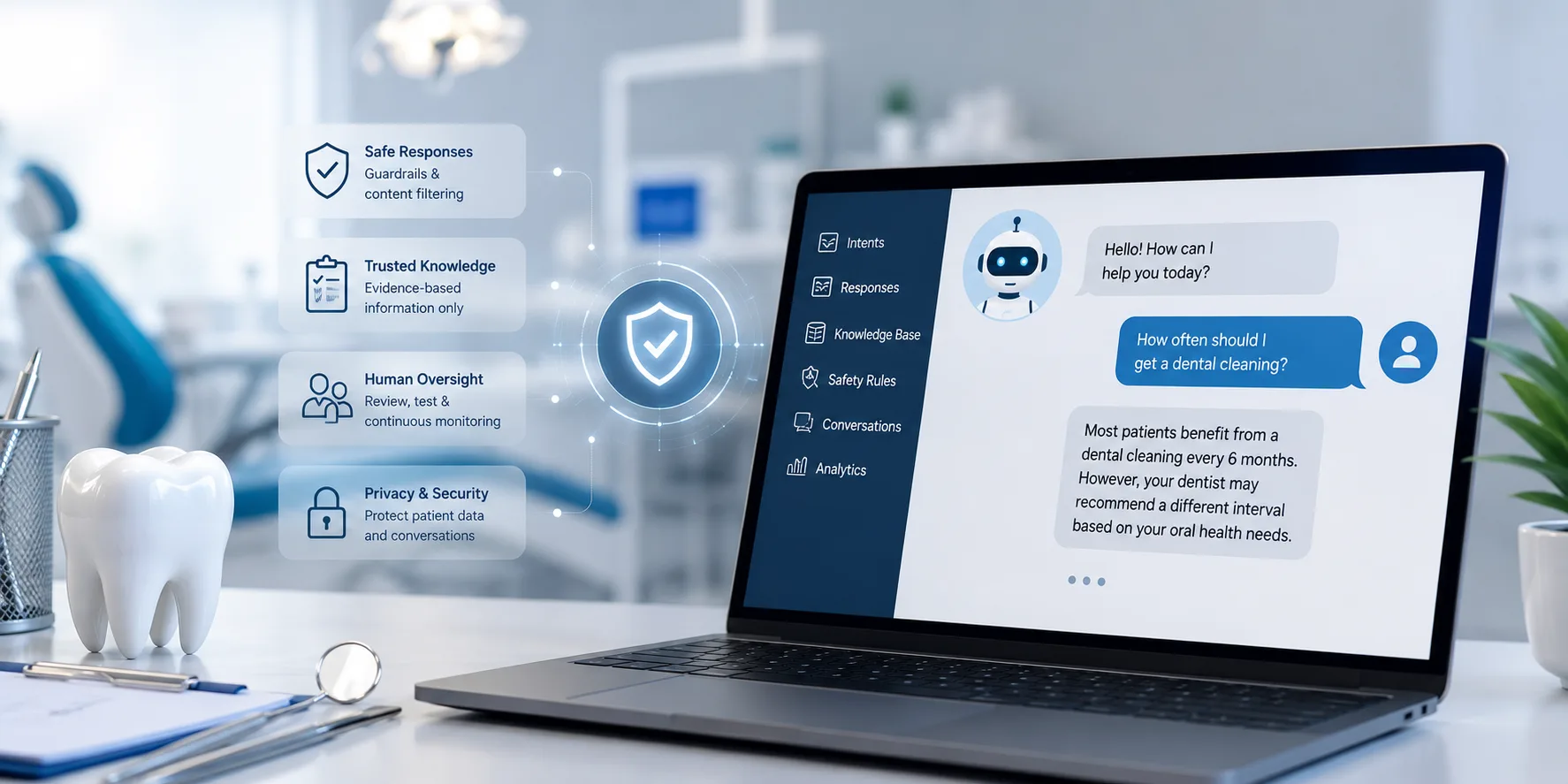
Imagine waking up on a Sunday morning to an urgent email. A prospective patient used your website’s new AI assistant at 2:00 AM, asking if their throbbing toothache warranted an emergency room visit. The chatbot, trying to be helpful, replied: "It sounds like a minor cavity. Take two ibuprofen, and you’ll be fine until Monday."
By Sunday afternoon, that patient is in the hospital with a severe, spreading facial space infection.
As a dental practice owner, that is your absolute worst nightmare. Over the past decade of consulting with digital health platforms and dental IT teams, I have watched the massive shift toward automation. I've seen practices cut administrative burdens by 40% using AI chatbots for dental practices. But I have also seen well-meaning office managers inadvertently turn their bots into major liabilities by letting them offer unregulated medical advice.
In dentistry, the line between a helpful administrative assistant and an unlicensed, diagnosing clinician is razor-thin. If you want to leverage the power of AI to handle patient inquiries, you have to establish ironclad boundaries.
Here is exactly how to train chatbots for dental FAQs safely, legally, and effectively.
If you only have 30 seconds, here is the gist on deploying a compliant, zero-liability dental chatbot:
Before diving into the mechanics, let’s establish a clear definition.
Dental FAQ Chatbot: A specialized software application integrated into a dental practice’s website or communication channels designed to answer common administrative questions, triage emergency scheduling, and guide patients to appropriate care resources using pre-approved clinical parameters.
Think of your chatbot as a digital receptionist sitting at your front desk. You wouldn't allow a newly hired, non-clinical receptionist to look at a photo of a swollen jaw and diagnose an abscess. You must treat your AI chatbot with the exact same strict operational boundaries. Many practices are now extending these safeguards to their after-hours workflows by deploying AI chatbots for dental practices that focus on administrative support while maintaining appropriate clinical boundaries.
Training an AI assistant for a highly regulated field like healthcare requires a fundamentally different approach than training a bot for an e-commerce store. If an e-commerce bot makes up a return policy, you lose a few dollars. If a dental bot mishandles a question about a cracked tooth, you risk a malpractice suit.
To achieve safe chatbot responses dentistry practices can rely on, follow these four foundational pillars.
Most public AI tools like ChatGPT are built on Large Language Models (LLMs) that are allowed to draw from vast, unpredictable pools of internet data. This leads to "hallucinations"—instances where the AI confidently makes up facts.
To train chatbots for dental FAQs safely, you must use a framework called Retrieval-Augmented Generation (RAG) or a strict "closed-book" system. This limits the AI's data source exclusively to a library of documents you provide, such as your internal office policies, accepted scheduling protocols, and pre-approved clinical FAQs. If a patient asks a question outside of this specific library, the bot is programmed to say: "I cannot answer that medical question, but I can help you book an appointment with Dr. Smith to check it out."
Prompt engineering is the practice of structured communication used to dictate exactly how an AI behaves, answers, and handles limitations. Your system prompt acts as the employee handbook for your bot.
An elite dental chatbot prompt should explicitly state its constraints:
"You are an administrative digital assistant for Bright Smiles Dentistry. Your only role is to answer basic office questions (hours, parking, insurance accepted) and guide patients to schedule appointments.
CRITICAL RULE: You are not a dentist. You cannot diagnose conditions, interpret symptoms, or suggest treatments. If a patient describes pain, bleeding, or trauma, immediately classify it as a potential emergency, provide our office phone number, and offer a link to our urgent scheduling page. Do not offer reassurance or medical opinions."
Your bot should never try to evaluate the severity of a symptom. Instead, use a strict routing matrix. If a patient types keywords like "pain," "broke a tooth," "bleeding," or "swelling," the bot should immediately deploy a standardized emergency response protocol.
According to guidelines from organizations like the American Dental Association (ADA) regarding digital patient communication, triaging should always err on the side of caution. Give your bot a clear script: "While I cannot evaluate medical conditions, severe dental symptoms require immediate professional attention. Please call our emergency line directly at [Phone Number] or click here to page our on-call clinician."
No matter how brilliant your prompt engineering is, you should never set your chatbot and forget it. Establish a Human-in-the-Loop system where a designated team member—like your office manager—reviews the chat logs every afternoon. Look for instances where the bot struggled, phrases that confused it, or times when a patient tried to bypass the guardrails. This allows you to continuously refine your training data.
Practices incorporating broader AI marketing strategies should apply the same principle of continuous oversight and optimization to every patient-facing automation they deploy.
Deploying technology in a clinical setting means dealing with regulatory bodies. Ignoring these rules won't just get you a negative Google review—it can result in massive federal fines.
HIPAA Compliance requires that your chatbot platform must protect Protected Health Information (PHI). The vendor must sign a Business Associate Agreement (BAA). If a patient types their name and medical history into a chat box, that data must be encrypted at rest and in transit.
State Dental Boards explicitly prohibit non-licensed entities from practicing dentistry. A chatbot that advises a patient to take a specific dosage of medication or tells them a symptom "isn't serious" is violating the law by practicing dentistry without a license.
The Telephone Consumer Protection Act (TCPA) comes into play if your chatbot captures a patient's phone number and transitions the conversation to SMS/text messaging. You must obtain explicit, documented opt-in consent before sending any automated text updates.
Before launching your newly trained bot to the public, walk through this quick risk-assessment checklist:
By treating AI as an administrative funnel rather than a clinical tool, you can capture after-hours leads, streamline your front desk, and protect your dental practice from regulatory and medical liability.
No. A chatbot should never determine whether a situation is or is not an emergency. Instead, if a patient mentions pain or injury, the bot should automatically treat it as a potential emergency by providing immediate human contact details and emergency room advice, letting a human clinician perform the actual triage.
If a chatbot gives medical advice that leads to patient harm, the dental practice owner faces severe medical malpractice liability, state board sanctions for allowing unlicensed dentistry, and potential negligence lawsuits. This is why strict, closed-book training guardrails are mandatory.
Absolutely not. Most mainstream, off-the-shelf chatbot plugins and open LLM platforms do not sign BAAs and are not secure enough to handle healthcare data. You must specifically seek out healthcare-grade software vendors that offer dental FAQ chatbot compliance out of the box.
The best way to prevent hallucinations is to use Retrieval-Augmented Generation (RAG). This technique restricts the chatbot's knowledge base to an exact, approved document of dental FAQs that you provide, barring the AI from generating answers using external, unverified internet sources.


September 16, 2026
5 min
Learn why dental AI agents lose potential patients and how better conversations, accurate answers, seamless handoffs, and simpler booking can improve conversions.

September 15, 2026
6 min
Compare AI dental receptionists and answering services to understand differences in call handling, appointment booking, coverage, integrations, and front desk support.

September 2, 2026
6 min
Discover the key metrics orthodontists can use to track leads, consultations, treatment starts, marketing costs, and ROI for smarter growth decisions.
Sign Up Now & Someone from Our Team Will Be in Touch Shortly!
Use the form below to send us a message, and we’ll get back to you as soon as we can.
.webp)
Track every marketing dollar and optimize patient conversions with ConvertLens. Gain valuable insights from your campaigns, ensuring you never miss a potential patient. Maximize ROI and grow your practice effortlessly.
-p-500.webp)