September 16, 2026
5 min
Learn why dental AI agents lose potential patients and how better conversations, accurate answers, seamless handoffs, and simpler booking can improve conversions.
May 1, 2026
10 min
Learn which daily metrics matter most for scaling dental groups, improving location performance, and driving smarter growth through data.

Running two dental offices is a busy job. Running five, ten, or twenty is a different job entirely, and the gap isn't effort, it's visibility. Multi location dental analytics exists precisely because the instincts that carried a single practice owner through years of decisions simply stop working once you're not physically present in every chair every day.
Dental Service Organizations, regional groups, and independent dentists scaling their footprint are all running into the same wall: a spreadsheet built for one office cannot represent ten, and a weekly report that used to feel current is already stale by the time anyone reads it. Group dental affiliation keeps climbing too, roughly 27% of early career dentists now affiliate with a DSO versus just 9% of veteran dentists, which means more of the industry is inheriting this exact problem every year.
Daily tracking, not weekly and not monthly, is what closes that gap. A production dip at one office, a no show spike at another, a hygiene recall rate quietly drifting downward across the whole group, none of these show up as emergencies until someone is watching closely enough to catch them early. This is a walk through the metrics that actually move the needle for multi location dental analytics, why each one matters, and what a daily tracking rhythm looks like once you build it properly.
In a single office, visibility is automatic. You walk the floor, talk to the front desk, and feel it when something's off, a light schedule, a missed follow up, a production gap. The loop between what's happening and what you know closes almost instantly.
Scale past one location and that closeness disappears. You're not in every office every day, so a location can underperform quietly for weeks before a monthly report finally surfaces it, by which point revenue is already gone and some of those patients have likely gone elsewhere. Daily tracking rebuilds that visibility artificially: a clear read on what happened yesterday everywhere, and what's expected today. It's not about micromanaging every detail, it's about catching problems while they're still small enough to fix cheaply.
The bigger unlock, though, comes after that first layer of visibility settles in. Once you're running several locations, you gain something a single practice owner never has: an internal benchmark. You're no longer guessing against generic industry averages, you can measure one office against another inside your own network, using practice performance dashboards built for exactly this comparison. You can see which locations convert better, where patient flow is genuinely slowing versus just having an off week, and which teams are quietly outperforming the rest. A single location practice looks outward for benchmarks. A multi location group can look inward, and that's usually the faster path to improvement.
Production is the pulse of the business, if it's healthy, most other problems are manageable, and if it's not, nothing else matters until it's addressed. Tracking it daily, broken out by both provider and location, surfaces two layers of insight that a monthly rollup flattens completely.
At the provider level, daily production shows you who's consistently hitting scheduled capacity and who isn't, which is a coaching conversation, not a blame conversation. An associate falling short might need help with case presentation; a hygienist running behind might just need a scheduling adjustment. At the location level, daily patterns reveal things weekly data smooths over entirely, one office might sag every Monday while another underperforms every Friday, and you can't fix a pattern you can't see.
What to watch daily: actual production against scheduled production (the production gap), production per hour by provider, unscheduled treatment value surfacing in hygiene visits, and the daily trend against the same day last week and last month. A healthy multi location group should be landing at 85 to 90% of scheduled production consistently. Fall below that at any single location and it's worth a same day look, not a wait and see.
Production tells you what you earned. Collections tell you what you actually kept, and the gap between those two numbers is where money quietly leaks out of a growing group. Industry data puts this in sharper focus than the "98% is normal" figure many practices still repeat: average collection rates across dental practices generally sit closer to 75%, and among groups with eight or more locations, the average drops further to around 72%, while the top performing decile of DSOs is collecting at roughly 97%. That's a 25 point gap between average and excellent, and at scale it's real money, not rounding error.
If your group produces $3 million a month and collects at 95% instead of 98%, that's $90,000 a month left on the table, and the gap tends to widen, not narrow, as a group adds locations, mostly because billing workflows fragment across offices instead of staying integrated. Daily monitoring lets your billing team act on aging accounts before they cross the 90 day mark, where recovery odds drop sharply, and it helps you spot whether one location is struggling with a specific insurance payer or whether front desk teams are avoiding financial conversations with patients. Our breakdown of treatment ROI measurement goes further into connecting operational fixes like this back to profitability.
What to watch daily: same day collections versus walkouts carrying a balance, whether every claim from the prior day actually got submitted, accounts receivable aging by location, and outstanding balances flagged for follow up.
New patients are the growth engine, without a steady flow, even a highly productive office slowly declines as its existing base ages and moves on. Tracking new patient count daily, alongside source attribution, tells you two things at once: whether your marketing is working, and specifically where.
Source attribution is where multi location groups tend to leave the most value on the table. Spend spread across Google Ads, local SEO, social, referrals, and community outreach means nothing in aggregate, group level marketing data. What matters is knowing which channel is driving new patients to which specific location, since a channel that performs well group wide can still be quietly failing at two of your ten offices.
A strong group should be targeting 25 to 50 new patients per location per month depending on market and size, with at least 80% of phone inquiries converting to a booked appointment. Reviewing campaign profitability by location regularly keeps marketing spend honest rather than assumed.
What to watch daily: new patient count by location against target, first appointment source, appointment status (scheduled, confirmed, seen, no show), and conversion rate from first contact to booked visit.
A dental practice has one fixed, non renewable inventory each day: the hours in every chair. An empty ten o'clock slot from yesterday cannot be sold today, it's simply gone. Schedule utilization, the share of available time actually filled with kept, productive appointments, is one of the most direct signals of operational health a multi location group has.
Tracked daily across every office, it shows exactly where the schedule is soft and where there's room to fill it, and it surfaces patterns invisible at monthly resolution: is one location consistently thirty percent open on Tuesday afternoons while another is overbooked every Thursday, generating wait time complaints? The strongest groups run real time short call lists so an opening gets filled within hours, not left empty for the rest of the day.
What to watch daily: utilization percentage by provider and location, open slots remaining today and tomorrow, same day fill opportunities, and whether high value procedure blocks are being prioritized first.
No shows and late cancellations are one of the more damaging operational problems a dental group faces, because margins depend on high chair utilization. In aggregate numbers across a large group, a serious no show problem at one location can hide comfortably inside an average that still looks fine.
Industry figures on this vary more than people expect. Some benchmarks cite 5 to 8% as typical, while a 2026 industry statistics review puts the average cancellation rate closer to 15.5% and no show rate around 7.4% across DSO affiliated practices, a reminder that the "normal" range depends heavily on which data set you're comparing against. Whichever benchmark a group uses, tracking it daily by location lets you test fixes fast: switch from one day email reminders to two day text reminders and you'll know within a week if it's working, not after a full quarter has already passed.
What to watch daily: no show count and rate by location and provider, same day cancellation count, whether no show patients actually rebooked, and last minute fills pulled from the short call list.
Hygiene is the foundation of most patient relationships. A patient current on hygiene visits is more likely to accept treatment, more likely to refer family, and more likely to stay a long term patient, while a patient who quietly falls out of recall usually leaves without ever explaining why.
Hygiene reappointment rate, the share of hygiene patients who leave with their next visit already booked, is one of the stronger predictors of long term practice health available, and it should be tracked daily by hygienist, by location, and as a group average. DSO benchmark data puts a healthy reappointment target around 90%, with anything below 80% worth flagging for attention. Multi location groups routinely find enormous variability here, one office pre schedules 95% of patients while another sits at 60%, and that gap is recoverable revenue sitting in plain sight. Scaling this kind of tracking across a growing patient base also means patient data protection has to scale right alongside it, not as an afterthought.
What to watch daily: reappointment rate by location and by individual hygienist, active patients overdue for their next visit, and unscheduled treatment value surfacing during hygiene exams.
New patients mean little if teams aren't presenting and closing treatment plans effectively. Treatment acceptance rate, the share of diagnosed treatment patients actually agree to schedule, is a direct read on case presentation skill and communication quality, and the benchmarks here are wider than most practices assume: industry averages sit closer to 42 to 45%, DSO group wide averages often land around 62%, and top performing offices push past 75 to 80% on well presented plans.
For a multi location group, the gap between your best and worst location on this single metric is usually a direct, recoverable revenue opportunity, and it's often a training gap rather than a demand problem.
What to watch daily: acceptance rate by location and by provider, the dollar value of unscheduled treatment plans sitting with each patient, and same day acceptance and scheduling rate.
This one gets tracked less often, but it's a useful comparative lens for understanding what's really happening at each location. If two offices see similar patient volume but noticeably different revenue per visit, that difference is telling you something specific: different case mix, different diagnostic patterns, or a weaker treatment acceptance process at one site. All three are actionable once you know which one it is, and the pattern often only becomes visible when you look at revenue by day of week and time of day, which can reshape how you template your schedule around your highest producing providers.
For a multi location group, reputation isn't a single thing, it's as many things as you have offices, and a rough patch of reviews at one location can drag down the group's overall perception with nobody noticing unless someone's specifically watching that office. Review data isn't a pure financial metric, but a cluster of complaints about wait times or billing confusion at one specific location is an operational signal as much as a reputation one, often flagging a problem your production and scheduling numbers haven't caught yet.
What to watch daily: new reviews by location and platform, star rating trend as a weekly moving average, patient satisfaction survey data, and any negative review urgent enough to need a same day response.
Revenue and production tell the top line story, but multi location profitability lives or dies on cost control. Daily or rolling visibility into labor cost as a percentage of production catches overtime creep and overstaffing before it quietly erodes margin by month end. A location staffed for a full day when its afternoon schedule is consistently light is paying for labor nobody's using.
A reasonable target is clinical labor, excluding doctor compensation, at roughly 22 to 28% of production, with administrative labor around 7 to 10%. Comparing each office against core dental KPI benchmarks keeps these targets grounded in something realistic rather than an arbitrary number picked at the group level.
Almost every generic KPI guide stops at production, collections, and scheduling. For a multi location group, though, the phone is often where growth quietly dies before it ever reaches a chair, and it deserves its own daily tracking rather than getting folded into "new patients" as an afterthought.
Enterprise benchmark data for multi location healthcare groups is more precise here than most dental specific sources: a strong answer rate sits at 94% or higher, with 85% treated as the minimum acceptable floor. Abandonment rate, callers who hang up before reaching anyone, should stay under 5%, and that number matters because roughly 60% of callers abandon after just sixty seconds on hold. Call to appointment conversion for a typical dental practice averages around 53%, while leading DSOs push that closer to 85%. Average speed to answer separates the two groups sharply too, top performers answer in 27 to 28 seconds versus an industry average closer to 4.4 minutes, a gap wide enough that it's plausible to estimate real dollar impact: a group handling 2,000 calls a day at a 7% abandonment rate can be looking at roughly $45,000 in lost same day revenue, which compounds into a meaningful annual number fast.
What to watch daily: answer rate and abandonment rate by location, average speed to answer, call to appointment conversion rate, and missed call response time, meaning how quickly a missed call actually gets a callback. Groups that treat this like the revenue metric it is tend to fix it faster than groups that file it under customer service, and reducing missed calls without adding headcount is usually a process fix before it's a staffing one.
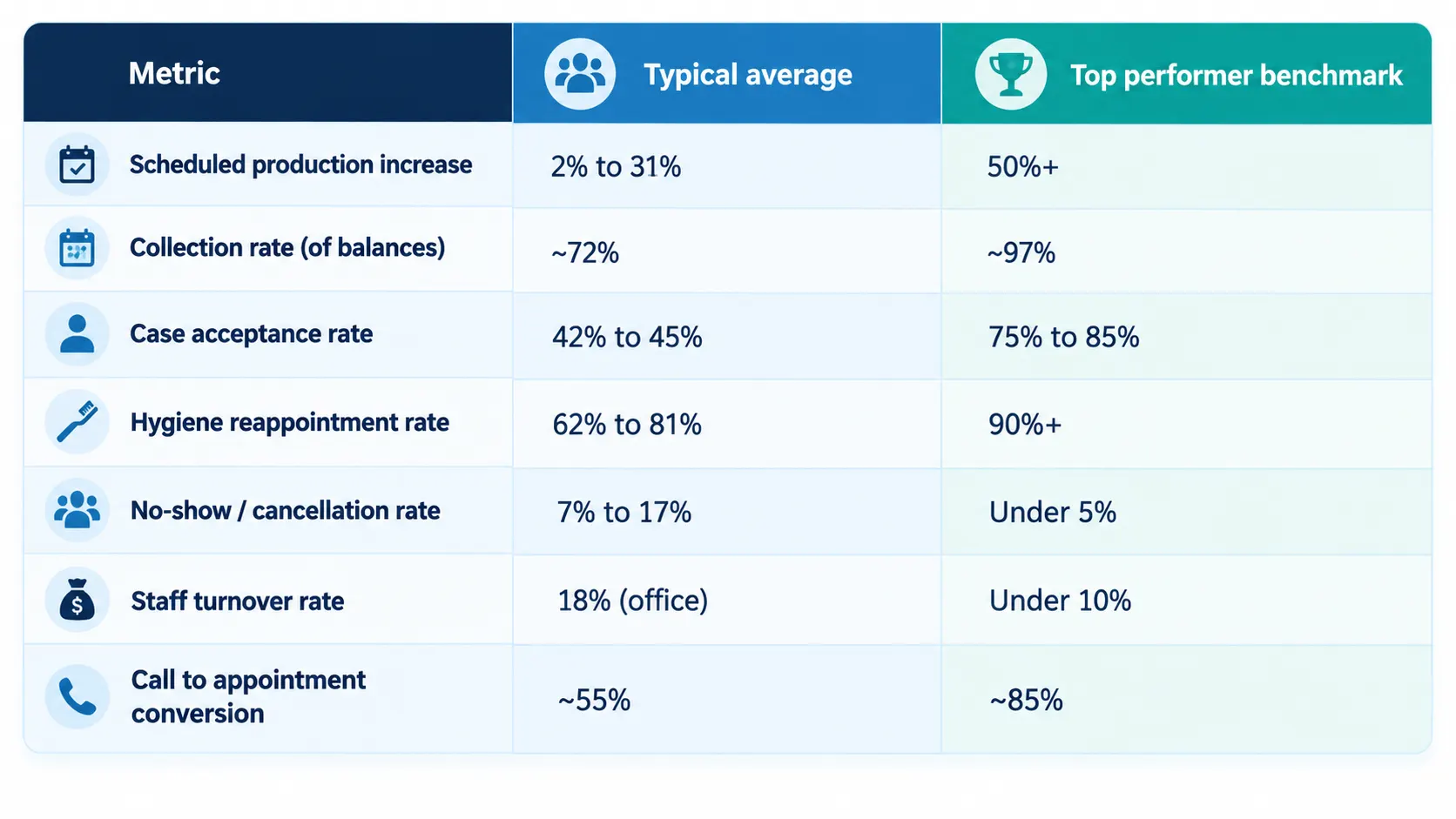
Every one of these gaps between average and top performer represents recoverable revenue, and the only way to know which gap your group is actually facing is to look at the numbers daily rather than discovering them three weeks after the fact.
Knowing what to track solves half the problem. The other half is making sure the data surfaces in a form your team genuinely opens every morning instead of ignoring.
Centralize the data first. For most multi location groups, the numbers live scattered across practice management software, billing platforms, marketing tools, and payroll systems, and a centralized dashboard removes the hours someone otherwise spends manually stitching reports together each morning. Then build views by role rather than one generic report for everyone: office managers need their single location, regional directors need their cluster, and owners need a high level view with the ability to drill into any specific office. Automate the morning briefing so leaders already know yesterday's performance and today's schedule before the day starts, rather than reconstructing it from memory. Set benchmarks by location, not group average, since a suburban family practice and an urban specialty office shouldn't be judged against identical numbers. And review the data as a leadership team, not just individually, since a short daily check in on the metrics above builds more accountability than any dashboard sitting unopened in a browser tab.
For groups managing this at real scale, our guides on operational challenges specific to multi location dental groups and comparing marketing performance across locations go deeper into the systems side of what's outlined here.
What's the single most important metric for a multi location dental group to track daily?
Production per provider and per location, since almost every other problem, from collections to scheduling to no shows, eventually shows up as a production problem if it goes unaddressed long enough.
How is a good collection rate different for a DSO versus a single practice?
Single practices often benchmark against 98%, but groups with eight or more locations average closer to 72%, with top performers around 97%. The gap tends to widen with scale because billing workflows fragment across offices rather than staying unified.
Why does call handling deserve its own daily tracking instead of folding into new patient numbers?
Because a missed or poorly handled call never becomes a new patient in the first place, so it disappears from marketing data entirely. Tracking answer rate, abandonment, and call to appointment conversion separately is the only way to catch that leak before it shows up as a soft new patient number weeks later.
What's a realistic target for hygiene reappointment rate across a multi location group?
Around 90% is the benchmark top performing groups hit, with anything under 80% worth investigating. The variance between locations on this specific metric tends to be larger than owners expect.
How often should leadership actually review these metrics together?
Daily for the operational numbers, production, collections, scheduling, no shows, and calls, with a weekly rollup for trend review and a monthly session focused on labor cost ratios and location level strategy adjustments.



September 16, 2026
5 min
Learn why dental AI agents lose potential patients and how better conversations, accurate answers, seamless handoffs, and simpler booking can improve conversions.

September 15, 2026
6 min
Compare AI dental receptionists and answering services to understand differences in call handling, appointment booking, coverage, integrations, and front desk support.

September 2, 2026
6 min
Discover the key metrics orthodontists can use to track leads, consultations, treatment starts, marketing costs, and ROI for smarter growth decisions.
Sign Up Now & Someone from Our Team Will Be in Touch Shortly!
Use the form below to send us a message, and we’ll get back to you as soon as we can.
.webp)
Track every marketing dollar and optimize patient conversions with ConvertLens. Gain valuable insights from your campaigns, ensuring you never miss a potential patient. Maximize ROI and grow your practice effortlessly.
-p-500.webp)