September 30, 2026
8 min
Slow lead follow-up can silently drain your dental marketing budget. See where enquiries fall through the cracks and how faster response recovers lost patient value.
May 21, 2026
10 min
Discover how conversion tracking helps dental practices identify missed calls, weak follow-ups, and front desk issues that reduce bookings.
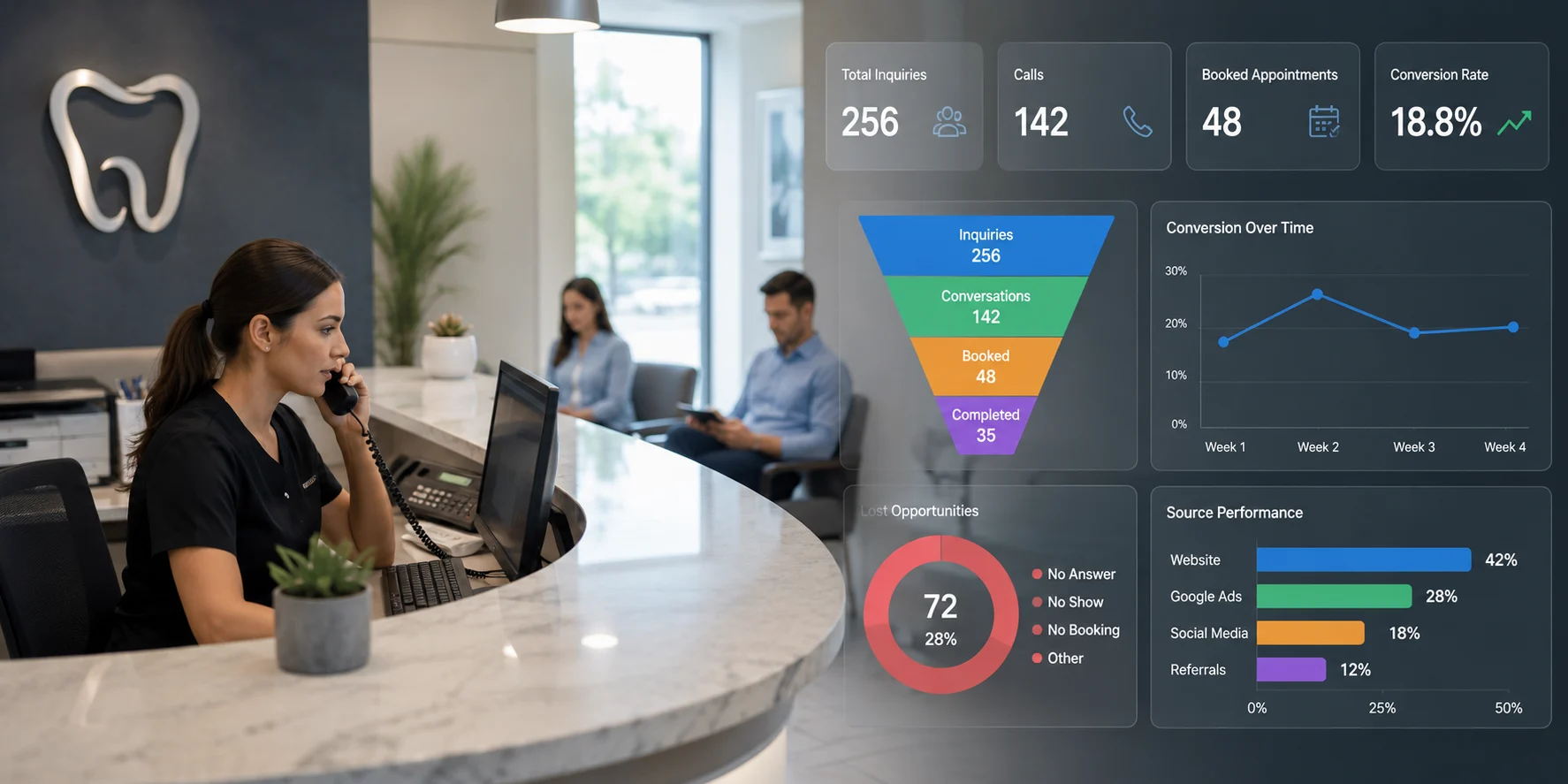
Most dental practices assume missed calls and low bookings are a marketing problem. In reality, a large part of it often sits at the front desk—in how inquiries are handled, followed up, or simply lost in day-to-day pressure. Conversion tracking changes that blind spot into something measurable.
Instead of guessing why patients don’t book after visiting your website or calling your practice, you can actually see where the drop-off happens — whether it’s missed calls, slow response times, poor follow-ups, or breakdowns in the booking process. This makes performance gaps visible instead of hidden.
This guide shows how conversion tracking connects your digital inquiries to real front desk behavior and how it can uncover exactly where patient opportunities are being lost before they turn into appointments.
Conversion tracking is simply the process of measuring what happens after a potential patient gets in touch with your practice. It is not about counting website visits, ad clicks, or form submissions. It is about understanding whether those inquiries actually turn into booked appointments.
Most dental practices are very good at tracking what comes in — how much is spent on Google Ads, how many people visit the website, or how many calls are received. What they rarely track is what happens next: how many of those calls were answered, how many were missed, how many people dropped off after being put on hold, and how many inquiries never converted into bookings after a price discussion or follow-up.
Without conversion tracking, you only see part of the picture. You might know you spent $2,000 on ads and gained some new patients, but you don’t know which campaigns actually generated bookings, which calls were lost, or what each new patient truly cost you. With proper conversion tracking, you can see exactly which ads drive real appointments, how many calls go unanswered, and how efficiently your front desk is converting interest into booked care. With proper ROI attribution insights, you can see exactly which ads drive real appointments, how many calls go unanswered, and how efficiently your front desk is converting interest into booked care. It changes decision-making completely.
You can’t improve what you don’t measure. Most dental practices assume inquiries are being handled properly just because the phone is ringing or the form is being filled. But the real story is in what happens after that first interaction. These four signals show exactly where potential patients are being lost between initial contact and confirmed appointments, and they often reveal gaps that marketing alone cannot fix.
Phone call conversions
Track not just how many calls are coming in, but also which ones are answered, how long they last, what time they occur, and most importantly, how many end in a booked appointment. This is usually where the biggest hidden leakage happens in busy front desks.
Form submission conversions
It’s not enough to know someone filled out a contact form. You need to track how many of those inquiries were actually followed up on and converted into confirmed appointments versus how many were delayed, missed, or never responded to.
Online booking conversions
Many patients begin the booking process online but never complete it. Tracking this helps identify friction in your scheduling flow, whether it’s availability, complexity, or unclear steps that are causing drop-offs before confirmation.
Chat and text conversions.
If your practice uses website chat or SMS-based communication, it’s important to track whether those conversations genuinely lead to bookings or simply end after initial engagement. These touchpoints often look active on the surface but quietly underperform when it comes to actual appointments.
When dental practices install conversion tracking for the first time, five problems show up consistently. Here's what each one looks like in the data and what's causing it at the front desk.
The benchmark for dental practices is answering 90%+ of inbound calls during business hours. Call tracking data regularly reveals practices answering 65–75% at best—meaning one in four or one in three patients who called your practice during the day got no answer.
This usually isn’t caused by a single issue but by everyday operational pressure. A front desk team member may be managing check-ins, check-outs, insurance queries, and incoming calls at the same time. Coverage gaps during lunch hours, short breaks, or peak times when multiple lines ring simultaneously all add up quickly.
Every missed call represents a lost opportunity. At an average patient value of $200–$500 in the first year, even five unanswered calls per day can translate into $1,000–$2,500 in lost potential revenue daily.
What the data shows
Call tracking dashboards often highlight patterns such as 28% of calls going to voicemail between 12 pm and 2 pm and 4:30 pm and 5:30 pm on weekdays.
What’s actually happening?
In many cases, a single receptionist is managing lunch-hour operations without backup support or overflow coverage. During these peak windows, patients who reach voicemail frequently do not call back and instead move on to another dental practice they find on Google.
Call tracking platform captures not just whether calls were answered but how long they lasted. A new patient inquiry that converts to a booked appointment typically takes 3–6 minutes. Calls that last under 90 seconds almost never convert. When call tracking shows a high volume of very short calls, it points to one of two front desk problems: the patient asked about price and the receptionist quoted a number and the call ended, or the receptionist answered, couldn't answer a question, said "let me take a message," and the patient never called back.
The price conversation problem
When a patient asks, "How much does a crown cost?" and gets a flat dollar figure with no context, they almost always don't book. When they get the response, "It depends on your specific situation, and the dentist will give you a full breakdown at your complimentary consultation, and we work with most major insurances"—they almost always do. Call recording reveals which script your team is using. Usually, it's neither of these—it's an unprepared, uncomfortable answer that kills the call.
Website contact forms often give a false sense of progress — a patient submits their details, and it feels like a completed lead. But conversion tracking that compares form submissions to actual booked appointments frequently shows that 20–40% of inquiries never receive a proper follow-up within 24 hours. In some practices, they are not followed up at all.
This is rarely due to negligence. In most cases, it is a workflow issue. Form submissions land in a shared inbox, get mixed with general emails, or arrive outside working hours and are forgotten by the next day. Without clear ownership, these inquiries quietly disappear. Practices that actively monitor dental lead response metrics are often able to identify these gaps much faster and improve follow-up consistency.
To fix this:
If your practice has an online booking portal (through tools like NexHealth, Zocdoc, or Denticon), conversion tracking can reveal how many patients start the booking flow but don't complete it and at which step they drop off. Common abandonment points include insurance verification fields that feel too complex, no available appointments within the next few weeks, mandatory account creation before booking, or unclear appointment type options that patients are unsure how to select.
Each abandonment is a patient who got close to booking and then gave up. They're not lost yet, but without a recovery mechanism (an automated email or text offering to help complete the booking), most of them will book elsewhere.
Conversion tracking often reveals that not all marketing channels perform the same once inquiries reach your front desk. While most practices focus on how many calls or leads each channel generates, the real insight comes from how many of those actually turn into booked appointments.
For example, Google Ads and Google Business Profile inquiries often convert at a higher rate because patients are actively searching with intent and usually call during working hours. On the other hand, channels like Facebook Ads may still generate calls, but a much smaller percentage of those inquiries turn into bookings.
This does not automatically mean those channels are ineffective. In many dental practices, the difference comes down to what happens after the call connects, such as price sensitivity, the type of treatment being discussed, or even the time of day those inquiries come in, when different staff members are handling the phone.
Conversion tracking helps you see this clearly. Instead of judging channels only by lead volume, you start understanding which sources actually bring in booked patients and which ones need better front desk handling or follow-up processes to improve performance. Reviewing broader marketing performance benchmarks can also help practices understand which acquisition channels deserve more investment.
Data changes the nature of these conversations entirely. You're no longer giving feedback based on feelings—you're reviewing facts together.
One of the most common challenges practice owners describe is how to address front desk performance without it becoming a personal or emotional conversation. The answer is to make the conversation about the data, not about the person. When you pull up a dashboard that shows your answer rate dropped to 61% on Tuesday afternoon, your conversation becomes "I want to understand what was happening Tuesday afternoon so we can solve it together," not "I think you've been missing calls."
The weekly conversion review: what to look at and with whom
A brief weekly conversion review—15 minutes, with your front desk lead—is one of the highest-leverage management habits a dental practice can develop. Here's what to cover:
When you introduce call recording and tracking to your team, frame it clearly as a coaching tool for the entire practice, not as a monitoring system for individual staff members. Saying, “We’re going to use these recordings to improve how we handle new patient calls as a team,” lands very differently from saying, “Your calls are being recorded.” The first approach creates trust, collaboration, and buy-in. The second often creates defensiveness and resistance.
Identify your most common patient enquiry types
Review your call data and identify the enquiries your practice receives most often. For most dental practices, this usually includes new patient enquiries, treatment-specific calls such as Invisalign or dental implants, and emergency dental calls. Build simple call handling processes around each one using real conversations from your practice. Many practices also combine this with practice growth reporting metrics to identify which enquiry types generate the strongest long-term patient value.
Create a library of successful patient calls
Save recordings of calls that resulted in booked appointments, especially same-day or next-day bookings. These become practical training examples that show your team what successful patient conversations actually sound like in your own practice environment.
Run monthly call review sessions with the team
Set aside 20–30 minutes each month to listen to a small number of real calls together. Review both successful and missed booking opportunities. Keep the focus on learning, consistency, and improving patient communication rather than blaming individual staff members.
Set clear conversion performance targets
Once you have baseline tracking data, set measurable goals such as call answer rate, booking conversion rate, and form response time. Reviewing these regularly helps your team understand what strong front desk performance actually looks like. Multi-location practices should also compare trends across offices using location-based analytics reporting to identify staffing or workflow inconsistencies.
Recognize improvement and consistency openly
When team members consistently improve booking rates, response times, or call handling, acknowledge it clearly. Positive reinforcement creates much stronger long-term engagement than constant correction.
How do I know if my dental front desk has a conversion problem?
The biggest signs are increasing marketing spend, more incoming calls or enquiries, but little growth in actual booked appointments. If your schedule still has gaps while the front desk feels “busy all day,” the issue is often conversion, not marketing. Running call tracking for 30 days usually reveals the problem quickly, especially if your answer rate is below 85%, new patient calls are very short, or web enquiries are not being followed up promptly.
What is a good call conversion rate for a dental practice?
For inbound new patient calls, a good call-to-appointment conversion rate is 60–70%. A rate below 45% is a strong signal that something in the phone handling process is losing patients. A rate above 75% consistently is excellent and typically reflects a well-trained front desk with documented scripts for the most common call types. Your answer rate, the percentage of calls that are actually picked up during business hours, should be at or above 90%. Anything below 80% is costing you patients, every single day.
Is it legal to record patient calls at a dental practice?
Yes — as long as proper disclosure and compliance measures are in place. Most dental practices use a short automated message such as, “This call may be recorded for quality and training purposes,” at the start of calls. However, call recording laws vary by state, especially in two-party consent states like California and Florida, where both parties must be informed. Check your specific state's wiretapping statutes, and consult your practice attorney if you're unsure. Since patient conversations may include protected health information, recordings should also be stored securely and handled in compliance with HIPAA guidelines using a HIPAA-compliant call tracking provider.
Does conversion tracking only apply to phone calls, or does it cover online bookings too?
Conversion tracking covers every major patient contact point, not just phone calls. A complete dental practice setup tracks phone enquiries, contact form submissions, online booking activity, website chat or text conversations, and even enquiries coming through your Google Business Profile. Phone calls usually make up the largest share of new patient enquiries for most dental practices, which is why call tracking is often the starting point, but understanding the full patient journey requires tracking all channels together.



September 30, 2026
8 min
Slow lead follow-up can silently drain your dental marketing budget. See where enquiries fall through the cracks and how faster response recovers lost patient value.

September 30, 2026
10 min
Dental AI agents can screen patient inquiries by treatment need, urgency, insurance, and location, handing your front desk only booking-ready leads.

September 27, 2026
8 min
See the 10 key KPIs dental practices should track for AI receptionists, including call resolution, booking rates, cost per appointment, and ROI.
Sign Up Now & Someone from Our Team Will Be in Touch Shortly!
Use the form below to send us a message, and we’ll get back to you as soon as we can.
.webp)
Track every marketing dollar and optimize patient conversions with ConvertLens. Gain valuable insights from your campaigns, ensuring you never miss a potential patient. Maximize ROI and grow your practice effortlessly.
-p-500.webp)