September 30, 2026
10 min
Dental AI agents can screen patient inquiries by treatment need, urgency, insurance, and location, handing your front desk only booking-ready leads.
August 13, 2026
8 min
Compare virtual and in-house treatment coordinators on cost, follow-up, workflow, and case acceptance to find the right model for your dental practice.

Dental practices are under more pressure than ever to turn treatment plans into accepted cases. Patients have more options, treatment costs can be a major consideration, and front desk teams are already balancing calls, scheduling, insurance questions, and patient follow-up. That makes having someone focused on treatment coordination increasingly important.
Practice owners and dental groups usually take one of two paths. They hire an in-house treatment coordinator who works directly from the office. Or they use a virtual treatment coordinator who can follow up with patients remotely, answer questions, and help move treatment plans toward acceptance. Both approaches can work, but the costs, workflow, and results can look very different.
Understanding that difference is what this article is about. We will compare virtual and in-house treatment coordinators in terms of cost, responsibilities, patient follow-up, and, most importantly, case acceptance, so you can decide which model makes the most sense for your practice.
A dental treatment coordinator helps patients move from diagnosis to scheduled treatment. They explain recommendations, discuss costs and payment options, answer non-clinical questions, schedule treatment, and follow up with patients who have not moved forward.
Typical responsibilities include:
• Reviewing treatment recommendations
• Explaining treatment in patient-friendly language
• Discussing fees, insurance estimates, and payment options
• Scheduling consultations and treatment
• Following up on unscheduled treatment
• Tracking outstanding treatment plans
• Documenting patient communication
• Reporting case acceptance to practice leadership
• Escalating clinical questions to the dentist or clinical team
A treatment coordinator should not diagnose patients, change treatment recommendations, or provide advice beyond their training and legal scope. Their job is simple: make treatment easier to understand and easier to start.
For virtual TCs, clear escalation processes are especially important. Clinical, financial, privacy, and urgent care questions should always reach the right, in-office team member.
A virtual treatment coordinator (VTC) works remotely and helps patients understand recommended treatment, answer questions, discuss financial options, schedule appointments, and follow up through phone, video, text, or email.
A VTC may be
• A remote employee
• An independent contractor
• Part of a dental staffing agency
• A centralized coordinator supporting multiple locations
• A virtual dental assistant with treatment coordination responsibilities
The biggest advantage is flexibility. A virtual TC can follow up outside normal office hours, which can make a real difference for patients who cannot talk during the workday.
For the model to work well, practices need:
• Secure technology and patient data protection
• Clear workflows and escalation processes
• Access to accurate clinical information
• Practice management system integration
• Dental-specific training
• Consistent quality checks and communication standards
A virtual TC should support the treatment process without making clinical decisions. Clinical questions should always go back to the appropriate dentist or clinical team member.
An in-house treatment coordinator works directly from the dental office and supports patients and the clinical team face to face.
They can:
• Join treatment presentations
• Discuss treatment and financial options in person
• Help patients schedule before they leave
• Coordinate with the dentist in real time
• Answer questions and address concerns immediately
• Help with complex or high-value treatment plans
This model can work especially well for implants, full mouth rehabilitation, cosmetic dentistry, Invisalign, and other treatments that often require more discussion and personal attention.
The tradeoff is cost and availability. An in-house TC works within the office's scheduled hours and can easily get pulled into front desk, insurance, or other administrative tasks. That can reduce the time they actually spend coordinating treatment.
An in-house treatment coordinator can cost more than the advertised salary. Pay varies by location, experience, and responsibilities, with U.S. base salaries often falling around $47,000 to $65,000 per year.
You also need to account for:
• Payroll taxes and benefits
• Paid time off
• Recruiting and training
• Software and equipment
• Management time
• Performance bonuses
• Turnover and coverage costs
Once these expenses are included, a coordinator earning $55,000 could cost the practice closer to $65,000 to $85,000 annually.
Turnover can add even more. When a TC leaves, the practice loses time and productivity while recruiting and training a replacement. During that gap, follow-up can slow down and treatment opportunities can be missed.
So when comparing an in-house TC with a virtual TC, don't look at salary alone. Compare the full cost against case acceptance, follow-up capacity, and the revenue each model helps generate.
A virtual treatment coordinator can cost less than an in-house TC, depending on experience, location, hours, and services.
Typical pricing includes the following:
• Offshore or fractional VTC: $8 to $13 per hour
• U.S.-based virtual agencies: $2,000 to $4,000 per month
• Specialty VTC programs: Pricing varies for implants, full arch, and orthodontic cases.
The cost may include training, technology, PMS integration, quality checks, management, and reporting.
The cheapest option is not always the best value. A trained VTC who follows up consistently and helps patients accept treatment can deliver far more value than a lower-cost coordinator who needs constant supervision.
The better comparison is total cost versus accepted treatment and case acceptance.
AI tools can handle reminders and basic scheduling, but they should support rather than replace a human treatment coordinator for complex or high-value cases.
The table below shows the typical differences between an in-house and virtual treatment coordinator. Actual costs vary based on location, hours, responsibilities, and case mix.
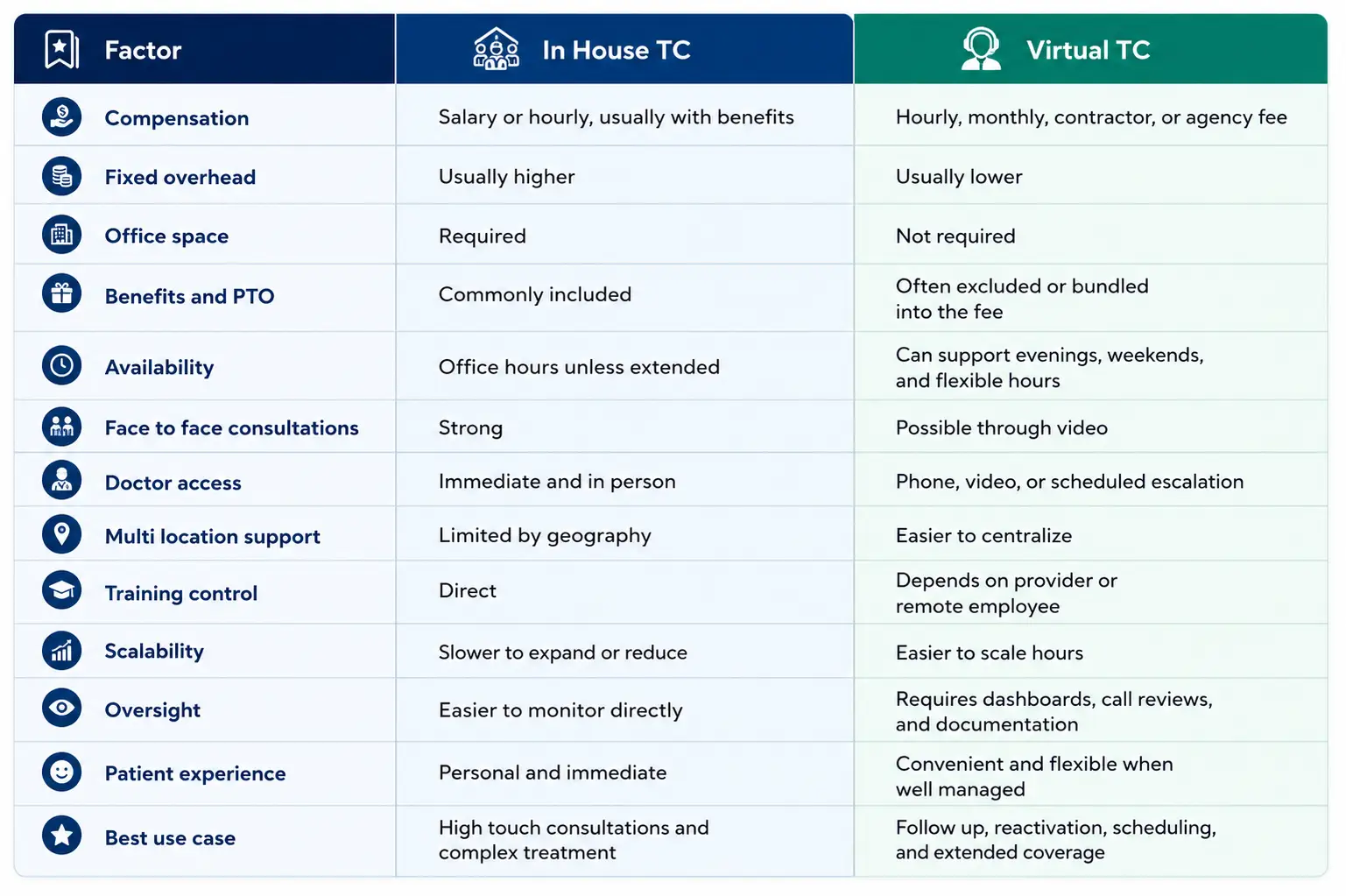
In most cases, a virtual treatment coordinator carries a lower direct cost, simply because the practice isn't providing office space, full benefits, or a guaranteed 40-hour week. A virtual model is often especially cost-effective when a practice really only needs 10 to 25 hours a week of dedicated treatment follow-up, which describes a lot of solo and two-doctor practices.
An in-house coordinator tends to be more economical when:
A virtual coordinator tends to be more economical when:
The correct comparison is never "salary versus hourly rate." It's:
Net return = incremental completed production minus fully loaded coordinator cost
Case acceptance can mean different things from one practice to another. A team might say, "We're at 70% case acceptance," but that number could include scheduled treatment, deposits, partial acceptance, or treatment that was simply discussed.
Before comparing a virtual TC with an in-house TC, define exactly what counts as an accepted case.
Case acceptance rate = (accepted cases ÷ presented cases) × 100
Your practice should clearly define what "accepted" means. A stronger definition could include treatment that is scheduled, a deposit is paid, or another documented commitment is made within a set timeframe.
Production acceptance rate = (accepted treatment value ÷ presented treatment value) × 100
This matters because eight small fillings are not the same as one $15,000 full-arch case. Headcount alone can hide that difference.
Case acceptance varies widely by practice, treatment type, and how it is measured. A commonly referenced range is around 45% to 60%, while high-performing practices can achieve significantly higher rates on certain procedures.
Preventive care usually has the highest acceptance, while larger treatments such as implants, full mouth rehabilitation, and orthodontics often require more follow-up.
Don't stop at the headline acceptance rate. Also track:
• Treatment plans presented
• Treatment value presented and accepted
• Acceptance within 24 hours, 30 days, and 90 days
• Deposit or financing completion
• Treatment start rate
• Cancellation and no-show rate
• Days from diagnosis to treatment
• Unscheduled treatment value
• Follow-up attempts and response rate
• Production per treatment plan
For a broader view of the metrics that matter across a dental practice, practices can also review dental practice performance indicators.
Most importantly, measure completed treatment, not just scheduled treatment. A case that gets scheduled but is repeatedly cancelled is not a true win. Your scorecard should ultimately show whether the coordinator helps turn appropriate treatment recommendations into completed care.
Yes, a virtual treatment coordinator can improve case acceptance, especially when the main problem is slow or inconsistent follow-up.
Patients often need more time before saying yes. They may want to:
A virtual TC can handle these follow-ups consistently without adding more work to an already busy front desk. Phone and video conversations can also give patients more space to ask questions and make a decision.
Virtual coordination can work especially well for implants, full-arch treatment, cosmetic cases, and other high-value procedures where follow-up matters.
However, it can fall short when:
The channel matters less than the patient experience. A virtual TC works when communication feels personal, informed, and consistent.
Practices that want to strengthen the follow-up process can also explore dental lead nurturing strategies, particularly when patients need multiple touchpoints before taking action.
An in-house TC can improve acceptance by helping patients immediately after the dentist presents treatment. They can answer questions, explain financial options, notice hesitation, and bring the dentist back into the conversation when needed.
A typical workflow looks like this:
That final step is a major advantage. There is no waiting for a callback or giving the patient time to lose momentum.
For practices focused on improving the transition from consultation to treatment, dental consultation conversion can provide additional context on the factors that influence patient decisions.
The main challenge is utilization. If the TC spends most of the day handling phones, insurance, or front desk duties, the practice may be paying for a treatment coordinator without getting enough dedicated treatment coordination.
Whether your coordinator works remotely or in the office, case acceptance comes down to a few basics:
Consistent measurement is also essential. Practices that want to understand whether treatment coordination is actually producing better outcomes can use treatment acceptance tracking to evaluate accepted treatment, follow-up activity, and production more systematically.



September 30, 2026
10 min
Dental AI agents can screen patient inquiries by treatment need, urgency, insurance, and location, handing your front desk only booking-ready leads.

September 27, 2026
8 min
See the 10 key KPIs dental practices should track for AI receptionists, including call resolution, booking rates, cost per appointment, and ROI.

September 24, 2026
6 min
An AI receptionist checks real-time schedules, matches providers and rooms, and confirms before updating, helping dental practices reschedule appointments without double-booking.
Sign Up Now & Someone from Our Team Will Be in Touch Shortly!
Use the form below to send us a message, and we’ll get back to you as soon as we can.
.webp)
Track every marketing dollar and optimize patient conversions with ConvertLens. Gain valuable insights from your campaigns, ensuring you never miss a potential patient. Maximize ROI and grow your practice effortlessly.
-p-500.webp)