September 21, 2026
9 min
Improve dental patient experiences with engagement technology that streamlines scheduling, strengthens retention, and eases front-desk workload.
September 21, 2026
7 min
Learn how AI receptionists handle dental emergency calls, when they should involve your team, and the safety protocols needed to protect patients.

What if every dental emergency call could be answered right when a patient needed help? Clear, calm, and ready to guide them to the right next step? That’s exactly where AI receptionists can support dental practices. They can handle incoming calls, ask patients about their concerns, and provide the information your practice has approved while your team focuses on in-office care.
Not sure how much an AI receptionist can safely handle during a dental emergency? You’re not alone. When practices start using AI to manage patient calls, one of the first questions is where it fits when a patient needs urgent attention. That’s why it’s important to understand what an AI receptionist can handle, when it should involve your team, and how you can set clear safety guidelines.
Whether you’re exploring AI for your front desk or already using a dental AI receptionist, these answers can help you understand how it can support emergency calls while keeping patient safety at the center.
Many dental AI receptionists struggle with emergency calls because they are built to answer questions and take messages, not recognize urgency. They ask routine questions such as, "What's your name and phone number?" without understanding what the patient is experiencing. A severe toothache can end up receiving the same response as a routine cleaning request, part of why missed and mishandled calls quietly drain practice revenue long before a practice realizes it.
The problem often starts with setup. Some systems rely mainly on basic website information, such as services, office hours, and appointment types. If your practice has not clearly defined emergency symptoms, triage questions, escalation rules, and after-hours instructions, the AI may not know how to respond when a patient needs urgent attention.
Dental emergencies also require more than a standard script. Facial swelling, uncontrolled bleeding, dental trauma, and a knocked-out tooth each call for different questions and next steps. An AI receptionist must understand your practice’s emergency guidelines and recognize when it should stop handling the conversation and involve your team.
Next-gen dental-specific AI voice receptionists like Eva are pros at handling dental emergencies. Eva can manage structured triage, attempt to find same-day appointment slots, and escalate calls according to your on-call protocol. It can recognize relevant warning signs, ask focused questions, provide approved guidance, and route urgent calls to the right person when necessary.
An AI receptionist for dental offices should recognize when a patient’s call needs more than routine scheduling help. This may include activating your practice’s emergency protocol when certain words, symptoms, or details point to a possible dental emergency, such as
When these signals appear, the AI receptionist should shift into emergency-handling mode. Instead of continuing with routine booking questions, it should ask only the essential questions approved by your practice, provide clear next-step guidance, and alert or transfer the call to your dental team when needed. It should never diagnose the condition or delay emergency medical care.
Strip away the marketing language. When a patient calls your dental office with an urgent concern, a well-configured AI receptionist should follow a clear, four-step process every time, even at 3 a.m.
“My tooth is hurting badly, my face is starting to swell, and I don’t know what to do.”
The AI should recognize that this is more than a routine scheduling request. Words such as “severe pain,” “bleeding,” “swelling,” “broke my tooth,” “knocked out,” or “trauma” can signal a possible dental emergency.
Instead of continuing with standard booking questions, the system moves into the emergency workflow your practice reviewed and approved during setup. You define which situations require urgent handling, such as significant facial swelling, uncontrolled bleeding, dental trauma, or certain post-operative concerns. The AI follows those rules rather than making its own clinical judgment.
“What happened, when did it start, and how bad is the pain?”
The AI can ask focused questions to gather the information your team needs. This may include what happened, when the symptoms began, the patient's pain level, whether there is swelling, fever, or bleeding, whether the caller is an existing patient, and the best callback number, much like the details practices already gather to improve patient appointment confirmations and reduce no-shows.
The purpose is to collect clear facts, not to diagnose the problem or tell the patient how serious their condition is.
“Can someone see me today, or do I need to speak with the on-call dentist?”
After collecting the details, the AI voice agent follows your practice's approved routing rules. Depending on the situation, it may check for a same-day emergency appointment, arrange urgent follow-up, handle a less urgent request during normal office hours, or escalate the call to your team. Getting this step right also means avoiding the common scheduling mistakes many dental practices make, which can turn an urgent slot into a missed one.
Your protocol should clearly identify situations that require immediate human attention. Severe or uncontrolled bleeding, significant facial swelling that may affect breathing or swallowing, serious dental trauma, and certain post-operative complications should not be treated like routine appointment requests.
“I need help now. Can you connect me with someone who can guide me?”
A genuine emergency should not simply end in a voicemail box. If your practice has an on-call process, the AI can follow it by routing the call or sending the patient’s details to the designated provider or team member.
You can define who receives the escalation, what information is shared, and what should happen if the first contact does not respond. For situations that may involve a serious medical emergency, such as difficulty breathing or swallowing, the patient should be directed to appropriate emergency medical care according to your practice’s approved instructions.
The interaction can also be recorded and logged, giving your team a clear account of what the patient reported, how the call was handled, and what action was taken, the same kind of visibility a dental CRM gives you across every patient touchpoint, and something a broader lead management system can flag for timely follow-up.
No system is perfect. Sometimes AI misjudges call urgency. A homeowner describes a "small leak" that turns out to be a significant pipe failure. Or someone with severe chest pain downplays symptoms and says they want an appointment for a checkup.
Good AI systems have fallback protocols. First, they ask clarifying questions. "You mentioned a leak. Is water actively flowing, or is it a slow drip?" Second, they include an override option. At any point, the caller can say "This is urgent" or "I need to speak to someone now," and the AI escalates immediately. Third, they log everything. If a business later reviews a call and realizes it should have been escalated, they can update the AI's training to catch similar scenarios next time.
Well-trained systems route the large majority of emergency calls correctly on the first attempt, roughly on par with an experienced human receptionist and far ahead of voicemail, which offers no immediate triage at all because the caller simply leaves a message. Because the AI triages and routes rather than diagnoses, the safety net is the override and escalation path above, not a claim of perfect detection. Treat any precise accuracy figure a vendor quotes with caution, especially for life-safety calls.
A dental AI receptionist can give your practice a reliable first response when patients call with urgent concerns, but safe handling depends on more than switching the system on. Your team needs to define the warning signs, emergency questions, escalation rules, appointment options, and after-hours instructions the AI should follow.
Once those details are in place, the receptionist can recognize possible emergencies, collect useful information, check appropriate appointment options, and involve your team when human judgment is needed. It should support your clinical and front desk teams, not diagnose patients or replace professional care.
The best way to assess any dental AI receptionist is to test it with realistic calls, review the transcripts, and update the workflow as new situations arise. A system that follows your practice’s protocols consistently can help your patients reach the right next step, even when your office is closed.
A 15-minute walkthrough of Eva using real dental emergency scenarios. See how it recognizes urgent calls, asks the right questions, checks appointment options, and follows your practice’s escalation rules when your team needs to step in.
We’ll show you what emergency call handling looks like with Eva, so you can see how our virtual front desk for dental practices fits into your front desk workflow.



September 21, 2026
9 min
Improve dental patient experiences with engagement technology that streamlines scheduling, strengthens retention, and eases front-desk workload.
September 21, 2026
7 min
Learn how AI receptionists handle dental emergency calls, when they should involve your team, and the safety protocols needed to protect patients.
September 16, 2026
5 min
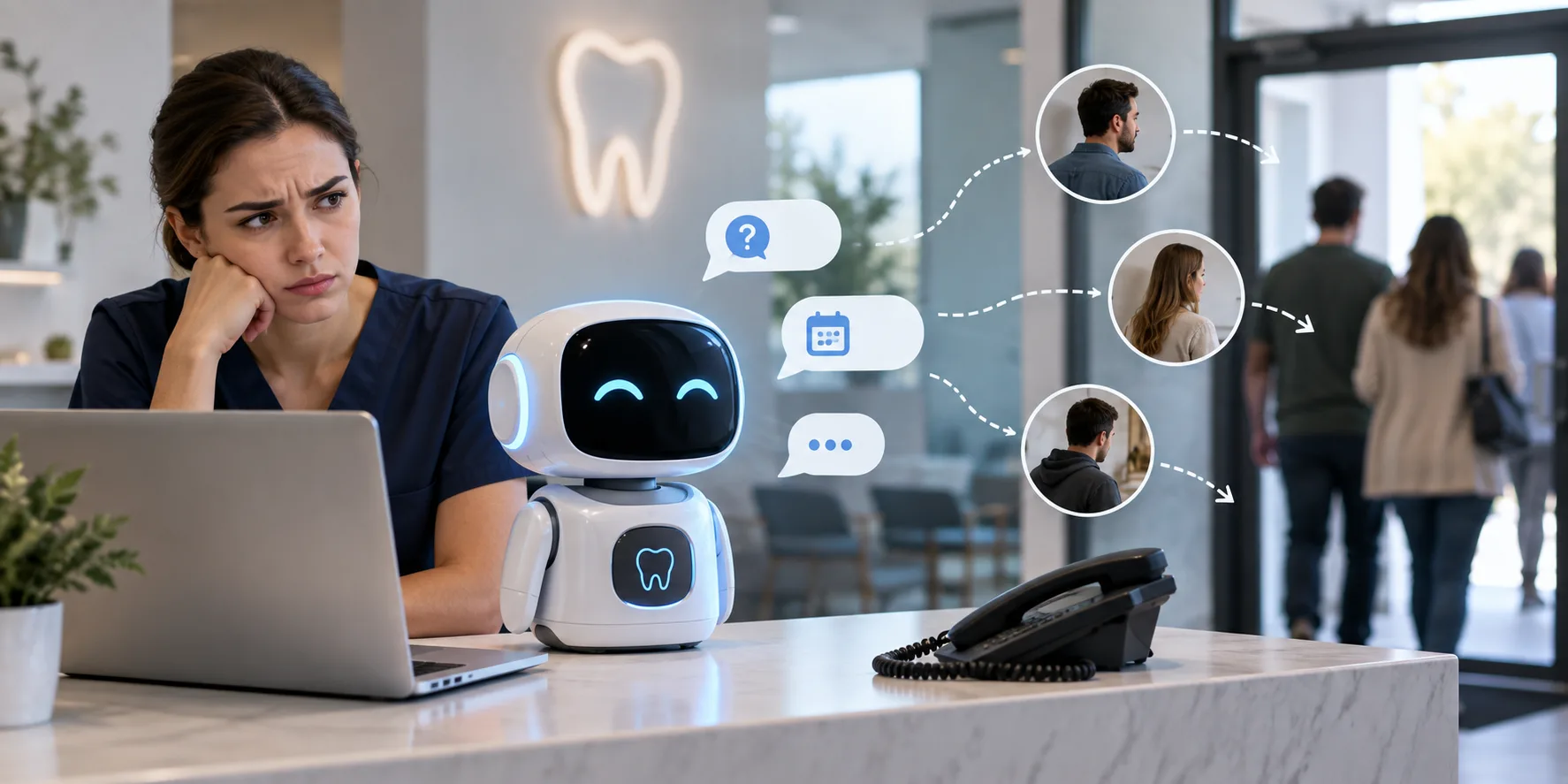
Learn why dental AI agents lose potential patients and how better conversations, accurate answers, seamless handoffs, and simpler booking can improve conversions.
Sign Up Now & Someone from Our Team Will Be in Touch Shortly!
Use the form below to send us a message, and we’ll get back to you as soon as we can.
.webp)
Track every marketing dollar and optimize patient conversions with ConvertLens. Gain valuable insights from your campaigns, ensuring you never miss a potential patient. Maximize ROI and grow your practice effortlessly.
-p-500.webp)