September 24, 2026
6 min
An AI receptionist checks real-time schedules, matches providers and rooms, and confirms before updating, helping dental practices reschedule appointments without double-booking.
September 23, 2026
6 min
AI receptionists can explain insurance verification, collect plan details, clarify billing terms, and answer payment questions, then pass complex account issues to your billing team.

Dental insurance and billing questions are a front desk workload problem that AI receptionists are well-suited to help handle. The questions come in all day: “Do you accept my insurance?" “What will my cleaning cost?" “Is this treatment covered?" and “Why is there a balance on my account?” Your team may spend valuable time checking benefits, explaining payment policies, reviewing estimates, and answering the same questions repeatedly. As call volumes rise, hold times grow, staff workloads increase, and patients can become frustrated before they even schedule an appointment. Dental practices face the same challenge every day: keep communication responsive, reduce pressure on the front desk, and give patients clear answers about their financial responsibilities.
Dental insurance and billing questions have become a daily cost pressure for practices. Your Patients want immediate answers about accepted insurance plans, estimated treatment costs, deductibles, copays, outstanding balances, and payment options. Each of these questions can require a front desk team member to check practice policies, review patient details, explain financial responsibilities, or contact an insurance provider before giving a clear answer.
The pressure grows when call volumes rise. Your front desk teams spend more time repeating the same explanations, patients wait longer for responses, and appointment conversations can stall before they ever reach scheduling. In that scenario, your practice faces a familiar tension: keep financial communication accurate, protect staff time, and give patients enough clarity to move forward with confidence.
The cost compounds across three areas:
Labor pressure, scheduling delays, and financial uncertainty make insurance and billing communication an operational issue, rather than just an administrative task.
For insurance and billing questions, the AI receptionist works within the information your practice has approved. It understands your insurance policies, billing rules, and payment options and knows when a question needs to be passed to the right team member before giving an answer.
A patient calls asking, “Can you check if my insurance covers this?” The AI receptionist can walk them through your practice’s verification process, tell them what information to provide, and explain what happens next. It can ask for their insurance card, the subscriber’s name, and date of birth, then remind them that verification does not guarantee payment.
This matters because insurance questions can eat up a surprising amount of front desk time. Instead of having your team repeat the same instructions on every call, the AI handles the routine questions and gives patients a clear next step, something a traditional answering service can't always do.
The AI can also keep the conversation moving without overstepping. It explains your practice’s process, sets expectations around coverage, and hands the question to your team when a patient needs a specific benefits check or has a more complicated insurance issue.
A patient starts a conversation with, “What information do you need to verify my insurance?” The AI receptionist can collect the basics upfront, including:
An AI receptionist can gather:
Instead of your front desk going back and forth for each missing detail, the AI gathers everything in one conversation and passes it along through your approved, secure intake process. That means your team has the information they need before they step in, without turning every insurance question into another task on the front desk’s plate.
Here's where a lot of practices get tripped up, so it's worth training your AI carefully on this one. "Do you accept my insurance?" can mean several different things:
A safe, accurate AI response sounds like:
For example, we currently participate with [Plan Name] PPO plans. Participation can vary by specific plan and location, so our team will confirm your exact network status when we verify your benefits.
That's much safer than a flat "Yes, we take that insurance," which can create a billing dispute if the patient's specific plan turns out to be different.
Patients ask about deductibles, copays, coinsurance, and annual maximums all the time. An AI receptionist can explain these terms in simple, straightforward language:
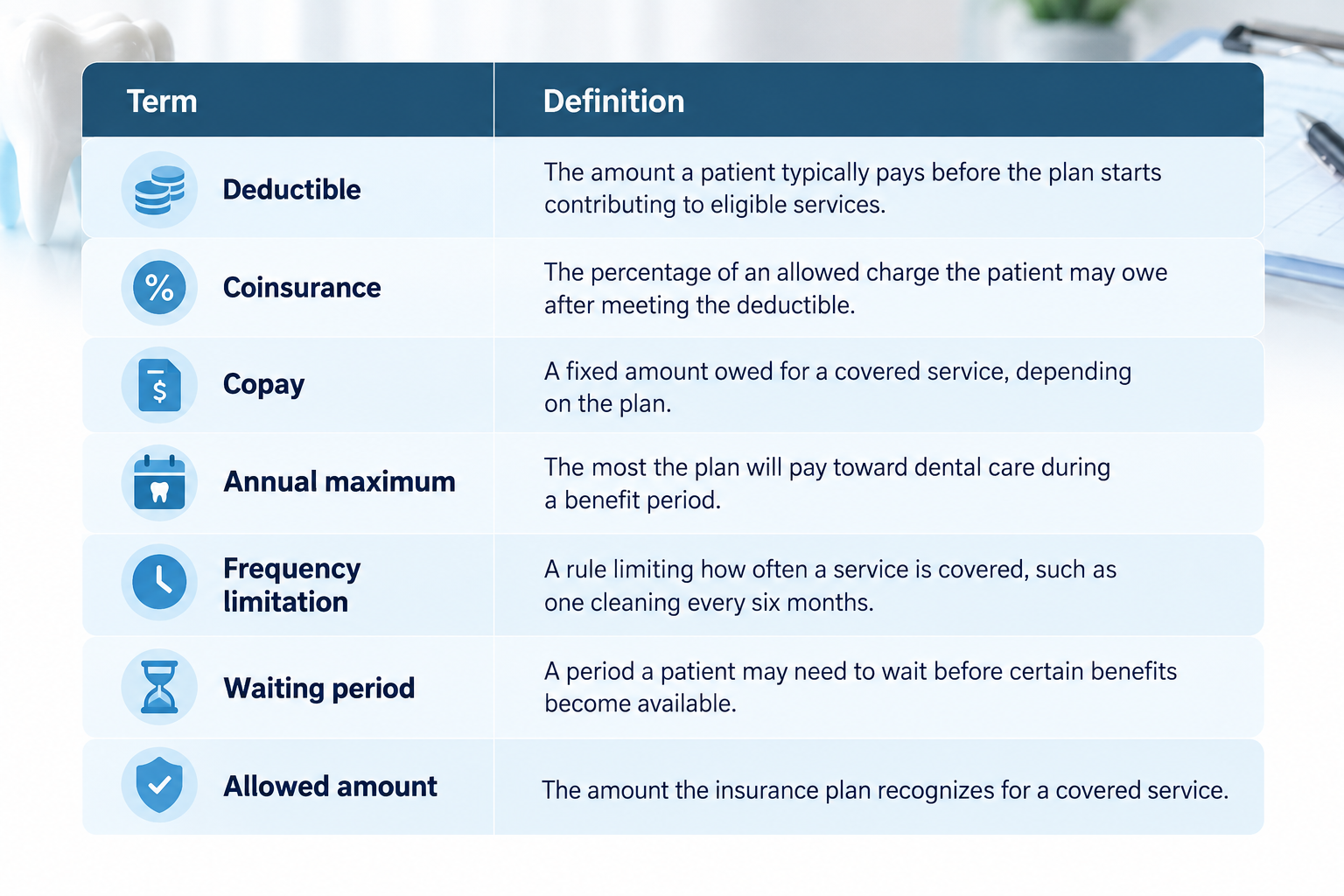
The AI should keep these explanations general unless it has access to verified, patient-specific information from an approved source.
This is another area where an AI receptionist can take a steady stream of repetitive work off your front desk. It can help patients with:
For example, you can make a payment securely through our online patient portal. If you have questions about your balance or want to discuss a payment arrangement, I can connect you with our billing team.
There is one important boundary: the AI should never ask a patient to share a full card number, CVV, or password in a regular chat or voice conversation. If the patient needs to make a payment, the AI should direct them to the practice's approved, secure payment system, in line with your HIPAA-compliant communication practices.
“Why did I get a bill if I had insurance?” It’s a question dental teams hear often, and it can be confusing for patients when they expect their insurance to cover everything.
An AI receptionist can explain the common reasons a statement may have been sent without trying to interpret the patient’s account. For example, a balance may be left after insurance processes a claim, a service may not be covered, the claim may still be under review, or the insurance company may need additional information.
A response could be as simple as
“Your statement may show a balance that was left after your insurance processed the claim. There are also times when a service isn’t covered or the insurance company is still reviewing the claim. If you’d like, I can connect you with our billing team so they can take a look at your account and explain exactly what the balance is for.”
That gives the patient a useful answer instead of leaving them wondering why a bill showed up. If the question involves their specific balance, claim, or insurance decision, the conversation can then move to a member of the billing team who can review the account directly.
Not every insurance or billing question should be handled by AI. Some conversations need a person who can look at the patient’s account, understand the full situation, and make the right call.
The AI receptionist should hand the conversation to a team member when:
In these situations, the AI does not need to keep the conversation going just for the sake of answering. It can briefly capture what the patient needs, pass along the relevant details, note how the patient would prefer to be contacted, and get the right person involved. The patient gets a smoother handoff, and the front desk does not have to start the conversation all over again.
Insurance and billing questions can quickly turn into a front desk bottleneck. One patient wants to know if you accept their plan, another asks what they need for insurance verification, and someone else is calling about a balance on their account. The AI receptionist can handle these routine questions using the information and rules your practice has already approved. Before rollout, it helps to know what to measure before implementing an AI receptionist.
That means patients get answers to common questions without waiting for a team member to pick up the phone. Your staff can spend less time repeating the same information and more time helping patients who need a conversation with a real person.



September 24, 2026
6 min
An AI receptionist checks real-time schedules, matches providers and rooms, and confirms before updating, helping dental practices reschedule appointments without double-booking.
September 23, 2026
6 min
AI receptionists can explain insurance verification, collect plan details, clarify billing terms, and answer payment questions, then pass complex account issues to your billing team.

September 21, 2026
9 min
Improve dental patient experiences with engagement technology that streamlines scheduling, strengthens retention, and eases front-desk workload.
Sign Up Now & Someone from Our Team Will Be in Touch Shortly!
Use the form below to send us a message, and we’ll get back to you as soon as we can.
.webp)
Track every marketing dollar and optimize patient conversions with ConvertLens. Gain valuable insights from your campaigns, ensuring you never miss a potential patient. Maximize ROI and grow your practice effortlessly.
-p-500.webp)