September 16, 2026
5 min
Learn why dental AI agents lose potential patients and how better conversations, accurate answers, seamless handoffs, and simpler booking can improve conversions.

September 15, 2026
6 min
Compare AI dental receptionists and answering services to understand differences in call handling, appointment booking, coverage, integrations, and front desk support.

Dental practices are dealing with more calls, more patient questions, and higher expectations than ever. Patients want quick answers when they call about an emergency appointment, Invisalign, insurance, or simply finding a time that works. When the front desk is already busy, even one unanswered call can mean one less booking.
Traditional answering services have helped practices manage this pressure for years. A human agent can pick up the phone, take a message, answer basic questions, and pass the details to your team. But the model still depends on someone being available to handle the next step.
AI dental receptionists take a different approach. Instead of simply answering and recording calls, they can understand patient intent, respond to routine questions, collect details, and handle appointment bookings in real time, including outside normal office hours.
So, is an AI dental receptionist really a better fit than a traditional answering service? In this guide, we’ll break down how both work, where each has an advantage, and what dental practices should consider before choosing one.
A traditional answering service gives your dental practice access to live call-center operators who answer on your behalf, usually when your office is closed or your front desk cannot get to the phone. Operators receive basic training in dental terminology and your practice protocols, then follow your predetermined scripts when speaking with patients.
They can typically:
The biggest advantage is the human connection. The limitation is that the service still depends on operator availability, set coverage hours, and your team handling the next step for many calls.
An AI dental receptionist takes a more hands-on approach. It can answer calls automatically, understand what a patient needs, and respond based on the information, rules, and scheduling access you provide.
It can typically:
That is where the two approaches really differ. A traditional answering service is there to answer and relay. An AI dental receptionist can answer, understand, and take action.
Most dental practices have some form of call support in place, but very few have a clear picture of what happens after a patient gets through. The terms "answering service" and "AI dental receptionist" are often used interchangeably by vendors, practice owners, and marketing teams. That confusion can have real consequences. Practices end up relying on answering services for calls that need immediate action or expecting AI receptionists to handle situations that still require a human. Either way, they can end up losing opportunities to turn calls into patients.
An answering service can make sure someone picks up. An AI dental receptionist can do much more, including handling routine questions and booking eligible appointments when connected to the practice's scheduling system.
The difference is not simply about who answers the phone. It is about what happens after the patient says, “Hi, I need an appointment.”
The answer depends on the call. A patient looking for a cleaning appointment at 8 p.m. does not need the same kind of help as someone calling about a complicated treatment question. Both an AI receptionist and a live answering service can keep your practice from missing the call, but they differ in what they can do once they pick up.
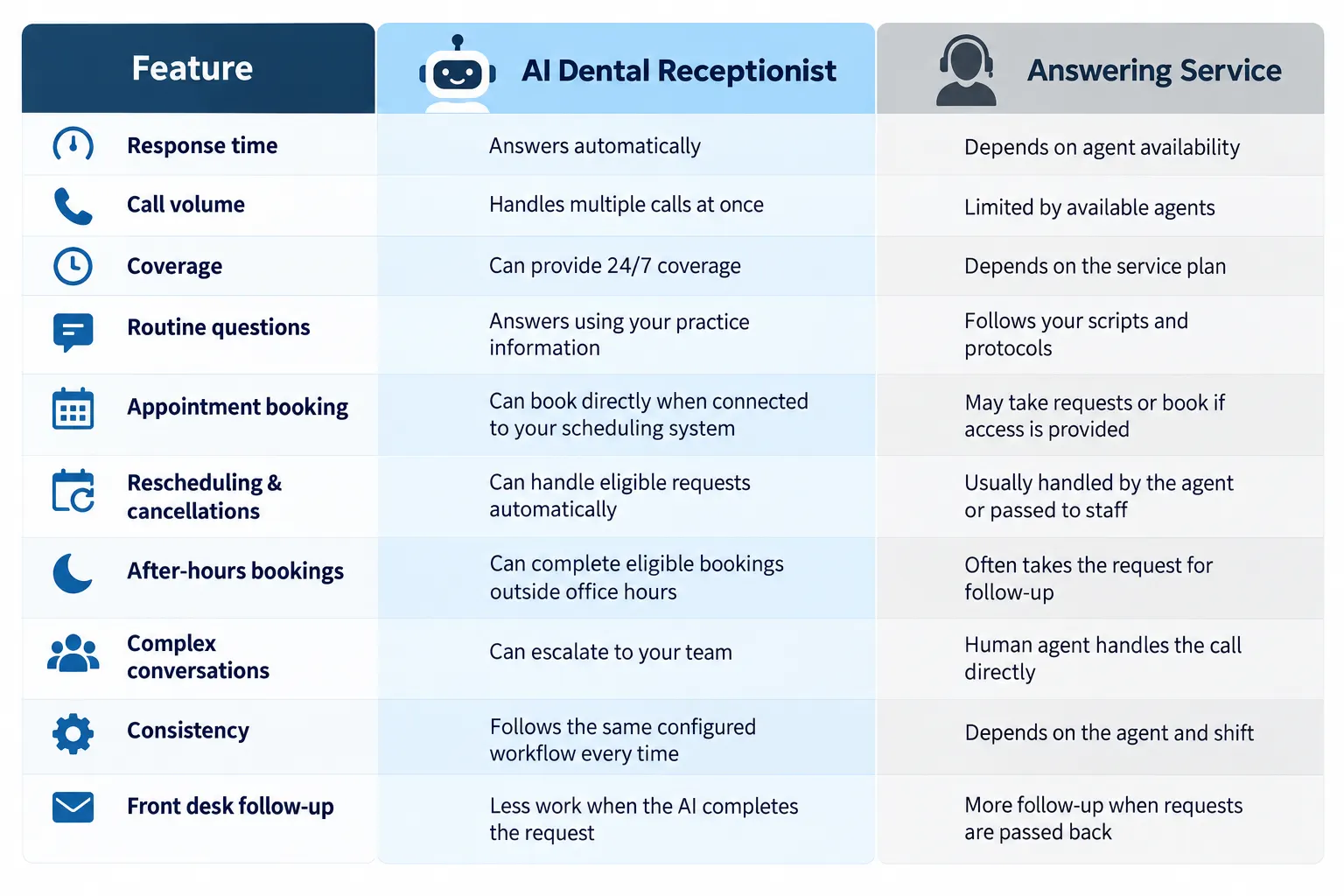
For routine, high-volume calls, the advantage starts to become clear. A patient asking about office hours, looking for an appointment, or calling after hours does not necessarily need a person to take a message. If the AI has the right practice information and scheduling access, it can handle the conversation and complete the next step while the patient is still on the phone. Current dental AI platforms increasingly compete on exactly this PMS integration and real-time booking capability.
A live answering service still has its place. When a caller is upset, confused, or dealing with a situation that needs empathy and judgment, having a real person available can be valuable. That is also why some current providers are moving toward a hybrid model, using AI for routine calls and bringing in human support when a conversation needs it.
But for the everyday calls that make up much of a dental front desk's workload, the bigger advantage is not simply that AI can answer the phone. It is that it can potentially finish the job. The call comes in, the patient's request is understood, the right workflow is followed, and an eligible appointment can be placed on the schedule without creating another task for your front desk.
That is where an AI dental receptionist starts to look less like an answering service and more like an extension of the front desk.
At first glance, they may seem pretty similar. Both can answer your practice phone and help patients when your front desk is busy. But once you look at what happens during the call, the gap becomes much easier to see.
Answering Service: A live operator picks up for your practice, follows your instructions, gathers the patient’s information, and handles the call within the guidelines you provide.
AI Dental Receptionist: Understands what the patient is calling about and can take care of routine requests, such as answering practice questions or helping with an appointment.
The difference: One makes sure the phone gets answered. The other can help get the patient where they need to go.
Answering Service: Can take an appointment request and pass the details along to your team. Some services can also book appointments if they have the right system access.
AI Dental Receptionist: When connected to a compatible scheduling system, can check open slots and book, reschedule, or cancel eligible appointments during the call.
The difference: The patient does not have to hang up and wait for someone to turn a request into an appointment.
Answering Service: Coverage varies by provider, staffing, and the plan your practice chooses. Some services offer nights, weekends, and 24/7 support.
AI Dental Receptionist: Can stay available around the clock, including nights, weekends, and holidays, without putting a staff member on the phone for every call.
The difference: When a patient calls after dinner or first thing Sunday morning, your practice can still be there to help. This makes after-hours patient communication an important consideration when comparing the two options.
Answering Service: Live operators can handle only as many calls as their available staff can take at that moment.
AI Dental Receptionist: Can handle multiple patient conversations at the same time, depending on the system and setup.
The difference: A packed Monday morning does not have to turn into a pileup of missed calls and voicemails.
Answering Service: Operators use the scripts, FAQs, and instructions your practice provides. How much they can handle beyond that depends on their training and access to information.
AI Dental Receptionist: Can be set up with your services, office hours, locations, policies, FAQs, and appointment rules.
The difference: Instead of relying on an operator to remember the right answer, your practice information is built into the conversation. Practices can also use structured dental FAQs to help AI systems provide consistent answers to routine patient questions.
Answering Service: A real person is already on the line, which can be helpful when a patient is upset, confused, or dealing with an unusual request.
AI Dental Receptionist: Can handle routine conversations and hand the call to your team when it reaches something outside its defined role.
The difference: It does not have to replace your front desk. It handles the everyday calls and knows when it is time to bring a person in.
Answering Service: Can collect names, contact information, appointment preferences, and other details your practice asks for.
AI Dental Receptionist: Can gather configured patient information during the call and, where supported, pass it into connected practice systems.
The difference: Your team can start with useful patient information instead of chasing down the basics later.
Answering Service: What it can do with appointments depends on the systems it can access and the permissions your practice gives it.
AI Dental Receptionist: Can connect with compatible scheduling or practice management systems to check availability and complete supported tasks.
The difference: The better the connection with your practice software, the more work can get done before the call ever reaches your front desk. This is why PMS integration can be an important factor when evaluating an AI receptionist.
Answering Service: Takes calls off your team’s shoulders, but appointment requests, callbacks, and other follow-ups may still land back on their desk.
AI Dental Receptionist: Can handle more routine tasks during the call, cutting down on callbacks and the little follow-ups that quietly eat into your team’s day.
The difference: The win is not simply having fewer missed calls. It is having fewer loose ends for your front desk to clean up later.
For a dental practice, that distinction matters. Getting the phone answered is useful. Getting the patient’s request handled is far more valuable.


September 16, 2026
5 min
Learn why dental AI agents lose potential patients and how better conversations, accurate answers, seamless handoffs, and simpler booking can improve conversions.
September 15, 2026
6 min
Compare AI dental receptionists and answering services to understand differences in call handling, appointment booking, coverage, integrations, and front desk support.

September 2, 2026
6 min
Discover the key metrics orthodontists can use to track leads, consultations, treatment starts, marketing costs, and ROI for smarter growth decisions.
Sign Up Now & Someone from Our Team Will Be in Touch Shortly!
Use the form below to send us a message, and we’ll get back to you as soon as we can.
.webp)
Track every marketing dollar and optimize patient conversions with ConvertLens. Gain valuable insights from your campaigns, ensuring you never miss a potential patient. Maximize ROI and grow your practice effortlessly.
-p-500.webp)