November 17, 2026
8 min
A missed call recovery rate shows which callers actually become booked, attended patients, not just who got a callback. Here is how to measure it.
November 17, 2026
12 min
A practice can have strong production and still run thin. See how production, collections, and profit differ, and which number to watch when.

Production, collections, and profit are often discussed in dental practice meetings, but not always with the same level of attention. This can leave practice owners reviewing impressive production figures or rising collections without fully understanding how well the practice is actually doing. The real question isn't just how much dentistry you produce or how much money you collect, but how much of that revenue your practice keeps.
Each number offers a different perspective on your practice's financial performance. Production reflects the value of the dentistry completed, collections show how much payment has come in, and profit reveals what remains after expenses. Looking at one without the others can leave important gaps in your understanding of the practice's financial health.
Yet practices that make sound financial decisions don't stop at the numbers that look good on a report. They look at how production, collections, and profit relate to one another, where the differences come from, and what those figures reveal about the business. Here's how to understand each number and decide which deserves your attention.
Dental revenue numbers are financial measures that show how much money your practice generates and how well it performs financially. These figures play an important role in dental revenue tracking, as they help you assess production, track collections, and understand profitability. By monitoring these numbers, you can evaluate your practice's financial performance and make informed decisions about its future growth.
Running a dental practice involves far more than treating patients and keeping the schedule full. You're also dealing with insurance claims, patient payments, staff salaries, supplies, chair time, and the everyday costs of keeping the practice running. With so much happening at once, it's easy to see why one revenue figure rarely tells you everything you need to know.
Different people in your practice may look at different numbers to judge how things are going:
Each number has its place, but they answer different questions. The trouble begins when you treat one as a measure of your practice's overall financial health.
Say your practice produces $250,000 in a month. At first glance, that sounds like a strong performance. But if you collect only $185,000 and your overhead eats into the remaining income, your bottom line may tell a very different story, often the first sign of revenue leakage in a dental practice. You may have had a busy month, but was it a profitable one? That's the distinction worth paying attention to.
Each number answers a different financial question for your dental practice. Production shows the value of the dentistry completed, collections show how much money comes in, and profit shows what remains after expenses.
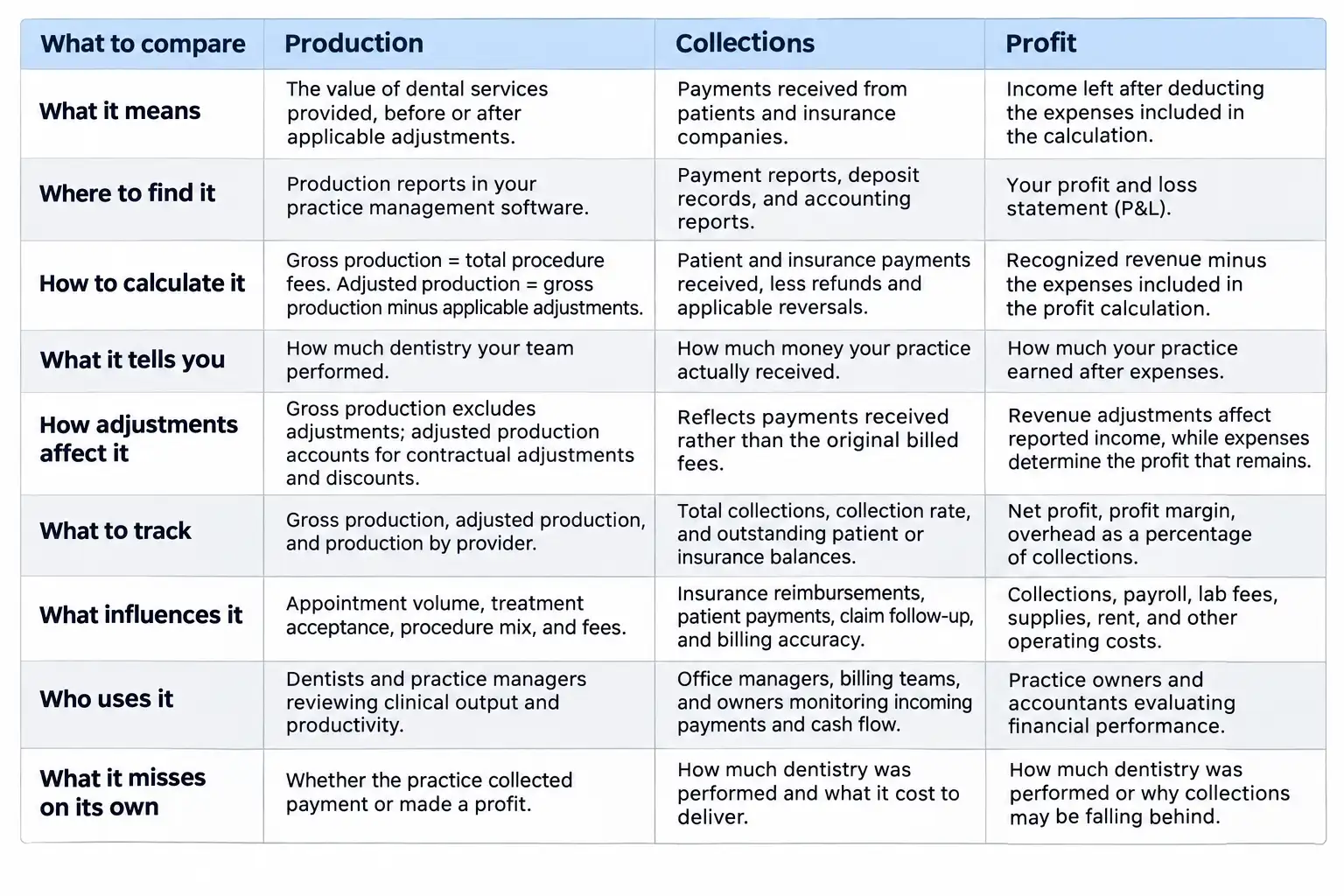
Profit can mean different things depending on which expenses are included, so for a meaningful comparison, use the same accounting method and reporting period, and make sure your P&L reflects the costs relevant to your practice. The ADA also distinguishes gross production, adjusted production, and collections, so it is worth avoiding treating them as interchangeable figures.
Production is the value of the dental work you complete and record in your practice management software. It shows how much dentistry your team is performing, but it doesn't tell you how much money you've actually received.
Your gross production uses your full fees, while adjusted production accounts for contractual write-offs and applicable discounts. Tracking production helps you see how well your schedule is being used, how patients are accepting treatment, and how much work each provider completes. Many practices find this easier to manage once they can track production and cash flow in one view instead of switching between separate reports.
For example, if your practice produces $100,000 in dentistry in a month, that doesn't mean $100,000 has come in. Some insurance claims may still be processed, and some patients may not have paid their balances yet.
Collections are the payments your practice receives from patients and insurance companies. These include copays, patient balances, insurance reimbursements, and payments made through financing plans.
Looking at collections alongside adjusted production helps you understand how much of the dentistry you've completed has actually been paid for. If production is climbing but collections aren't keeping pace, you may need to look at unpaid claims, outstanding patient balances, or delays in payment follow-ups, the kind of gaps covered in tracking revenue from treatment plans to collections.
Your collection rate can help you measure this:
Collection rate = Net collections ÷ Adjusted production × 100
For example, if your adjusted production is $100,000 and your net collections are $95,000 over a comparable period, your collection rate is 95 percent. The gap may reflect normal payment timing or money that needs further follow-up.
Profit is what remains after your practice accounts for its revenue and expenses. Even when production and collections look healthy, costs such as payroll, rent, lab fees, dental supplies, and marketing can take a substantial bite out of your earnings, which is why comparing your own numbers against general dental practice profit margin benchmarks is worth doing.
Tracking profit helps you see whether the money coming into your practice is translating into a worthwhile financial return. If collections increase but profit stays flat, rising overhead or other expenses may be absorbing the difference.
For example, if your practice collects $100,000 and incurs $85,000 in expenses during the same accounting period, it has $15,000 left before any additional items not included in those expenses. Your reported net profit will depend on how your practice accounts for owner compensation, interest, taxes, and other costs.
That's why production, collections, and profit deserve attention together. One shows the dentistry you perform, another shows the money you receive, and the third helps you understand what your practice earns after expenses.
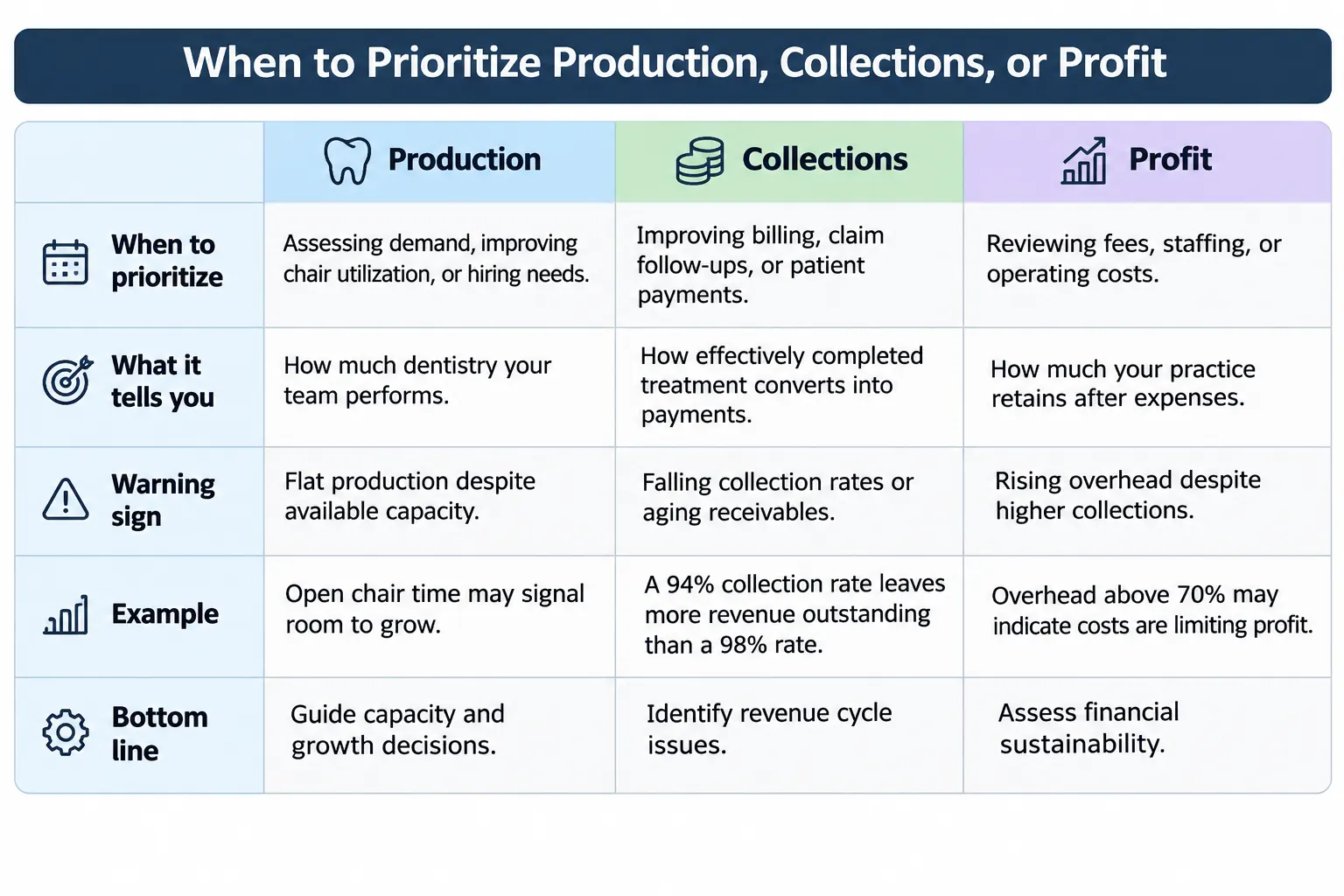
Which metric matters most depends on the challenge your practice is facing.
If cash flow is tight, review your collection rate and ageing receivables. If your schedule has gaps, look at production and case acceptance. If production and collections are healthy but profit remains low, review your overhead costs, and keep in mind that revenue and ROI are not the same thing when you're deciding where to reinvest.
Ask yourself:
The key is to look at all three numbers together. Growing production, consistent collections and controlled overhead point to healthier growth. If production rises but collections fall behind or costs climb, your practice may be doing more work without improving its financial position. Pulling all three onto a single dental KPI dashboard makes this easier to see at a glance rather than hunting through separate reports.
Improving production starts with making better use of your team's time, your schedule, and the treatment opportunities already in front of you.
A full schedule and a busy front desk keep your practice running, but the money doesn't always come in as quickly as the dentistry gets done. Improving collections comes down to staying on top of patient balances and insurance claims so payments don't slip through the cracks, the same focus behind efforts to maximize dental practice collections.
Even a modest improvement in collections can bring more cash into the practice without adding extra appointments or clinical work.
Higher collections don't always mean more money left at the end of the month. Improving profit means keeping expenses under control while making the most of the revenue your practice earns.
What is the difference between production and collections in a dental practice?
Production is the value of the dentistry completed, based on your fee schedule. Collections are the payments that actually come in from patients and insurance. A practice can have strong production and still see weak collections if claims or patient balances go uncollected.
Why can a practice with strong production still have low profit?
Production only measures the value of completed work, not what is actually collected or what it cost to deliver. Rising overhead, payroll, lab fees, or supply costs can absorb the gap between a strong production month and the profit that remains after expenses.
What is a good collection rate for a dental practice?
Many practices aim for a net collection rate of 95 percent or higher, though the right benchmark depends on your payer mix and fee schedule. It is more useful to track your own rate over time than to chase a single industry figure.
How often should a practice review production, collections, and profit together?
Most practices benefit from reviewing production and collections weekly or monthly, with a fuller profit review, including overhead, done at least monthly alongside the profit and loss statement.
Can two practices with the same production have very different profit?
Yes. Two practices producing the same amount of dentistry can end up with very different profit if one has a lower collection rate, higher overhead, or higher staffing and lab costs than the other.



November 17, 2026
8 min
A missed call recovery rate shows which callers actually become booked, attended patients, not just who got a callback. Here is how to measure it.
November 17, 2026
12 min
A practice can have strong production and still run thin. See how production, collections, and profit differ, and which number to watch when.

November 7, 2026
7 min
How DSOs use capacity-based marketing to pause or redirect ad spend when a location is full, so budget reaches practices with room to take new patients.
Sign Up Now & Someone from Our Team Will Be in Touch Shortly!
Use the form below to send us a message, and we’ll get back to you as soon as we can.

Track every marketing dollar and optimize patient conversions with ConvertLens. Gain valuable insights from your campaigns, ensuring you never miss a potential patient. Maximize ROI and grow your practice effortlessly.
