September 30, 2026
8 min
Slow lead follow-up can silently drain your dental marketing budget. See where enquiries fall through the cracks and how faster response recovers lost patient value.
September 30, 2026
8 min
Slow lead follow-up can silently drain your dental marketing budget. See where enquiries fall through the cracks and how faster response recovers lost patient value.

A dental lead does not come with a 24-hour waiting period. Research on lead response time found that contacting an inbound lead within five minutes made businesses about 100 times more likely to make contact and 21 times more likely to qualify the lead than waiting 30 minutes.
For a dental practice, that gap can matter long before anyone talks about conversion rates. A patient who has just reached out is already paying attention. Leave the enquiry sitting in an inbox while the front desk handles everything else, and that attention has plenty of time to disappear. The marketing may have done its job, but the follow-up can still determine what happens to the lead next. And when every new patient enquiry has already cost the practice money to generate, slow follow-up can make an expensive lead even more expensive.
Discover how slow lead follow-up can drain the value from your dental marketing budget, where promising enquiries slip through the cracks, and what practices can do to respond faster and turn more of those leads into real patient opportunities.
Let’s ask a straightforward question: What happens after a dental lead comes in?
A practice may have a process for generating enquiries, but that does not always mean there is an equally clear process for handling them. Someone may fill out a contact form, request information, send a message, or ask about an appointment, and the next step can depend entirely on who happens to see it first.
That can create small gaps that are easy to miss during a busy day.
A lead might:
None of these problems necessarily points to a poor marketing campaign. They are process issues that can happen after the enquiry has already entered the practice.
The trouble is that marketing reports usually show what happened before the lead arrived. They may tell the practice how many people clicked an ad, visited a landing page, or submitted a form. They do not always show what happened next.
That makes lead follow-up easy to overlook when reviewing marketing performance. A practice can spend time evaluating campaigns while missing a separate part of the process that directly affects how many enquiries actually move forward.
A closer look at what happens after every lead arrives can reveal where those opportunities are getting stuck, and where a simple change in the follow-up process could make a measurable difference.
Most dental practices never calculate how much delayed lead response is actually costing them.
There are several reasons for that. A practice manager may know the monthly production numbers, advertising budget, and number of new patients. What they may not know is how many potential patients disappeared somewhere between making an inquiry and actually becoming a patient.
That missing piece can make the financial impact surprisingly difficult to spot.
Consider a practice that receives 100 new enquiries in a month. If 15 of those enquiries never progress and the practice typically generates an average of $3,000 in production from a new patient, the value associated with those 15 enquiries would be:
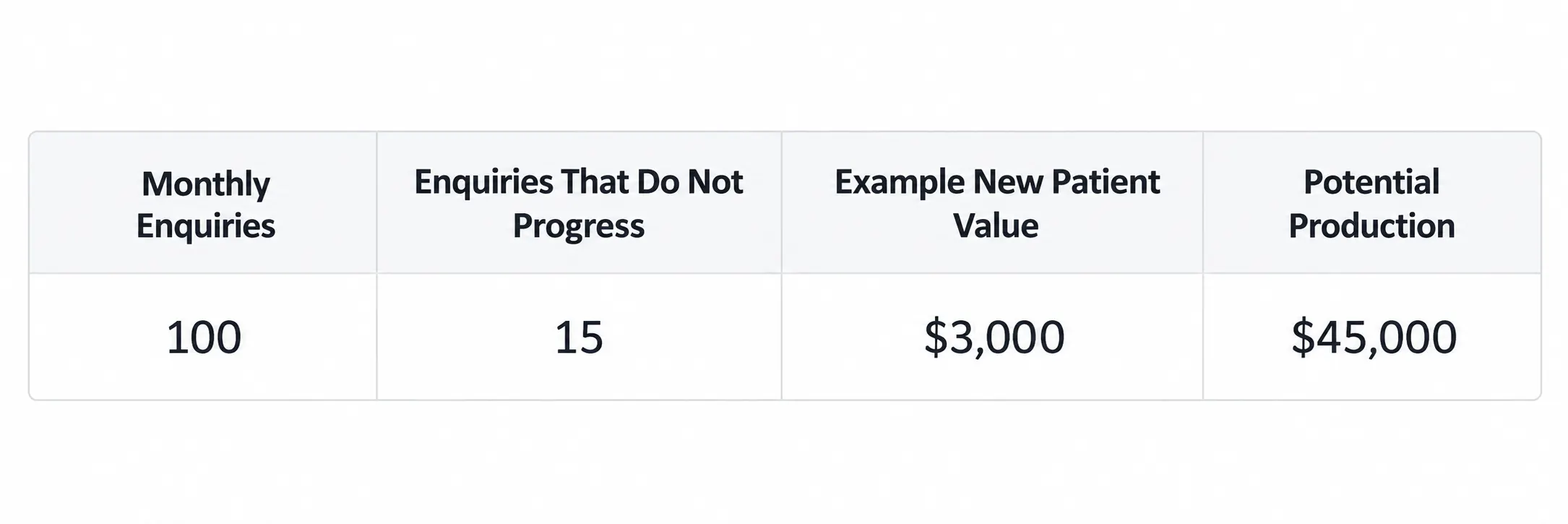
The $45,000 is only an illustration, not a prediction of lost revenue. Not every enquiry would have become a patient, and new patient value varies significantly by treatment, insurance, and practice.
The useful part of the calculation is the question it raises: How many enquiries does the practice receive that never make it onto the schedule, and what would those patients have been worth? Tracking that gap is really a question of how to improve dental lead conversion rates rather than just how many leads a campaign produces.
That number can change how a practice looks at its marketing performance. Instead of asking only how many leads a campaign produced, it becomes possible to examine what those leads were ultimately worth to the practice.
For a practice generating hundreds of enquiries over the course of a year, even a small gap between enquiries and scheduled patients can represent a meaningful amount of unrealized production.
A dental practice does not need a complicated lead-management operation to improve follow-up. What matters is having a process the team can follow consistently, even on a busy day.
1. Find the gaps first.
Start by reviewing recent website forms, chat enquiries, and other new-patient enquiries. Look at how long patients waited for a response, how many received no follow-up, and how many eventually scheduled. This gives the practice a clearer picture of what is happening after an enquiry arrives.
2. Decide what “fast” means
Set a response standard the team can realistically maintain during practice hours. New enquiries should have a clear owner and a defined next step, rather than relying on someone noticing them when they have a spare minute.
3. Give every enquiry a follow-up path
A patient who does not answer the first call should not automatically become a closed lead. A simple sequence, similar to the cadence in how fast you should reply to dental leads, might include:
The exact timing can vary by practice and enquiry type. A patient asking about an urgent dental problem may need a very different response from someone researching an elective treatment.
4. Make the handoff clear
The front desk should know which enquiries need attention first and who owns each one. Short, natural talking points can also help staff answer common questions without turning every conversation into a sales pitch.
5. Decide what happens after hours
A lead that arrives after the office closes still needs somewhere to go. Depending on the practice, that could mean an automated acknowledgement, an answering service, an AI website or reception system, or a clearly defined next-morning follow-up process. The important part is that the enquiry does not disappear simply because the office is closed.
6. Connect leads to actual appointments
Tracking lead numbers alone rarely reveals how successful a campaign really is. Compare where enquiries came from with how many scheduled, showed up, and became patients, since patient fall-off between first contact and appointment is often where the real budget leakage happens. This can reveal differences between campaigns that generate attention and campaigns that generate patients.
7. Keep interested patients in the conversation
Some patients need time before booking. A person researching implants, cosmetic dentistry, or another significant treatment may have questions to resolve before making an appointment. A thoughtful follow-up sequence can give those patients a reason to continue the conversation without sending repetitive messages or contacting people who have asked not to be contacted.
The best system is one the dental team can actually maintain. Clear ownership, sensible follow-up steps, and visibility into what happens after an inquiry give the practice a much better chance of making the most of the opportunities its marketing is already creating.
The right technology can take some of the pressure off the front desk without taking the human side out of patient communication.
Modern dental practices can use a combination of:
The technology does not need to replace the front desk. Its job is to handle the parts of the process that are repetitive, time-sensitive, or difficult to manage during a busy day.
A patient can receive an immediate response, have basic questions answered, or provide their details while the team is helping someone in the office. When a conversation needs a person, the relevant information can be passed along so the staff member can step in with context instead of starting cold.
During business hours, responding within five minutes is a useful benchmark for practices that can support it. After hours, an immediate automated acknowledgment can let the patient know their message was received and explain when the team will respond. Urgent dental concerns and high-value treatment enquiries may need faster attention.
Most practices see better results with three to six touches over a week or two, mixing phone, text, and email. Stop when the patient books, says no, or the sequence ends, then move them to a low-frequency nurture list.
Texting dental leads can be permitted, but practices need to follow applicable consent, privacy, and telemarketing requirements. Depending on the message and circumstances, this can include HIPAA considerations, TCPA requirements, and state-specific rules. Practices should have their specific texting workflow reviewed by a qualified compliance professional.
A dedicated new-patient coordinator can make sense when enquiry volume has grown beyond what the existing team can consistently manage. The role can focus on responding to new enquiries, following up with undecided patients, answering common questions, and helping move qualified opportunities toward appointments. Practices should first look at their enquiry volume and current workflow before adding another position.
AI can help with after-hours answering, instant text replies, routine questions, and basic scheduling. ConvertLens's Eva supports voice conversations, while Viola works as a website chat agent for dental practices. AI works best alongside the dental team, especially for complex cases or patients who need a human touch. Always test any tool thoroughly before trusting it with your practice’s reputation.
A high lead count does not necessarily mean a practice is generating high-quality patient opportunities. Some enquiries may come from people who are only researching, outside the practice’s service area, looking for treatments the practice does not provide, or simply not ready to schedule. Reviewing lead quality, appointment conversion, treatment type, and the path each enquiry takes after submission can help identify where the drop-off occurs.
Yes. Routine care may not carry the same urgency as a dental emergency, but patients still have plenty of choices once they decide to look for a practice. Someone enquiring about a cleaning, exam, Invisalign, implants, or cosmetic treatment may contact several practices before choosing where to book. A timely response keeps the practice involved while the patient is actively considering their options.


September 30, 2026
8 min
Slow lead follow-up can silently drain your dental marketing budget. See where enquiries fall through the cracks and how faster response recovers lost patient value.

September 30, 2026
10 min
Dental AI agents can screen patient inquiries by treatment need, urgency, insurance, and location, handing your front desk only booking-ready leads.

September 27, 2026
8 min
See the 10 key KPIs dental practices should track for AI receptionists, including call resolution, booking rates, cost per appointment, and ROI.
Sign Up Now & Someone from Our Team Will Be in Touch Shortly!
Use the form below to send us a message, and we’ll get back to you as soon as we can.
.webp)
Track every marketing dollar and optimize patient conversions with ConvertLens. Gain valuable insights from your campaigns, ensuring you never miss a potential patient. Maximize ROI and grow your practice effortlessly.
-p-500.webp)