September 30, 2026
8 min
Slow lead follow-up can silently drain your dental marketing budget. See where enquiries fall through the cracks and how faster response recovers lost patient value.
August 21, 2026
10 min
Discover how dental practices can measure TikTok and social media performance by tracking engagement, leads, clicks, and booked patients to identify channels that drive real growth.
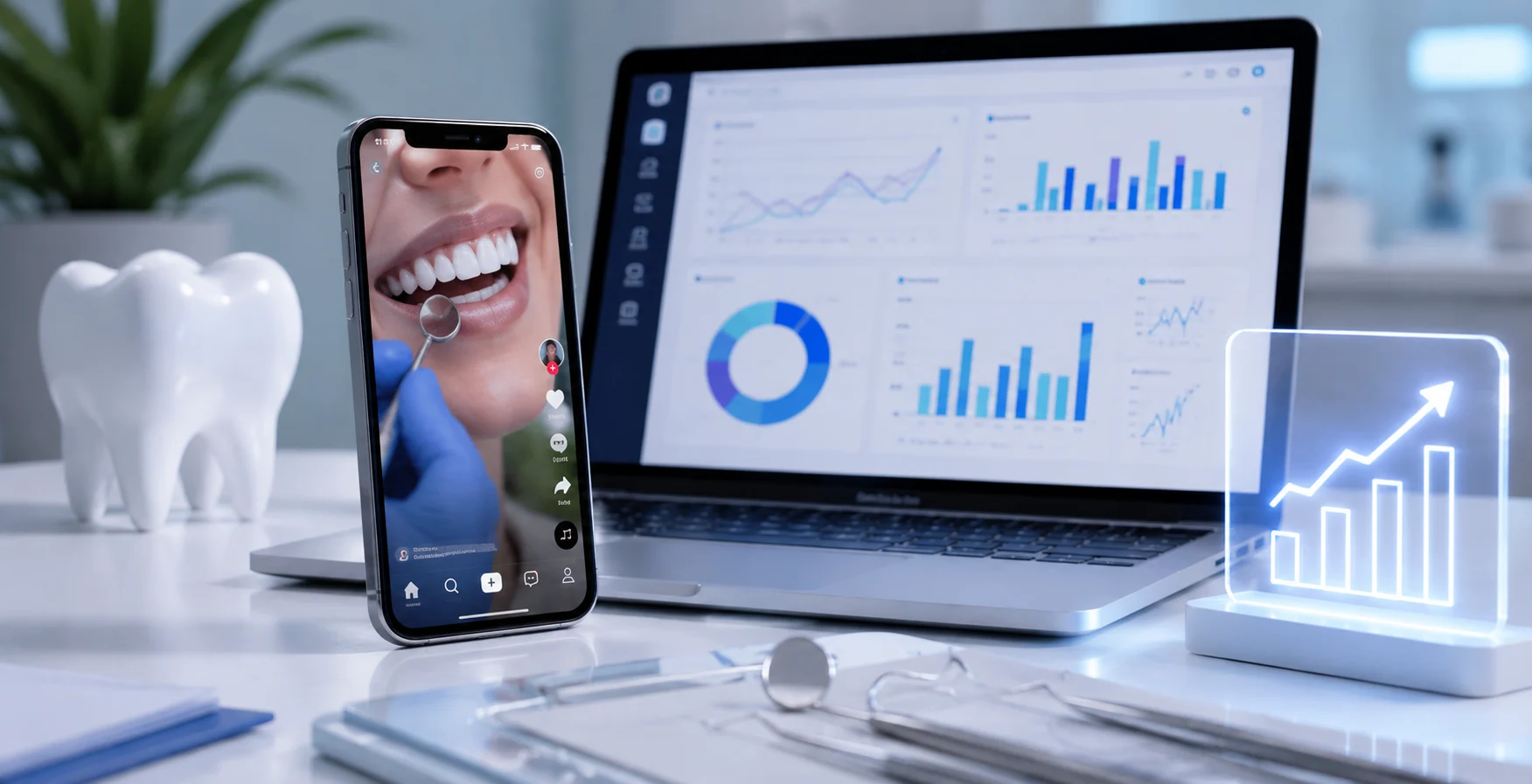
Orthodontic campaigns on TikTok often cost $8 to $12 per lead. On Google Ads, the same kind of lead can cost $116. On Facebook, it's around $80. That's a huge gap, and it's why more dental practices are testing TikTok. But cheap leads only matter if you're tracking whether they turn into real patients.
This guide covers what to track on social media and how to turn likes and views into a real measurement plan.
TikTok content for dental practices gets an average organic engagement rate of 3.4% per post. That might sound small, but compared to other platforms, it's strong. Dental content on TikTok can see engagement rates 400% higher than the same kind of content on Instagram Reels.
Part of this comes from who's watching. About 45% of dental practices now run an active TikTok account, and roughly 30% of their audience is between 18 and 24 years old, a group that's harder to reach through traditional ads. Reaching this audience well also depends on a consistent, recognizable brand strategy for dentists, since a younger audience tends to notice and reward practices that feel authentic rather than corporate.
Follower count feels good to watch, but it doesn't tell you much about your practice's growth. A few numbers matter far more:
Each platform reports its numbers a little differently, which makes side-by-side comparison harder than it should be. A simple way to compare fairly:
None of these platforms should be judged only on their own numbers. The real test is which one is actually sending booked patients, a number you can only see by connecting social data to your measuring clinic campaign performance process.
Likes and views are a starting point, not a finish line. To know if social media is actually growing your practice, you need to trace the path from a video view to a booked, completed appointment.
This means tagging links in your social bio and posts so clicks can be tracked back to the specific post or campaign. It means using a landing page built for social traffic, not just sending people to your general homepage. And it means checking, monthly, whether the leads from social are actually showing up in your PMS as booked patients, not just sitting in a CRM as an unconverted lead.
Our marketing analytics tools connect this chain directly, so you can see social performance next to every other channel, not in a separate report you have to build by hand.
You don't need a complicated dashboard to track this well. A simple monthly check should cover:
Reviewing this monthly, instead of quarterly, lets you catch a dip early and adjust your content or spend before a small problem becomes a bigger one.
Not all dental content performs the same on TikTok. Educational content that answers a real question, like what happens during a root canal or why teeth get sensitive after whitening, tends to do well because it gives people a reason to watch to the end.
Behind-the-scenes content, showing the team, the office, or a light, funny moment during a normal day, tends to build trust and personality, which matters for a service people choose based partly on comfort and rapport. Before-and-after case stories also tend to perform well on video, since they combine education with proof, giving viewers both a reason to watch and a reason to trust the result. Purely promotional content, a straight ad for a discount or a service, usually underperforms both of these, since it doesn't give the algorithm, or the viewer, a reason to keep watching.
The practical takeaway is to track engagement rate by content type, not just by platform. A practice that only posts promotional content and wonders why engagement is low is often solving the wrong problem, since the fix is the content itself, not the platform or the posting schedule.
A few patterns show up repeatedly once a practice starts looking closely at its social media numbers.
Social media results, especially on TikTok, rarely follow a straight line. A practice might post consistently for a month with modest results, then see a single video perform far better than expected, followed by a quieter stretch again. This is normal, and it's part of why looking at monthly averages matters more than reacting to any single week.
Give a new platform at least two to three months of consistent posting and tracking before judging whether it's worth the investment. Early data is often too noisy to draw firm conclusions, and a practice that quits after three unremarkable weeks may be walking away right before the strategy starts to click.
Social media should never be measured in a vacuum. A practice running Google Ads, TikTok, and a referral program all at once needs a way to see all three side by side, using the same definitions of a lead, a booking, and a completed patient across every channel.
Without that shared view, it's easy to end up comparing numbers that don't actually mean the same thing. A "conversion" on TikTok's own dashboard might mean a video view plus a click, while a "conversion" in your PMS means a completed, paid visit. Treating those as equivalent numbers, just because they're both labeled "conversions," is a common and costly mistake.
The fix is to route every channel's data, social included, through the same PMS-verified measurement process. That's the only way to fairly compare a TikTok ad against a Google Ads campaign, since both need to be judged by the same final outcome: real, booked, paying patients.
Social media, and TikTok in particular, can be one of the cheapest ways to reach new patients right now. But cheap only matters if you can prove it. Track engagement, cost per lead, and clicks, but never stop short of connecting those numbers to real, booked appointments in your PMS.
If you want to see your social performance next to every other marketing channel in one place, Convertlens's marketing analytics are built to show you exactly that.
Is TikTok actually worth it for dental practices?
For many practices, yes, especially those looking to reach younger patients. The engagement rates and lower cost per lead compared to Google Ads and Facebook make it worth testing, as long as you're tracking whether those leads turn into booked patients.
What's a good engagement rate for dental content?
Around 3.4% is a reasonable average for TikTok dental content. If your rate is well below that, the content itself, not just the platform, is likely the issue.
How much does a TikTok ad campaign cost for a dental practice?
Clicks typically run $0.50 to $1.50, with about $5 to $9 per 1,000 impressions. For orthodontic lead campaigns specifically, cost per lead often falls between $8 and $12, well below Google Ads or Facebook for comparable campaigns.
Should I focus on one platform or spread across several?
Most practices do best starting with one platform, tracking it closely, and expanding once they understand what content and offers actually convert. Spreading thin across several platforms without measurement usually wastes both time and budget.
Do I need a big budget to see results on TikTok?
No. Because cost per click and cost per lead both run lower on TikTok than on Google Ads or Facebook for similar campaigns, practices can often test the platform meaningfully with a modest budget before deciding whether to scale it up.
How do I know if a post's views are translating into real interest?
Watch the views-to-click rate, not the view count alone. A video with a hundred thousand views and almost no website clicks is entertaining, but it isn't doing the job of a marketing post. A video with far fewer views but a strong click rate is often the better investment.
Should front desk staff or a marketing agency run the account?
Either can work, but whoever runs it needs quick access to the analytics, not just posting access. A person creating content without visibility into what's actually converting is guessing, no matter how good their instincts are.



September 30, 2026
8 min
Slow lead follow-up can silently drain your dental marketing budget. See where enquiries fall through the cracks and how faster response recovers lost patient value.

September 30, 2026
10 min
Dental AI agents can screen patient inquiries by treatment need, urgency, insurance, and location, handing your front desk only booking-ready leads.

September 27, 2026
8 min
See the 10 key KPIs dental practices should track for AI receptionists, including call resolution, booking rates, cost per appointment, and ROI.
Sign Up Now & Someone from Our Team Will Be in Touch Shortly!
Use the form below to send us a message, and we’ll get back to you as soon as we can.
.webp)
Track every marketing dollar and optimize patient conversions with ConvertLens. Gain valuable insights from your campaigns, ensuring you never miss a potential patient. Maximize ROI and grow your practice effortlessly.
-p-500.webp)