October 7, 2026
5 min
Missed-call text-back vs. AI receptionist for dental practices: what each handles, when each wins, and which recovers more booked appointments.
October 7, 2026
5 min
Missed-call text-back vs. AI receptionist for dental practices: what each handles, when each wins, and which recovers more booked appointments.

You already have something every dental practice works hard to generate: patients calling your office. Those calls can come from someone ready to book, a parent asking about a child's appointment, or a new patient trying to find out if you take their insurance. When nobody picks up, that opportunity can quickly disappear. A missed-call text back gives the patient a way back in. An AI receptionist can answer the call, handle common questions, and help move the conversation toward an appointment.
If your practice uses missed-call text back to catch calls your team couldn't answer, you are already recovering some of that lost demand. But an unanswered call and an unanswered question are two different things. Here is how a missed-call text back compares with an AI receptionist, what each can handle, and where each one can help your practice book more patients.
Missed-call text-back (MCTB) is a simple way to recover a call that nobody picked up. When a dental practice misses a patient’s call, an automated text is sent asking the caller to continue the conversation by SMS. It can be useful after hours, during busy periods, or whenever the front desk cannot get to the phone.
MCTB does not answer the caller’s questions, check what treatment they need, or book the appointment on its own. If the patient replies, someone from the practice still needs to take over, answer their questions, and move the conversation towards a booking.
For a dental practice, that can be enough to rescue a few otherwise lost calls. But it still depends on the patient replying and a member of the team being available to follow up.
An AI receptionist takes the conversation a step further. Instead of simply texting a missed caller, it can respond to the patient, answer routine questions, collect the details the practice needs, and help move the patient towards an appointment.
A caller asking about Invisalign, emergency appointments, opening hours or the cost of a treatment does not necessarily want to wait for the front desk to call back. An AI receptionist can handle those first questions immediately, including outside normal working hours, while passing more complex or sensitive conversations to the practice team.
Instead of getting lost in features, here is how each option handles the moments that matter in a dental practice.
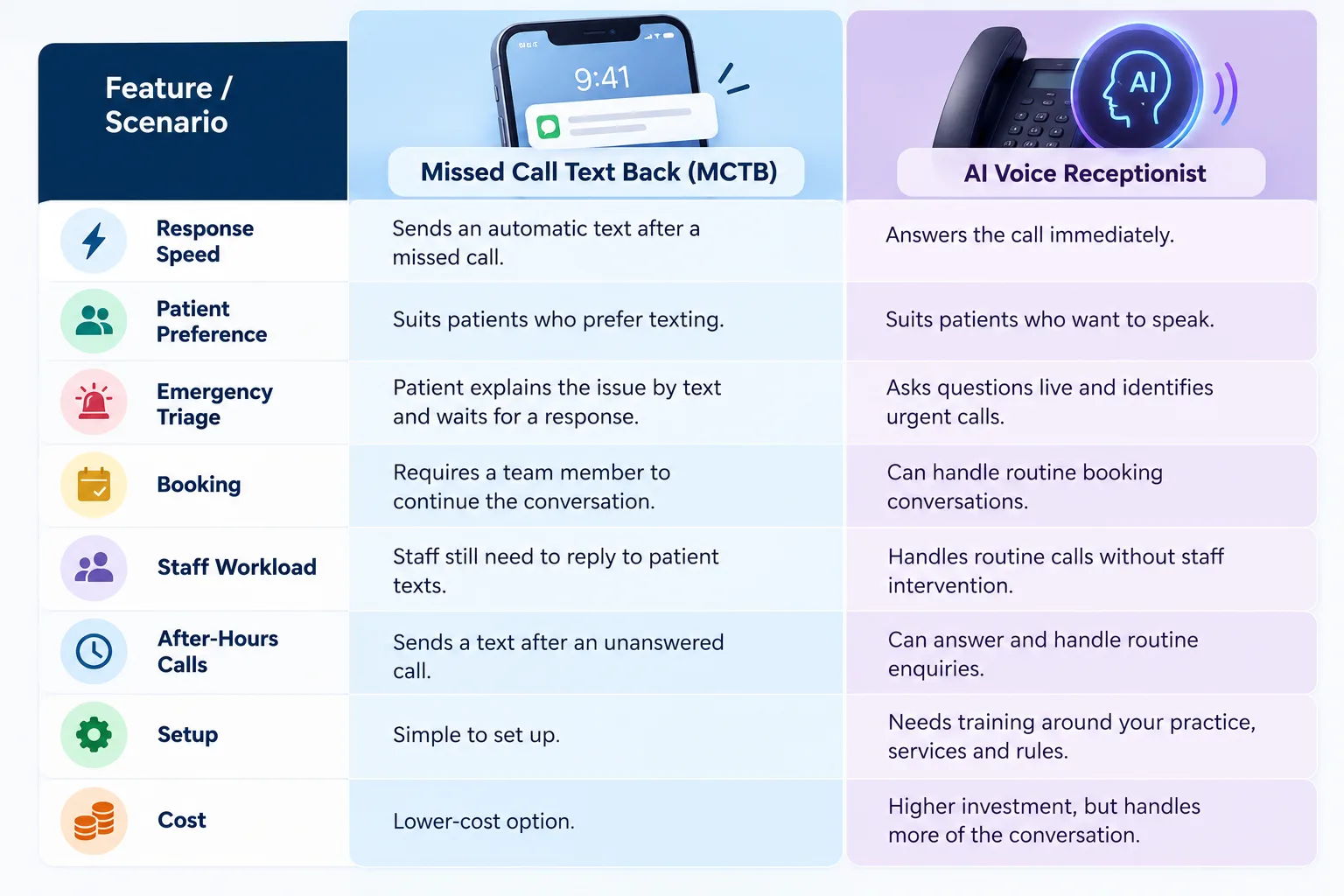
In most cases, an AI receptionist has the edge because it answers the patient right away and keeps the conversation moving toward an appointment. MCTB can recover a missed call, but it still relies on the patient replying and your team taking it from there.
That said, the better choice depends on how many calls you miss and what a booked appointment is worth to your practice. Let’s put the numbers to it.
Not every missed call needs an AI receptionist waiting in the wings. Sometimes, the practice just needs a quick way to reopen the conversation, especially when missed calls are occasional, and patients are happy to text.
If your front desk answers 90%+ of calls and only a handful of new-patient calls slip through each week, you may not need a full AI setup. A simple text back gives those callers an easy way to reconnect without adding much cost or complexity.
Busy parents, younger patients, and working professionals are often perfectly happy to text. For them, replying to a quick message can be easier than finding time to call the practice back and sit through another round of phone tag.
Not ready to bring AI into the front desk? That’s fine. Text-back is an easy first step toward faster follow-up. You can close the gap on missed calls without changing your entire workflow or making a bigger technology investment.
Even practices using an AI receptionist can have calls slip through. A call can drop, a patient can hang up, or someone may simply prefer to continue by text. In those moments, MCTB gives the patient another way back to the practice.
Not every practice management system works smoothly with AI scheduling or deeper integrations. If yours has limitations, MCTB can still work alongside your existing booking process, giving missed callers a simple way to reconnect without forcing your team to rebuild the workflow.
There are plenty of situations where answering the call beats sending a text after it’s already been missed.
Lunch hour, morning check-in, Monday madness, or the post-holiday rush can leave your front desk juggling three things at once. An AI receptionist does not need a lunch break or an extra pair of hands. It can answer those calls while your team handles the patients already standing at the desk.
If your practice receives a steady stream of calls after hours, late at night, or on weekends, an AI receptionist can keep those conversations moving when your front desk is closed. Instead of voicemail, patients get an immediate response and a chance to book.
If you’re spending heavily on Google Ads, Local Services Ads, SEO, or direct mail to get the phone ringing, a missed call can turn that marketing dollar into someone else’s patient. An AI receptionist answers when your team cannot, giving those hard-earned leads a better chance of becoming appointments.
Keeping several front desks consistent takes a lot of coordination. An AI receptionist helps keep the same information, call flow, and patient experience across every location, while directing each conversation to the right office or team.
Your front desk has enough on its plate without having to choose between answering the phone and helping the patient standing right in front of them. In that scenario, an AI receptionist can pick up routine calls, answer common questions, collect patient details, and handle basic scheduling when connected to the right system. Your team gets more room to focus on the patients in front of them, while the phones keep moving in the background.
When someone calls about swelling, uncontrolled bleeding, or a knocked-out tooth, speed matters. A properly configured AI receptionist can identify urgent language based on your practice's escalation rules, gather the necessary details, and route the call to the appropriate team or on-call contact.
Many high-performing dental practices aren’t choosing between the two. They give each one a specific job and let the call move down the line.
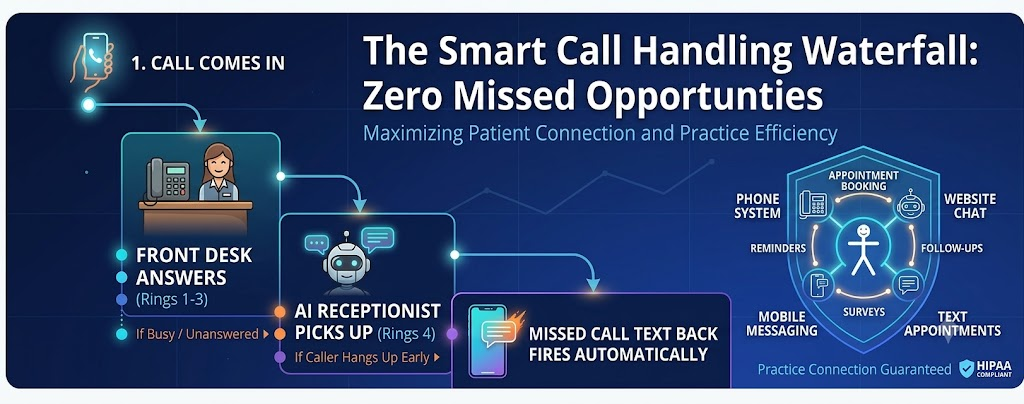
When you work with the approach, each layer catches what the previous one cannot, so fewer calls end up as missed opportunities, and your front desk gets room to breathe.


October 7, 2026
5 min
Missed-call text-back vs. AI receptionist for dental practices: what each handles, when each wins, and which recovers more booked appointments.

October 7, 2026
7 min
AI follow-up helps cosmetic dental practices respond faster, reduce no-shows, and convert more high-intent veneer and Invisalign leads into booked consultations.

September 30, 2026
8 min
Slow lead follow-up can silently drain your dental marketing budget. See where enquiries fall through the cracks and how faster response recovers lost patient value.
Sign Up Now & Someone from Our Team Will Be in Touch Shortly!
Use the form below to send us a message, and we’ll get back to you as soon as we can.
.webp)
Track every marketing dollar and optimize patient conversions with ConvertLens. Gain valuable insights from your campaigns, ensuring you never miss a potential patient. Maximize ROI and grow your practice effortlessly.
-p-500.webp)